
EV Charging Time and Units in India: Home and DC Fast
How long an EV or e-scooter takes to charge on a 15 A socket, a 3.3 kW or 7.2 kW charger or DC fast charging, the units used and cost per km.
By Redbison Dev · · 10 min read

India edition. Indian edition for 230 V homes, with 15 A sockets, 3.3 kW and 7.2 kW AC chargers, DC fast chargers, cost in rupees per unit and km, PPAC petrol prices of 6 November 2026 and CEA's grid emission factor. US edition
A 30 kWh electric car charged from 20% to 100% at home needs 24 kWh in the battery and about 27 units from the meter. On a 3.3 kW AC wall charger that takes about 8 hours 16 minutes; on a 7.2 kW charger about 3 hours 47 minutes. At an example tariff of ₹8 a unit either costs about ₹218. A 50 kW DC fast charger takes the same car from 20% to 80% in about 28 minutes, but at an example ₹20 a unit it costs ₹387 for less energy.
This edition works through Indian charging with the EV Charging Time and Cost Calculator for India: what sets the speed at home, why DC charging slows near full, how many units a charge draws, and what a kilometre costs against petrol at today's prices.
The calculation
charging time = kWh into the battery / (charger kW x efficiency)
Units from the meter are higher than the kWh stored, because some energy is lost as heat. The calculator uses 88% efficiency for a 3.3 kW wall charger in the Indian version, 85% for a portable socket charger and 93% for DC. So 24 kWh into the battery is 24 / 0.88 = 27.3 units on a 3.3 kW charger.
Two limits decide the charger kW you actually get:
- The car's onboard charger on AC. A car that accepts 7.2 kW on AC charges no faster on an 11 kW charger.
- The car's peak DC rate. A car that accepts 50 kW charges no faster on a 60 kW or 120 kW DC charger. The calculator shows which one is limiting.
Home charging on a 230 V supply
On a 230 V home supply there are three practical options:
| Option | Power | 20% to 100% of 30 kWh | Units drawn | Cost at ₹8 |
|---|---|---|---|---|
| Portable charger in a 15 A socket | about 3.45 kW | 8 h 11 min | 28.2 | ₹226 |
| 3.3 kW AC wall charger | 3.3 kW | 8 h 16 min | 27.3 | ₹218 |
| 7.2 kW AC wall charger | 7.2 kW | 3 h 47 min | 27.3 | ₹218 |
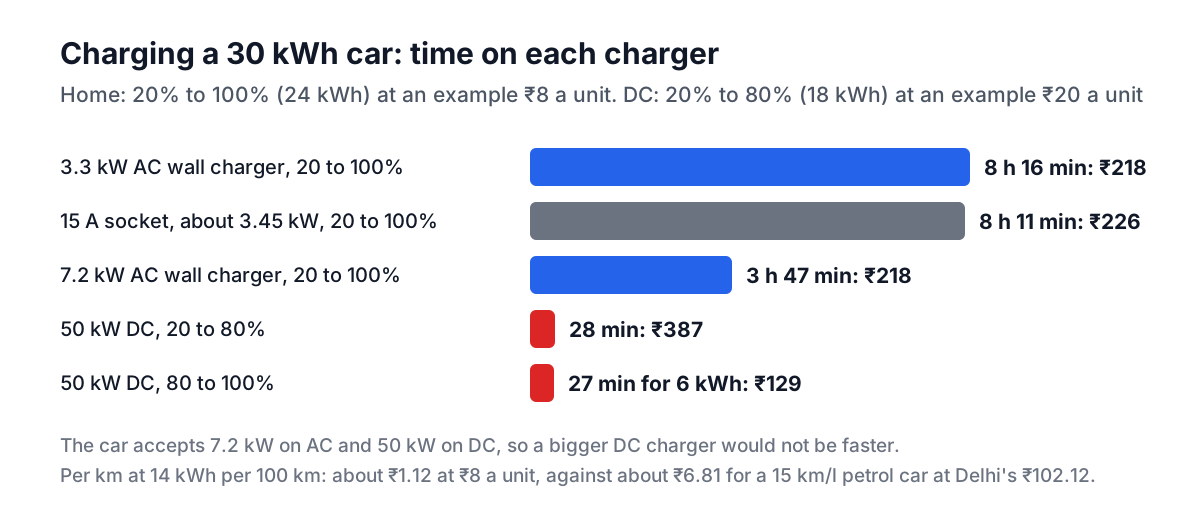
If you park overnight, 3.3 kW is often enough: a car using 14 kWh per 100 km gains about 24 km of range per hour of charging. The 7.2 kW charger matters when you need a full charge in a few hours, or when your DISCOM offers a cheaper night or daytime window that is shorter than eight hours. A socket charger draws a 15 A circuit at close to full load for hours, so have an electrician check the wiring, earthing and socket before using it every night, as the US Department of Energy's home charging guidance also advises for any home.
Electric scooters and bikes
The same maths applies to electric two-wheelers, on a smaller scale. Take a scooter with a 3 kWh battery and a 650 W portable charger (read the kW or watts on the charger's label). From 20% to 100%:
- Energy into the battery: 2.4 kWh. Units from the meter at 85% efficiency: 2.82.
- Time: about 4 hours 21 minutes.
- Cost at ₹8 a unit: about ₹22.59.
That is why a scooter charge barely shows on a household bill. Enter your scooter's battery and charger rating in the calculator for its own figures.
DC fast charging, and why it slows near full
On a highway, a DC fast charger delivers far more power, but the car's battery management reduces it as the cells fill. The calculator holds the car's peak to a slow-down point (50% by default) and then reduces it in a straight line to 15% of peak at 100%.
For the 30 kWh car with a 50 kW DC limit, at an example ₹20 a unit:
| Window | Energy into battery | Time | Cost |
|---|---|---|---|
| 20% to 80% | 18 kWh | 28 min | ₹387 |
| 80% to 100% | 6 kWh | 27 min | ₹129 |
The last 20% takes as long as the 60% before it. On a long drive, stop at about 80% and charge again later. Operators set their own prices and some show GST separately or add a session fee, so enter the price from the charging app; the ₹20 here is an illustration. A bigger DC charger would not help this car: on a 60 kW unit the time is still 28 minutes, because the car caps it at 50 kW.
Cost per km against petrol
Cost per km is price per unit times kWh per km. At ₹8 a unit and 14 kWh per 100 km, the electric car costs about ₹1.12 per km on home charging. At ₹20 a unit on DC charging it is about ₹2.80.
For comparison, the Petroleum Planning and Analysis Cell's daily metro prices show petrol on 6 November 2026 at ₹102.12 a litre in Delhi, ₹111.21 in Mumbai, ₹107.77 in Chennai and ₹113.51 in Kolkata. A petrol car giving 15 km per litre therefore costs about ₹6.81 per km in Delhi and ₹7.41 in Mumbai, around six times the home-charging figure. Use your own car's mileage and your DISCOM tariff; the EV vs Petrol Cost Calculator for India runs the full comparison over years.
On emissions, the Central Electricity Authority's CO2 Baseline Database, version 22.0, gives a weighted average grid emission factor of 0.675 t CO2 per MWh for FY 2025-26, down from 0.774 in FY 2013-14. At 14 kWh per 100 km that is about 94.5 g of CO2 per km from the grid.
Tools for this job
- EV Charging Time and Cost Calculator for India: time, units, cost and km added on each charger type.
- EV vs Petrol Cost Calculator for India: running cost over the years against a petrol or diesel car.
- Electricity Cost Calculator for India: what the extra units add to your bill.
- Related reading: EV vs petrol costs in India, and the US EV charging guide for US Level 1 and Level 2 charging.
Frequently asked questions
How many units does it take to fully charge an electric car?
The battery's kWh plus charging losses. Charging a 30 kWh car from 20% to 100% puts 24 kWh into the battery and draws about 27.3 units from the meter at 88% efficiency on a 3.3 kW charger. From empty to full would be about 34 units.
How long does a 7.2 kW charger take?
About 3 hours 47 minutes to add 24 kWh, for example 20% to 100% on a 30 kWh car, if the car's onboard charger accepts 7.2 kW. On a 3.3 kW charger the same charge takes about 8 hours 16 minutes.
Is it safe to charge an electric car from a 15 A socket?
With the portable charger supplied for the car, and a socket and circuit in good condition, it is one way to charge at home. It draws close to the circuit's full load for hours, so have an electrician check the wiring and earthing first.
What does it cost per km to run an electric car in India?
At ₹8 a unit and 14 kWh per 100 km, about ₹1.12 per km on home charging, or about ₹2.80 at a DC charger charging ₹20 a unit. A 15 km/l petrol car at Delhi's ₹102.12 a litre costs about ₹6.81 per km.
Sources and further reading
- Retail selling price of petrol and diesel in metro cities, Petroleum Planning and Analysis Cell. Daily metro prices; the figures here are for 6 November 2026.
- Important news: daily prices, Petroleum Planning and Analysis Cell. Delhi petrol at ₹102.12 and diesel at ₹95.20 a litre on 6 November 2026.
- CO2 Baseline Database for the Indian Power Sector, User Guide version 22.0, Central Electricity Authority. Weighted average emission factor of 0.675 t CO2 per MWh for FY 2025-26.
- Charging electric vehicles at home, US Department of Energy. Home charging basics and checking electrical capacity.
- Learn more about the fuel economy label for electric vehicles, US Department of Energy and EPA. What a kWh per 100 distance figure means for cost.
Open the EV Charging Time and Cost Calculator
More Energy & Sustainability
Every tool in the Energy & Sustainability section, free and in your browser.