
How Long Does an EV Take to Charge in Australia?
EV charging times on a power point, a 7 kW or 11 kW wallbox and DC fast chargers, in hours and km, with costs on peak, off-peak, solar soak and your own solar.
By Redbison Dev · · 10 min read
Australia edition. Australian edition for 230 V homes: power-point charging, single-phase and three-phase wallboxes, DC fast chargers, costs on the Victorian Default Offer's 2026-27 time-of-use rates and on rooftop solar, in A$ and km. US edition
On a 7 kW wallbox, adding 36 kWh to a 60 kWh battery (20% to 80%) takes about 5 hours 26 minutes. From a normal power point it takes about 18 hours 25 minutes, and on a 150 kW DC fast charger about 19 minutes, if the car accepts that much. In Australia the bigger question is often when you charge, because time-of-use plans and rooftop solar make the same 40 kWh from the wall cost anywhere from about A$2 to A$15.
This edition works through Australian charging with the EV Charging Time and Cost Calculator for Australia: the speed limits in an Australian home, why DC charging slows above 80%, and how to line charging up with the cheapest hours.
The sum behind every charging time
charging time = kWh added to the battery / (charging power x efficiency)
The kWh added is usable capacity times the percentage gained: 60 kWh x 60% = 36 kWh. Charging power is the lower of what the charger supplies and what the car accepts, its onboard charger on AC or its battery limit on DC. Efficiency covers losses as heat: the calculator assumes 85% from a power point, 90% on a wallbox and 93% on DC, so the meter records more than the battery stores, 40 kWh for the wallbox charge.
What an Australian home can supply
- Power point. A portable charger plugged into a standard power point delivers about 2.3 kW at 230 V. For a car using 16 kWh per 100 km, that adds about 14 km of range an hour, so an overnight 10 hours adds about 144 km. Plug straight into the wall, not into an extension lead or power board.
- Single-phase wallbox. About 7.4 kW at 32 A, installed by a licensed electrician: about 46 km of range an hour.
- Three-phase wallbox. 11 kW if your home has three-phase power and the car accepts 11 kW on AC. The 20% to 80% charge drops to 3 hours 38 minutes.
| Charger | 20% to 80% of 60 kWh | From the wall | At 33c a kWh |
|---|---|---|---|
| Power point, 2.3 kW | 18 h 25 min | 42.35 kWh | A$13.98 |
| Wallbox, 7.4 kW | 5 h 26 min | 40 kWh | A$13.20 |
| Wallbox, 11 kW three-phase | 3 h 38 min | 40 kWh | A$13.20 |
| DC fast, 150 kW | 19 min | 38.7 kWh | A$23.23 at an example 60c |
The power point costs a little more for the same charge because more energy is lost at low power. The 33 cents and 60 cents here are illustrations; use your own plan's rate and the price shown in the charging network's app.
Timing the charge: peak, off-peak and solar soak
Time-of-use pricing changes the answer more than the charger does. The Essential Services Commission's Victorian Default Offer for 1 July 2026 to 30 June 2027 sets three daily windows on its residential time-of-use tariff: peak from 4 pm to 9 pm, off-peak from 9 pm to 11 am, and a "solar soak" period from 11 am to 4 pm. In the Jemena zone, including GST, those are 37.57, 21.76 and 17.65 cents per kWh.
For the 40 kWh wallbox charge in the calculator:
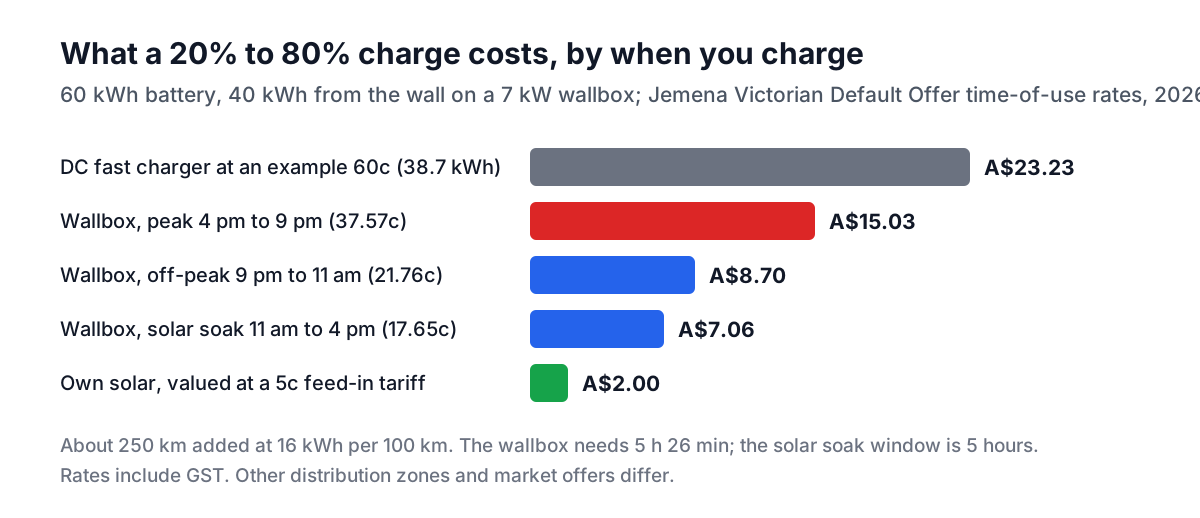
- Peak, 4 pm to 9 pm: A$15.03.
- Off-peak, 9 pm to 11 am: A$8.70.
- Solar soak, 11 am to 4 pm: A$7.06.
Plugging in when you get home at 6 pm costs more than double what the same charge costs if it starts at 9 pm or during the day. The window lengths matter too: the solar soak period is 5 hours, and a 7.4 kW wallbox fills about 33 kWh in that time, close to the full 36 kWh. A power point puts only about 9.8 kWh into the battery in the same 5 hours, about 72 km of range.
Rates differ between distribution zones: off-peak runs from 21.17 cents (CitiPower) to 22.60 cents (AusNet Services), and peak from 37.57 to 47.64 cents. Other states and market offers have their own windows; check your plan.
Charging from your own solar
If you have rooftop panels, the cost of charging from them is roughly the feed-in tariff you give up by not exporting. At an illustrative 5 cents per kWh, the 40 kWh charge costs A$2.00 for about 250 km. A wallbox that can follow your panels' output, or a car set to charge in the middle of the day, gets most of the benefit; on a cloudy day the shortfall comes from the grid at your daytime rate. The Solar Payback Calculator for Australia shows how an EV changes the value of a system.
DC fast charging and the 80% rule
On DC the car sets the pace. The calculator holds the car's peak power to a slow-down point (50% by default) and then reduces it in a straight line to 15% of the peak at 100%. For the 60 kWh car with a 150 kW peak:
| Window | Energy into battery | Time |
|---|---|---|
| 10% to 80% | 42 kWh | 21 min |
| 20% to 80% | 36 kWh | 19 min |
| 80% to 100% | 12 kWh | 18 min |
The last 20% takes almost as long as the 70% before it, so on a road trip it is usually quicker to stop at around 80% and charge again further on. Real curves vary by model and battery temperature; if you know your car's, move the slow-down point to match.
Tools for this job
- EV Charging Time and Cost Calculator for Australia: time, cost and km added on every charger type, with session and per-minute fees.
- EV vs Petrol Cost Calculator for Australia: running costs over the years against a petrol or diesel car.
- Solar Payback Calculator for Australia: what rooftop solar returns when it also charges a car.
- Electricity Cost Calculator for Australia: the extra kWh on your bill.
- Related reading: EV vs petrol costs in Australia, and the US EV charging guide for US Level 1 and Level 2 charging.
Frequently asked questions
How long does it take to charge an EV from a normal power point?
At about 2.3 kW, adding 36 kWh takes about 18 hours 25 minutes, or roughly 14 km of range an hour for a car using 16 kWh per 100 km. An overnight 10 hours adds about 144 km.
What is the cheapest time to charge an EV in Victoria?
On the Victorian Default Offer's 2026-27 time-of-use tariff, the solar soak window from 11 am to 4 pm is cheapest, 17.65 cents per kWh in the Jemena zone, then off-peak from 9 pm to 11 am at 21.76 cents. Peak from 4 pm to 9 pm is 37.57 cents. A 40 kWh charge costs A$7.06, A$8.70 or A$15.03.
Is an 11 kW charger worth it over a 7 kW one?
Only if your home has three-phase power and your car accepts 11 kW on AC. Then a 20% to 80% charge on a 60 kWh battery drops from 5 hours 26 minutes to 3 hours 38 minutes, which helps if your cheap window is short.
Why does DC fast charging slow down after 80%?
The car reduces power as the battery fills to protect the cells. In the calculator's model a 60 kWh car takes 21 minutes from 10% to 80% on a 150 kW charger, and another 18 minutes from 80% to 100%.
Sources and further reading
- Victorian Default Offer, Essential Services Commission. 2026-27 flat and time-of-use residential rates, including the peak, off-peak and solar soak windows.
- Victorian Default Offer price review 2026-27, Essential Services Commission. Average bills and the consumption assumptions behind them.
- Green Vehicle Guide, Australian Government. Vehicle comparisons and a home charging time and cost calculator.
- Energy Made Easy, Australian Government. Plan comparison for NSW, Queensland, South Australia, Tasmania and the ACT.
- Charging electric vehicles at home, US Department of Energy. Home charging basics and having an electrician check the home's capacity.
Open the EV Charging Time and Cost Calculator
More Energy & Sustainability
Every tool in the Energy & Sustainability section, free and in your browser.