
How Long Does an Immersion Heater Take to Heat Water?
Time and cost to heat a hot water cylinder with a 3 kW immersion, what a combi boiler or electric shower can deliver, and why 60 °C storage matters in the UK.
By Redbison Dev · · 9 min read
United Kingdom edition. UK edition in litres and °C for immersion-heated cylinders, combi boilers, electric showers and 3 kW kettles, with costs at the Ofgem price cap rates for 1 October to 31 December 2026 and the HSE 60 °C storage guidance. US edition
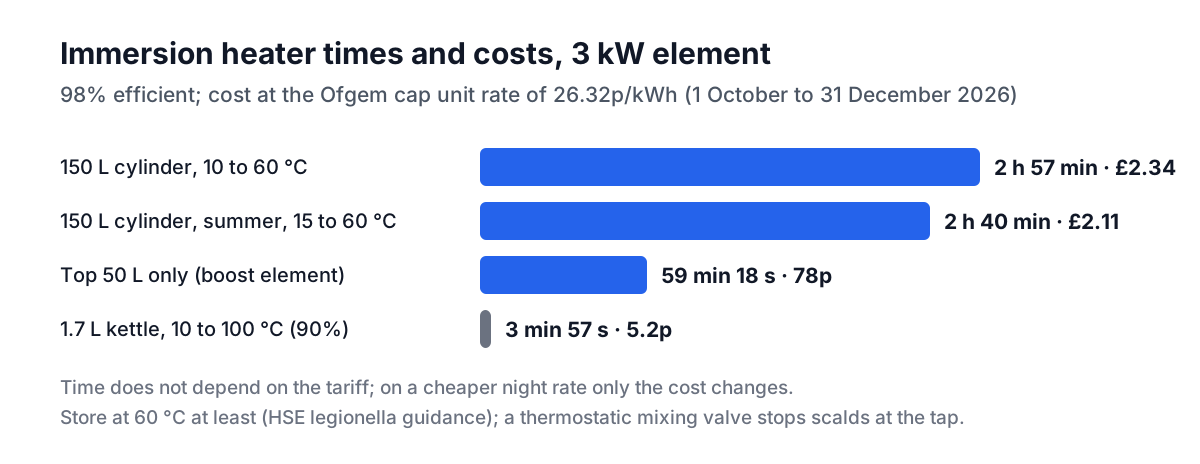
A 150 litre hot water cylinder heated by a 3 kW immersion heater takes about 2 hours 57 minutes to go from 10 °C mains water to 60 °C. The water absorbs 8.72 kWh, the element draws 8.90 kWh, and at the Ofgem price cap unit rate of 26.32p per kWh for 1 October to 31 December 2026 that heat-up costs £2.34. Those are the two questions this edition answers: how long after switching on the immersion there is a full tank, and what it costs.
This edition works through the sum with the Water Heating Time Calculator for the systems found in British homes: immersion-heated cylinders, combi boilers, electric showers and the kettle.
The sum behind every answer
Heating water takes energy in proportion to how much water there is and how many degrees it rises:
energy (kWh) = litres x density x 4,186 J/kg·K x rise (°C) / 3,600,000
A handy shortcut: each litre needs about 0.058 kWh to rise by 50 °C, or 1.16 kWh per 1,000 litres per degree. The time is then the energy divided by the heater's power and efficiency. An immersion element sits in the water, so almost everything it draws ends up as heat; the calculator uses 98%.
For the 150 L cylinder:
energy = 150 L x 0.9997 kg/L x 4,186 x 50 / 3,600,000 = 8.72 kWh
time   = 8.72 / (3 x 0.98)                          = 2.965 h, shown as 2 h 57 min
cost   = 8.72 / 0.98 x £0.2632                      = £2.34
Immersion heaters: what changes the time
The season. Mains water is colder in winter. From 15 °C in summer, the same cylinder takes 2 hours 40 minutes and £2.11, about 18 minutes and 23p less than from 10 °C.
Top or bottom element. Some UK cylinders have two immersions, or one long element and one short "boost" element near the top. Water heated by the top element rises and stays above the cold water, so a boost heats only the water above it. If 50 litres sit above the top element, a boost takes 59 minutes 18 seconds and costs 78p, enough for a shower or two, while the full heat-up from the bottom element takes nearly three hours. They are normally wired so only one runs at a time, so do not add their ratings together.
A part-used cylinder. You rarely heat from cold. After morning showers the stored water might average 45 °C; bringing 150 L back from 45 to 60 °C is a 15 °C rise instead of 50 °C, so it takes under a third of the full time.
Tariff, but only for cost. On Economy 7 or another time-of-use tariff, the immersion is timed to run overnight. The time is set by the element, not the price. If your night rate were 15p per kWh, a full heat-up would cost £1.33 instead of £2.34. Ofgem's cap limits the combined cost of multi-rate tariffs rather than each rate, so type the night rate from your own bill.
An immersion uses 3 kWh for every hour it is actually heating, which is 79p an hour at the cap rate. A thermostat switches it off once the water reaches temperature, so the cost of a full heat-up is the figure above, not the hours the timer is on times 79p.
Combi boilers and electric showers: power sets the flow
A combi boiler has no tank. It heats mains water as it flows, so the useful question is not "how long" but "how many litres a minute". The calculator's recovery figure gives it: litres per hour that the heater can raise through a given temperature rise.
For a shower at about 40 °C from 10 °C mains water (a 30 °C rise):
| Heater | Output used | Flow it can heat by 30 °C | Energy for a 60 L shower | Cost per shower |
|---|---|---|---|---|
| 30 kW combi boiler, 90% | 27 kW | 12.9 L/min | 2.33 kWh of gas | 18.5p at 7.97p/kWh |
| 24 kW combi boiler, 90% | 21.6 kW | 10.3 L/min | 2.33 kWh of gas | 18.5p |
| 9.5 kW electric shower, 99% | 9.4 kW | 4.5 L/min | 2.11 kWh | 56p at 26.32p/kWh |
Gas prices are the cap unit rate of 7.97p per kWh for the same period. The table explains two common complaints. A combi struggles to run two showers at once because each extra outlet shares the same output. And an electric shower in winter gives a weaker flow than in summer, because colder mains water needs a bigger rise at the same power. The energy per shower is nearly the same whichever heater you use; the price per kWh is what makes gas showers cheaper than electric ones at these rates.
Kettles: why the 3 kW model draws 13 A
Take a 3 kW kettle, about the most a 13 A plug-in appliance can draw on the 230 V supply (3,000 / 230 = 13.0 A). At 90% efficiency from 10 °C water:
| Amount | Time to boil | Cost at 26.32p/kWh |
|---|---|---|
| 1.7 L, full kettle | 3 min 57 s | 5.2p |
| 1.0 L | 2 min 19 s | 3.1p |
| 250 ml, one mug | 35 s | 0.8p |
Boiling only what you need saves time more than money: a full kettle for one mug costs about 4p extra and takes over three minutes longer. A kettle loses some heat to its own body and the air, which is why the calculator uses 90% rather than the 98% for an immersed element.
60 °C storage, and why not lower
It is tempting to turn the cylinder thermostat down to save energy, but the Health and Safety Executive's legionella guidance says hot water "should be stored at 60°C at least to kill legionella bacteria", with outlets reaching at least 50 °C within a minute of running the tap. The guidance is written for people managing water systems at work, and it is also widely applied to homes. Heating to 60 °C instead of 50 °C means a 50 °C rise instead of 40 °C from 10 °C water, so 25% more energy: about 1.8 kWh, or 47p, more per full heat-up of a 150 L cylinder.
Water at 60 °C can scald, so new homes in England must meet the hot water safety requirements in Approved Document G, which is where the thermostatic mixing valve before the bath comes from. If you have young children or older relatives at home, check that one is fitted.
Why your cylinder takes longer than the sum
- Standing losses. A cylinder loses heat through its jacket. A modern factory-insulated cylinder loses much less than an old one with a loose red jacket; add a jacket to an old copper cylinder.
- Scale. In hard water areas, limescale on the element slows heating and shortens its life.
- Thermostat setting. If the stat is set to 65 °C, the rise is 55 °C, not 50 °C, and the time goes up by a tenth.
- Undersized element. Some older cylinders have a smaller element. Read the rating on the element head and use it.
Tools for this job
- Water Heating Time Calculator: time, kWh and cost in pounds for any volume, temperature rise and heater.
- Electricity Cost Calculator: what any appliance costs to run at your unit rate.
- Specific Heat Calculator: heating any material, including phase changes.
- The US water heating guide covers gas-fired storage tanks, which are rare in British homes.
Frequently asked questions
How long does an immersion heater take to heat a full tank?
A 3 kW immersion takes about 2 hours 57 minutes to heat a 150 litre cylinder from 10 °C to 60 °C, and about 4 hours 9 minutes for 210 litres. In summer, with mains water nearer 15 °C, the 150 litre cylinder takes about 2 hours 40 minutes.
How much does it cost to run an immersion heater?
A 3 kW element uses 3 kWh per hour while heating, 79p an hour at the price cap unit rate of 26.32p per kWh for October to December 2026. A full heat-up of a 150 litre cylinder from 10 °C costs £2.34 because the thermostat stops the element once the water is hot.
Is it cheaper to heat water with the immersion or the boiler?
At the cap rates for October to December 2026, gas is 7.97p per kWh and electricity 26.32p. A gas boiler at 90% efficiency delivers hot water for about a third of the cost of a 98% efficient immersion. The immersion is cheaper only on a low enough off-peak rate, or with spare solar power.
Should I use the boost button?
Use it when you need a little hot water quickly. A top element heating the 50 litres above it takes about an hour and costs 78p, against nearly three hours and £2.34 for the whole cylinder.
What temperature should my hot water cylinder be?
HSE guidance is to store hot water at 60 °C at least, so that legionella bacteria are killed, and to reach at least 50 °C at the taps within a minute. A thermostatic mixing valve keeps the water at the bath to a safe temperature.
Sources and further reading
- Energy price cap unit rates and standing charges, Ofgem. GB average Direct Debit rates for 1 October to 31 December 2026: electricity 26.32p and gas 7.97p per kWh.
- Legionnaires' disease: things to consider, Health and Safety Executive. Store hot water at 60 °C at least; outlets at 50 °C within one minute.
- Electricity Safety, Quality and Continuity Regulations 2002, regulation 27, legislation.gov.uk. The declared low-voltage supply of 230 volts.
- Approved Document G: sanitation, hot water safety and water efficiency, GOV.UK. Hot water safety in new homes in England.
- University Physics Volume 2, 1.4: Heat transfer, specific heat and calorimetry, OpenStax. The sensible heat equation.
- Thermophysical properties of fluid systems, US National Institute of Standards and Technology. Density and specific heat of water.
Open the Water Heating Time Calculator
More Thermal
Every tool in the Thermal section, free and in your browser.