
How Long Does a Hot Water Cylinder Take to Heat Up in NZ?
Heat-up time and cost for NZ hot water cylinders from 135 to 300 litres, what a controlled or night rate changes, and why the cylinder should sit at 60 °C.
By Redbison Dev · · 9 min read
New Zealand edition. New Zealand edition in litres and °C for electric hot water cylinders, with the Electricity Authority's peak and night hours, controlled rates, Healthify's 60 °C advice, a gas continuous-flow comparison and costs from your own c/kWh in NZ dollars. US edition
A 180 litre electric hot water cylinder with a 3 kW element takes about 3 hours 24 minutes to heat from 12 °C to 60 °C. The water takes in 10.04 kWh and the element draws 10.25 kWh, which at a power price of 30 cents per kWh is NZ$3.07 a heat-up. The 30 c figure is only an illustration; use the rate on your own power bill, and if your cylinder is on a cheaper controlled rate, the cost drops while the time stays the same.
This edition works through those numbers with the Water Heating Time Calculator for the cylinders, power plans and habits of New Zealand homes.
How the heat-up time is worked out
Two steps. The energy to heat the water depends on the volume and the temperature rise:
energy (kWh) = litres x density x 4,186 J/kg·K x rise (°C) / 3,600,000
The time is that energy divided by the element's power and efficiency. A cylinder element sits in the water, so the calculator uses 98% efficiency:
180 L from 12 °C to 60 °C:
energy = 180 x 0.9995 x 4,186 x 48 / 3,600,000 = 10.04 kWh
time   = 10.04 / (3 x 0.98)                   = 3.415 h, shown as 3 h 24 min
bought = 10.04 / 0.98                         = 10.25 kWh
Each litre needs about 0.056 kWh for that 48 °C rise. Double the cylinder and you double the energy and the time; double the element and you halve the time but not the energy.
Cylinder sizes compared
Cylinder sizes vary widely between a flat and a large family home. With a 3 kW element unless stated, heating to 60 °C:
| Cylinder | Element | From | Time | kWh bought | Cost at 30 c/kWh |
|---|---|---|---|---|---|
| 135 L | 2 kW | 12 °C | 3 h 50 min | 7.68 | NZ$2.31 |
| 180 L | 3 kW | 12 °C | 3 h 24 min | 10.25 | NZ$3.07 |
| 250 L | 3 kW | 12 °C | 4 h 44 min | 14.23 | NZ$4.27 |
| 250 L | 3 kW | 8 °C (winter) | 5 h 8 min | 15.42 | NZ$4.63 |
| 300 L | 3 kW | 8 °C (winter) | 6 h 10 min | 18.51 | NZ$5.55 |
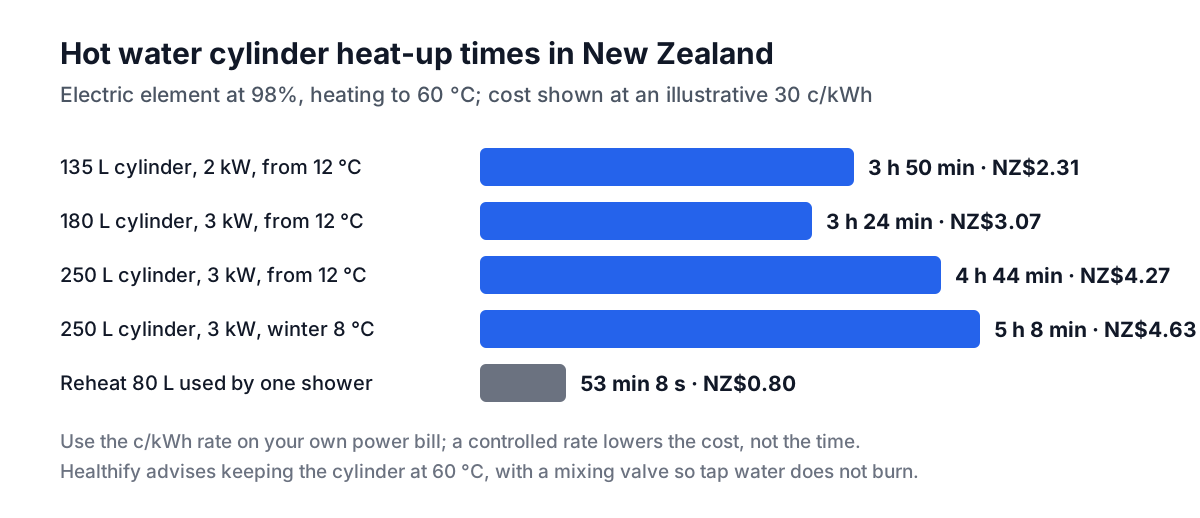
The small cylinder is slower than the 180 L one despite holding less, because it has a 2 kW element. Check the element rating on the cylinder's label or element cover before you rely on any figure.
Night rates, peak hours and controlled cylinders
The Electricity Authority's guide to time-of-use plans gives typical peak periods of 7 am to 10 am and 5 pm to 9 pm, off-peak or shoulder periods of about 10 am to 5 pm and 9 pm to 11 pm, and the cheapest night period of about 11 pm to 7 am. It suggests putting a timer on the hot water cylinder so it heats in the cheaper hours.
That night window is 8 hours. Every cylinder in the table above, including a 300 L one from winter mains water at 6 hours 10 minutes, can be fully heated inside it with a 3 kW element. A 300 L cylinder with only a 2 kW element would need over 9 hours, so it would spill into the morning peak.
Many homes have a controlled cylinder instead. The Electricity Authority's page on understanding your bill explains that your power company may offer a lower rate for it in exchange for being able to turn the cylinder off when demand on the local network is high. The heat-up time once the power is on is the same; what changes is that the element may be off for part of the evening peak. If the household runs out of hot water at dinner time, a larger cylinder or a timed boost earlier in the afternoon may help more than a bigger element.
At a 20 c/kWh controlled or night rate, the 180 L heat-up costs NZ$2.05 instead of NZ$3.07.
A shower, a top-up and a jug
You rarely heat a cylinder from cold. Some everyday cases:
| Job | Volume and rise | Time | Cost at 30 c/kWh |
|---|---|---|---|
| Reheat the water one 8-minute shower used at 10 L/min | 80 L, 12 to 40 °C | 53 min 8 s | NZ$0.80 |
| Top the cylinder back up after it mixed down | 180 L, 50 to 60 °C | 42 min 12 s | NZ$0.63 |
| Full 1.7 L jug, 2.2 kW, 90% | 1.7 L, 12 to 100 °C | 5 min 16 s | 5.8 c |
| 1 L in the same jug | 1 L, 12 to 100 °C | 3 min 6 s | 3.4 c |
The shower row counts the energy to warm all 80 litres from 12 °C to about 40 °C at the head; the cylinder delivers that as a smaller amount of 60 °C water mixed with cold. With a lower-flow shower head the reheat time falls in proportion.
Gas continuous flow: litres a minute, not hours
Homes with reticulated gas or LPG bottles may have a continuous-flow gas water heater instead of a cylinder. It has no heat-up time; the question is how much water it can heat at once. The calculator's recovery figure answers that. A unit delivering 25 kW at 85% efficiency, heating mains water from 12 °C to 40 °C for a shower, can supply about 653 litres an hour, or 10.9 L per minute. Run a second shower and the two share that flow.
60 °C: the setting not to turn down
Turning the thermostat down saves a little: the 180 L cylinder heated to 55 °C instead of 60 °C uses 9.18 kWh instead of 10.25, about 32 cents less per heat-up at 30 c/kWh. But Healthify's page on Legionnaires' disease is clear: "Keep the temperature of your home hot water cylinder at 60°C", because "Legionella bacteria cannot survive at 60°C or above". It recommends a mixing valve so the water does not burn at the tap, especially if children or older adults live in the house.
Why the real time is longer
- Heat loss while heating. Older cylinders lose heat through thin insulation. A cylinder wrap and lagging on the first metre of pipe reduce it.
- Winter mains water. The table shows a 24-minute difference on a 250 L cylinder between 12 °C and 8 °C mains water.
- Controlled supply. A cylinder switched off at peak times takes longer, measured by the clock, to finish.
- Scale and sediment. Heavy deposits on the element in hard-water or bore-water areas slow heating.
Tools for this job
- Water Heating Time Calculator: time, kWh and cost in NZ dollars for any cylinder and temperature rise.
- Electricity Cost Calculator: what any appliance costs at your c/kWh rate.
- Specific Heat Calculator: heating other materials and liquids.
- The US water heating guide covers gas storage tanks and US gallon units.
Frequently asked questions
How long does a hot water cylinder take to heat up?
A 180 litre cylinder with a 3 kW element takes about 3 hours 24 minutes from 12 °C to 60 °C. A 250 litre one takes about 4 hours 44 minutes, or 5 hours 8 minutes from 8 °C winter water. A 135 litre cylinder with a 2 kW element takes about 3 hours 50 minutes.
How much does it cost to heat a hot water cylinder in NZ?
Multiply the kWh bought by your rate. A full 180 litre heat-up from 12 °C uses about 10.25 kWh: NZ$3.07 at 30 c/kWh or NZ$2.05 at 20 c/kWh. Your own rate is on your power bill, often lower for a controlled cylinder.
Will my cylinder heat up overnight on a night rate?
Usually. The Electricity Authority puts the night period at about 11 pm to 7 am, 8 hours. A 300 litre cylinder with a 3 kW element needs about 6 hours 10 minutes from 8 °C winter water, so it fits; with a 2 kW element it would not.
What temperature should my hot water cylinder be set at?
60 °C. Healthify advises keeping the home cylinder at 60 °C because Legionella bacteria cannot survive at that temperature or above, and fitting a mixing valve so tap water is not hot enough to burn.
How long does it take to boil a jug?
A full 1.7 litre jug at 2.2 kW takes about 5 minutes 16 seconds from 12 °C, using 0.19 kWh. One litre takes about 3 minutes 6 seconds. Boiling only what you need is the quickest saving.
Sources and further reading
- Legionellosis (Legionnaires' disease), Healthify. Keep the home cylinder at 60 °C and fit a mixing valve.
- Understanding your power bill, Electricity Authority. Prices in cents per kWh and controlled rates for hot water cylinders.
- How to get cheaper power bills with a time-of-use plan, Electricity Authority. Typical peak, off-peak and night hours, and timers on cylinders.
- University Physics Volume 2, 1.4: Heat transfer, specific heat and calorimetry, OpenStax. The sensible heat equation.
- Thermophysical properties of fluid systems, US National Institute of Standards and Technology. Density and specific heat of water.
Open the Water Heating Time Calculator
More Thermal
Every tool in the Thermal section, free and in your browser.