
How Long Does a Geyser Take to Heat Up, and What It Costs
Heat-up time, units and rand cost for 100 to 200 litre geysers with 2 to 4 kW elements, Eskom's 60 °C advice, and what a 20A Homelight supply can carry.
By Redbison Dev · · 9 min read
South Africa edition. South African edition for electric geysers in litres and °C, with costs at Eskom's Homelight rates for 1 April 2026 to 31 March 2027 (270.30 and 343.61 c/kWh including VAT), the 4 400 W and 13 200 W supply limits and Eskom's geyser advice. US edition
A 150 litre geyser with a 3 kW element takes about 2 hours 40 minutes to heat from 15 °C to 60 °C. The water takes in 7.84 kWh, the element uses 8.00 units (kWh), and at Eskom's Homelight 60A rate of 343.61 c/kWh including VAT, valid from 1 April 2026 to 31 March 2027, that heat-up costs R 27,49. On Homelight 20A at 270.30 c/kWh it costs R 21,63. Eskom says the geyser can use up to 50% of a household's electricity, which is why this is the appliance worth getting right.
This edition works through those numbers with the Water Heating Time Calculator for the geysers found in South African homes, and what changes the time, the units and the rand.
The sum behind the answer
Heating water takes energy in proportion to how much there is and how far it rises:
energy (kWh) = litres x density x 4,186 J/kg·K x rise (°C) / 3,600,000
time (h)     = energy / (element kW x efficiency)
A geyser element sits in the water, so nearly all the electricity becomes heat; the calculator uses 98%. For the 150 L geyser:
energy = 150 x 0.9991 x 4,186 x 45 / 3,600,000 = 7.84 kWh
time   = 7.84 / (3 x 0.98)                    = 2.67 h, about 2 h 40 min
units  = 7.84 / 0.98                          = 8.00 kWh
cost   = 8.00 x R 3,4361                      = R 27,49
In the calculator, enter your tariff in rand per kWh with a decimal point: 343.61 c/kWh is 3.4361.
Geyser sizes and elements compared
| Geyser | Element | From | Time to 60 °C | Units | Cost on Homelight 60A |
|---|---|---|---|---|---|
| 100 L | 2 kW | 15 °C | 2 h 40 min | 5.33 | R 18,33 |
| 150 L | 3 kW | 15 °C | 2 h 40 min | 8.00 | R 27,49 |
| 150 L | 3 kW | 10 °C (winter) | 2 h 57 min | 8.90 | R 30,57 |
| 200 L | 3 kW | 15 °C | 3 h 33 min | 10.67 | R 36,66 |
| 200 L | 4 kW | 15 °C | 2 h 40 min | 10.67 | R 36,66 |
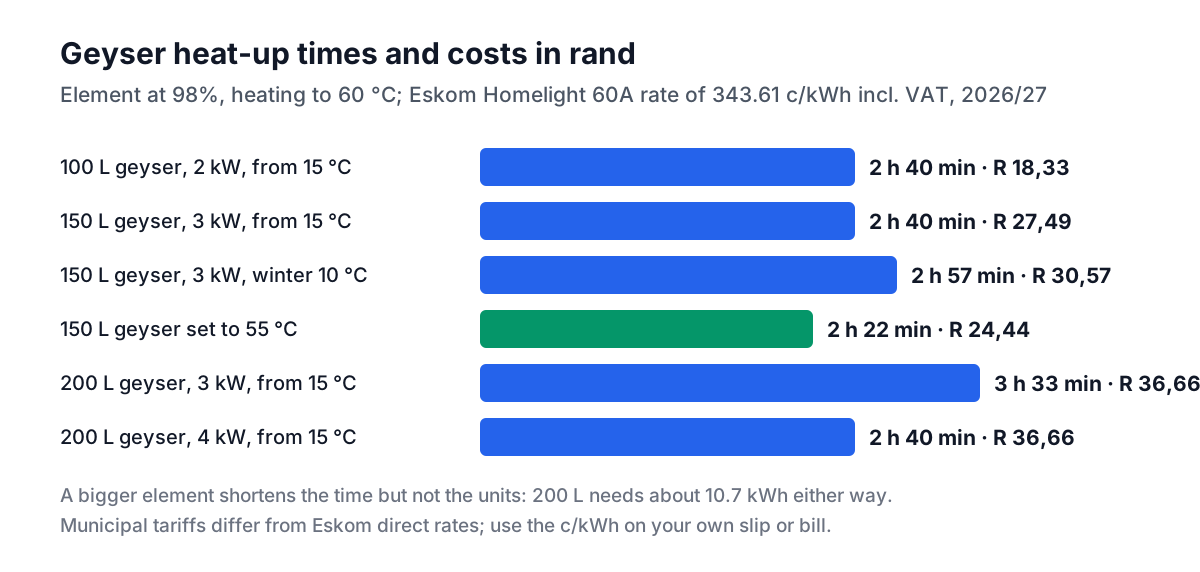
Two things stand out. When the element grows in step with the geyser, a full heat-up takes the same time: the 100 L with 2 kW, the 150 L with 3 kW and the 200 L with 4 kW all take 2 hours 40 minutes. And a bigger element does not save units: the 200 L geyser needs 10.67 kWh with either element. It only gets the job done sooner.
Will the geyser trip a 20A supply?
Eskom's tariff booklet for 2026/27 explains that any combination of appliances can run together as long as the total stays under about 4 400 W on a 20A Homelight supply and 13 200 W on a 60A supply.
| While the geyser heats | Load | On 20A (4 400 W) | On 60A (13 200 W) |
|---|---|---|---|
| 3 kW element alone | 3 000 W | fits, 1 400 W spare | fits |
| 3 kW element + 2.2 kW kettle | 5 200 W | too much | fits |
| 4 kW element alone | 4 000 W | only 400 W spare | fits |
| 4 kW element + 2 kW stove plate | 6 000 W | too much | fits |
On a 20A supply, a 4 kW element leaves almost nothing for the rest of the house, so a 3 kW element, or a geyser on a timer that heats while little else is running, is the practical choice.
Winter, setpoint and the 60 °C question
Colder mains water in winter means a bigger temperature rise. From 10 °C instead of 15 °C, the 150 L geyser takes about 18 minutes longer and costs R 3,07 more each full heat-up.
The thermostat setting matters more. Eskom's winter advice is to check that your geyser temperature is set no higher than 60 °C and to fit a geyser blanket on older units. Heating the same 150 L geyser to 55 °C instead of 60 °C takes 2 hours 22 minutes and costs R 24,44, about R 3,05 less per heat-up; heating it to 70 °C would cost R 6,11 more. Going below 60 °C has a health trade-off, though. Guidance from health and safety regulators elsewhere, such as the UK Health and Safety Executive, is to store hot water at 60 °C at least to kill legionella bacteria. Sixty degrees balances the energy saving against that risk.
How many units does a shower use?
Eskom's bathroom tips suggest showers of about seven minutes with a showerhead flowing at less than 10 litres a minute: at most about 70 litres. If all 70 litres were drawn from the geyser and replaced by cold water, reheating them from 15 °C to 60 °C takes 1 hour 14 minutes and 3.73 units, R 12,83 on Homelight 60A. Because the water at the showerhead is mixed with cold, the geyser's real share is less.
A kettle for comparison
A 1.7 litre kettle at 2.2 kW and 90% efficiency boils from 15 °C in about 5 minutes 5 seconds, using 0.19 kWh: about 64 cents on Homelight 60A. That is about a fortieth of a full geyser heat-up.
Why the real time is longer, and what the sum leaves out
- Standing loss. A hot geyser loses heat all day through its casing and the pipes. Eskom suggests insulating the geyser and the first 1.5 m of pipes, according to its energy saving tips. The calculator gives the time and cost of each heat-up, not this standing loss.
- Timers and interruptions. If the supply is off for part of the heat-up, by a timer, ripple relay or an outage, the clock time to a hot geyser is longer even though the units are the same.
- Element rating. Older geysers may have a 2 kW element where you expect 3 kW. Read the rating on the element or the geyser label.
- Scale. In hard water areas, scale on the element slows heating.
Heat pump and solar geysers break the simple sum: a heat pump moves heat from the air and uses a fraction of the units for the same hot water, and a solar geyser takes part of its energy from the sun. Use the calculator for the electric backup element in those systems.
Tools for this job
- Water Heating Time Calculator: time, units and rand cost for any geyser, element and temperature.
- Electricity Cost Calculator: what any appliance costs at your c/kWh rate.
- Solar Panel Calculator: sizing panels for a home, including the geyser's share.
- The US water heating guide covers gas-fired tanks and US gallon units.
Frequently asked questions
How long does a geyser take to heat up?
A 150 litre geyser with a 3 kW element takes about 2 hours 40 minutes from 15 °C to 60 °C. A 100 litre geyser with 2 kW and a 200 litre geyser with 4 kW take about the same. A 200 litre geyser with only 3 kW takes about 3 hours 33 minutes.
How many units does a geyser use to heat up?
About 8 units (kWh) for a full 150 litre heat-up from 15 °C to 60 °C, and about 10.7 units for 200 litres. Reheating the 70 litres of a seven-minute shower uses about 3.7 units.
How much does it cost to heat a geyser in South Africa?
At Eskom's Homelight 60A rate of 343.61 c/kWh including VAT, from 1 April 2026 to 31 March 2027, a full 150 litre heat-up costs R 27,49; on Homelight 20A at 270.30 c/kWh it costs R 21,63. Municipal customers pay their council's tariff, so use the rate on your own slip or bill.
Is a 4 kW element better than 3 kW?
It heats faster, not cheaper. A 200 litre geyser takes 2 hours 40 minutes with 4 kW and 3 hours 33 minutes with 3 kW, using 10.67 units either way. On a 20A Homelight supply, a 4 kW element leaves only about 400 W for everything else.
What temperature should I set my geyser to?
Eskom advises no higher than 60 °C. Turning it down to 55 °C saves about R 3,05 per full heat-up of a 150 litre geyser, but health guidance on legionella is to store hot water at 60 °C at least.
Sources and further reading
- Tariffs and charges booklet 2026/2027, Eskom. Homelight 20A 270.30 c/kWh and 60A 343.61 c/kWh including VAT from 1 April 2026, and the 4 400 W and 13 200 W supply limits.
- Energy-wise ways to get ready for winter, Eskom. Geyser share of up to 50% of household use, 60 °C setting and geyser blankets.
- Energy saving tips, Eskom. Insulating the geyser and the first 1.5 m of pipes.
- Using electricity smartly in bathrooms, Eskom. Seven-minute showers and showerheads under 10 litres a minute.
- Legionnaires' disease: things to consider, UK Health and Safety Executive. Storing hot water at 60 °C at least.
- University Physics Volume 2, 1.4: Heat transfer, specific heat and calorimetry, OpenStax. The sensible heat equation.
Open the Water Heating Time Calculator
More Thermal
Every tool in the Thermal section, free and in your browser.