
Head of Water, Pressure in Bar and Flood Loads on Walls
Turn metres of head into bar and kPa, then work out the force floodwater puts on a house wall, a flood board, a tidal flap valve and a tank panel, with UK examples.
By Redbison Dev · · 9 min read

United Kingdom edition. Written for the UK: pressure in bar and metres of head as plumbers use them, the 7 m minimum in England and Wales, and the force on walls worked through for the 0.3 m and 0.6 m flood depths in government flood resilience guidance, a seawater outfall and an IBC. US edition
Every metre of fresh water above a point adds 9.81 kPa of pressure, just under 0.1 bar, whatever the shape or size of the container. On a wall, that pressure grows from nothing at the surface to its maximum at the base, so the total force is the pressure halfway down times the wetted area, and it acts one third of the way up from the bottom. Those two facts answer most British questions about water at rest: why a gravity shower is weak, what the water company must supply, and how hard floodwater pushes on a house. The UK Hydrostatic Pressure Calculator does the sums in bar or kPa, and this edition works through them with UK cases.
Head and bar: the plumber's units
UK plumbing talks about head, the vertical height of water above an outlet, and about bar. The link is p = ρgh. With fresh water at 1,000 kg/m³ and standard gravity of 9.80665 m/s²:
| Head of fresh water | Pressure | Where you meet it |
|---|---|---|
| 1 m | 9.81 kPa, 0.098 bar | Per metre of height |
| 3 m | 29.4 kPa, 0.294 bar | Shower one floor below a loft cistern |
| 7 m | 68.6 kPa, 0.686 bar | The minimum static head in the communication pipe in England and Wales |
| 10 m | 98.1 kPa, 0.981 bar | The "10 m per bar" rule of thumb |
| 10.2 m | 100 kPa, 1 bar | Exact head for 1 bar |
The 7 m figure is the pressure standard in regulation 17G of the Water Supply and Sewerage Services (Customer Service Standards) Regulations 2008 for English water companies, with the same 7 m in regulation 10 for Wales. A combi boiler or an unvented cylinder runs on that mains pressure; a vented system fed from a loft cistern runs on its own head, which is why a gravity shower with 1.5 m of head has only about 0.15 bar to work with before pipe losses.
Bar on a gauge is gauge pressure, measured from the atmosphere. Absolute pressure adds the atmosphere, 101.325 kPa or 1.01325 bar at sea level. A pump datasheet that says "bar(a)" means absolute; most UK plumbing figures are gauge.
Force on a wall: the formula
For a vertical rectangle of width b and height H with water up to its top edge:
F = ρ g b H² / 2 acting at 2H/3 below the surface, H/3 above the base
For a panel whose top edge is at depth t below the surface, the depth of its centroid is h_c = t + H/2, and:
F = ρ g h_c (b H) y_cp = h_c + (b H³ / 12) / (h_c b H)
The square on H is the point to remember. Double the depth of water against a wall and the force quadruples, while the overturning moment about its base rises eightfold.
Floodwater against a house
The government's guidance Improving the flood performance of new buildings turns this physics into a design rule. It favours a water exclusion strategy (keep the water out) for flood depths up to 0.3 m, asks for a structural check between 0.3 m and 0.6 m, and recommends a water entry strategy (let the water in, then dry out) above 0.6 m, because standard masonry buildings are at significant risk of structural damage when the water level outside is about 0.6 m or more higher than inside.
The calculator shows why the line sits there. With fresh water and the depth measured from the ground:
| Flood depth outside, dry inside | Force per metre of wall | Acts at, above ground | On a 6 m frontage |
|---|---|---|---|
| 0.3 m | 0.44 kN | 0.10 m | 2.65 kN |
| 0.6 m | 1.77 kN | 0.20 m | 10.59 kN |
| 1.0 m | 4.90 kN | 0.33 m | 29.42 kN |
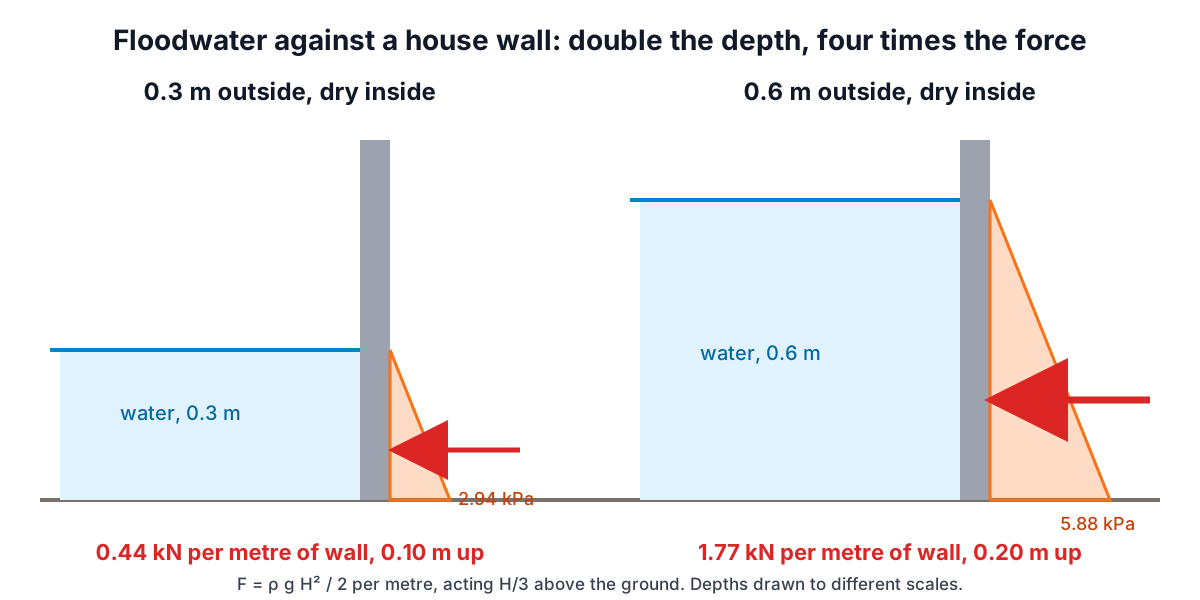
Going from 0.3 m to 0.6 m doubles the depth and quadruples the load, from 0.44 to 1.77 kN on each metre of wall. That load acts on a wall that was designed to carry roof and floor loads downwards, not to resist sideways water pressure, and it adds to the uplift on a ground floor slab and the push of saturated ground. Floodwater also moves and carries debris, which the static figure leaves out.
A flood board in a doorway
A demountable flood board across a 0.9 m wide doorway, holding back 0.6 m of water:
F = 1000 x 9.80665 x 0.9 x 0.6² / 2 = 1,589 N (1.59 kN)
acting 0.4 m below the water surface, 0.2 m above the threshold
At 0.3 m the same board carries 0.40 kN. The board's fixings and seals take the load into the door reveals, which is why products are tested and installed to a stated maximum depth. GOV.UK's flood preparation guidance points to the Blue Pages directory and the National Flood Forum for choosing products.
Seawater and a tidal flap valve
A 1 m x 1 m flap valve on a surface water outfall into an estuary, with its top edge 2.5 m below the water level at high tide. Seawater is denser than fresh water; this example uses 1,025 kg/m³, the calculator's typical seawater preset:
h_c = 2.5 + 0.5 = 3.0 m
F = 1025 x 9.80665 x 3.0 x 1.0 = 30.16 kN
y_cp = 3.0 + (1 x 1³ / 12) / (3.0 x 1) = 3.028 m
The centre of pressure is only 28 mm below the centre of the flap, because at that depth the pressure hardly changes over its height. That is the general rule: the deeper a gate, the closer the force acts to its centroid.
A 1,000 litre IBC panel
Take a rainwater harvesting IBC holding about 1.0 m of water. A full side panel 1.2 m wide carries:
F = 1000 x 9.80665 x 1.2 x 1.0² / 2 = 5.88 kN, acting 0.33 m above the base
The cage carries that load. The base pressure is 9.81 kPa (0.098 bar), so a tap at the bottom of a full IBC delivers less than a sixth of the 7 m mains minimum, which is why a pump is needed for a hose or a washing machine. The UK tank volume calculator gives the contents of the same tank.
Mistakes to avoid
- Measuring along a slope or a pipe run. Only vertical depth below the water surface counts.
- Putting the force at mid-height. On a wall from the surface down it acts one third of the way up from the base.
- Using 1 bar = 10 m for design. It is 10.2 m of fresh water; the rule of thumb is about 2% out.
- Ignoring the other side. A flood wall with water on both sides carries only the difference in levels, which is why a water entry strategy works.
- Forgetting moving water. Flow, waves and debris add load; this calculator gives the static part only.
For the stiffener or post that carries the load, the UK beam deflection calculator checks bending, and the UK guide to water pipe sizing covers what happens to head once water flows. The pump power guide turns head into the duty a pump must deliver.
Frequently asked questions
How many bar is 1 metre of head?
About 0.098 bar (9.81 kPa) for fresh water. Ten metres of head is 0.981 bar, so "10 metres per bar" is a close rule of thumb; exactly 1 bar is 10.2 m of fresh water.
What force does floodwater put on a house wall?
With water outside and none inside, the force per metre of wall is ρ g H² / 2. At 0.3 m deep that is 0.44 kN per metre; at 0.6 m it is 1.77 kN, four times as much, acting 0.2 m above the ground. Government flood resilience guidance treats about 0.6 m of difference between outside and inside as the point where standard masonry is at significant risk of structural damage.
Why does flood guidance say to let water in above 0.6 m?
Because the sideways load grows with the square of the depth difference, and standard masonry walls are not designed to resist it. Letting water in equalises the levels on both sides, so the wall carries little net load. The guidance favours keeping water out up to 0.3 m, a structural check between 0.3 m and 0.6 m, and water entry above 0.6 m.
What water pressure must a UK water company provide?
In England and Wales the Customer Service Standards Regulations 2008 set a minimum of 7 m of static head in the communication pipe serving a property, about 0.69 bar.
Sources and further reading
- Improving the flood performance of new buildings: flood resilient construction, Department for Communities and Local Government (2007), on GOV.UK. Water exclusion up to 0.3 m, water entry above 0.6 m and the structural reason.
- Prepare for flooding: protect your property, GOV.UK. Flood doors, air bricks and where to find products.
- Water Supply and Sewerage Services (Customer Service Standards) Regulations 2008, regulation 17G, legislation.gov.uk. The 7 m pressure standard in England.
- Water Supply and Sewerage Services (Customer Service Standards) Regulations 2008, regulation 10, legislation.gov.uk. The same standard in Wales.
- CODATA value: standard acceleration of gravity, National Institute of Standards and Technology. 9.80665 m/s².
- CODATA value: standard atmosphere, National Institute of Standards and Technology. 101 325 Pa.
- Water Density, US Geological Survey. How temperature and salt change density.
Open the Hydrostatic Pressure Calculator
More Fluid Mechanics
Every tool in the Fluid Mechanics section, free and in your browser.