
15mm or 22mm Pipe? Sizing UK Copper by Flow and Head
How to choose 15, 22 or 28 mm copper from a flow in litres per second: Table X bores, water speed, friction loss per metre and the head a cistern or main can spare.
By Redbison Dev · · 10 min read
United Kingdom edition. Works in UK metric copper to BS EN 1057 (Table X and Table Y bores), litres per second, metres of head and kPa, with the 7 m minimum mains pressure the customer service standards set in England and Wales, and the head limits of gravity-fed (vented) systems. US edition
Most UK pipe-sizing questions come down to one choice: 15 mm or 22 mm, and occasionally 28 mm. The answer depends less on the pipe's name than on two numbers you can work out: how fast the water moves through the bore, and how many metres of head the run burns in friction compared with what your cistern or the main can give. Take 0.3 litres per second as a bath tap's flow: 20 m of 15 mm Table X copper loses about 8.3 m of head; the same run in 22 mm loses 1.2 m. On a loft cistern a couple of metres above the taps, only one of those works. The UK Water Pipe Size Calculator sizes BS EN 1057 copper from a flow in l/s.
This is a design check, not a substitute for the Water Supply (Water Fittings) Regulations or a plumber's survey of the property.
What 15, 22 and 28 mm actually mean
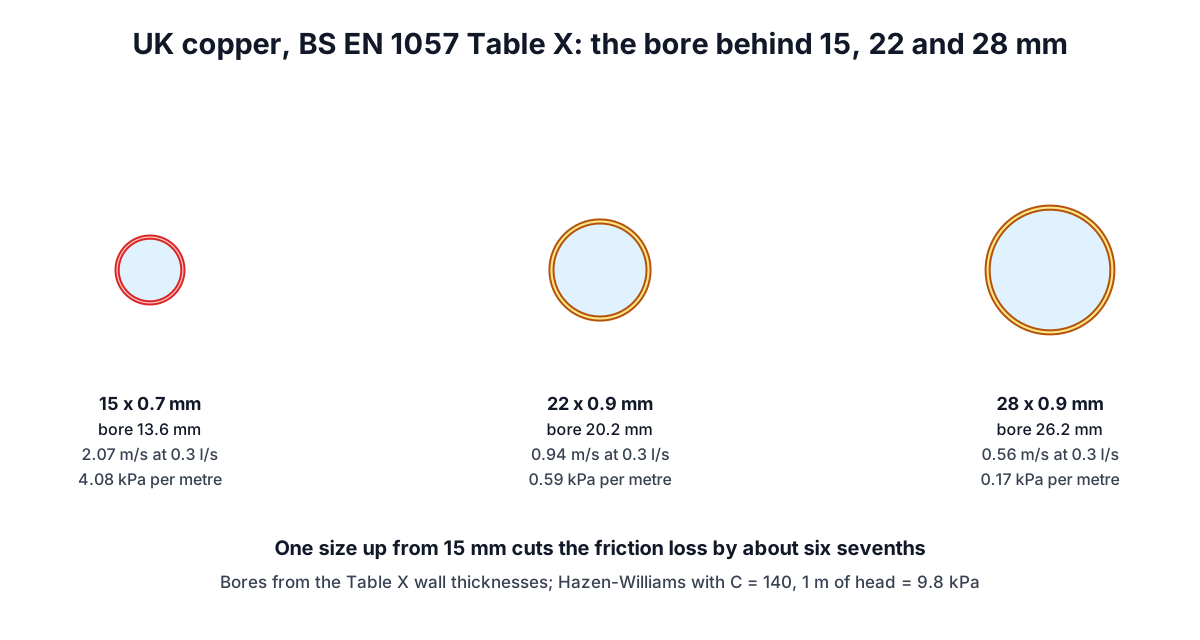
UK copper is named by its outside diameter. The bore depends on the wall thickness, and BS EN 1057 tube comes in two common ranges. Wednesbury's size table lists:
| Tube | Table X wall | Table X bore | Table Y wall | Table Y bore |
|---|---|---|---|---|
| 15 mm | 0.7 mm | 13.6 mm | 1.0 mm | 13.0 mm |
| 22 mm | 0.9 mm | 20.2 mm | 1.2 mm | 19.6 mm |
| 28 mm | 0.9 mm | 26.2 mm | 1.2 mm | 25.6 mm |
| 35 mm | 1.2 mm | 32.6 mm | 1.5 mm | 32.0 mm |
The bore is the outside diameter minus two walls. Table X (Wednesbury's Black Label range, half-hard in these sizes) is what the calculator uses. Table Y has thicker walls and slightly smaller bores. That sounds trivial, but friction loss rises with roughly the fifth power of the bore, so 0.6 mm less in a 15 mm tube matters: at 0.3 l/s over 20 m, Table Y 15 mm loses 10.4 m of head against 8.3 m for Table X.
Step one: the smallest bore for a velocity limit
Flow equals bore area times velocity, so a maximum velocity fixes a minimum bore:
d_min (mm) = 1000 × √(4 × Q / (π × v))      Q in m³/s, v in m/s
           = 35.68 × √(Q in l/s / v in m/s)
The calculator then picks the smallest standard tube whose bore is at least that. For 0.3 l/s:
| Velocity limit | Minimum bore | Smallest Table X tube | Actual velocity |
|---|---|---|---|
| 2.4 m/s | 12.6 mm | 15 mm (13.6 mm bore) | 2.07 m/s |
| 1.5 m/s | 16.0 mm | 22 mm (20.2 mm bore) | 0.94 m/s |
There is no single UK velocity figure in the Water Fittings Regulations; the limit is a design choice. Faster water is noisier and hits harder when a tap shuts quickly, and, as the next step shows, it costs far more head. The calculator's UK version starts at 1.5 m/s, and you can change it.
Step two: friction loss and the head you have
Velocity alone will not tell you whether the bath fills properly. For that you need the friction loss, which the calculator works out with the Hazen-Williams formula in its SI form:
loss per metre (m of head) = 10.67 × Q^1.852 / (C^1.852 × d^4.8704)
Q in m³/s, d in metres, C = 140 for copper
1 m of head ≈ 9.8 kPa ≈ 0.098 bar
Then compare the total with what is available:
- Gravity-fed (vented) systems: the head is the vertical distance from the water level in the cold cistern down to the outlet. That height is all the pressure there is, and it is often small for a bath or shower on the floor below the loft.
- Mains-fed outlets, combi boilers and unvented cylinders: start from the pressure at your stop tap, less any rise to the outlet and the losses in meters, valves and the appliance itself. Check the minimum dynamic pressure and flow in the cylinder or boiler maker's instructions.
How much can you count on from the main? In England and Wales, the Water Supply and Sewerage Services (Customer Service Standards) Regulations 2008 set a minimum of seven metres static head in the communication pipe serving a property, about 0.69 bar; Scotland and Northern Ireland have their own arrangements. In England, if the pressure falls below that for an hour or more on two occasions within 28 days, the customer is owed £50 (regulation 17G); the Welsh rule pays £25 (regulation 10). That is a floor, not a typical figure, but it shows what a 15 mm run at bath-tap flows does to it: 20 m at 0.3 l/s loses 81.6 kPa, more than the whole guaranteed minimum.
Worked examples
Each of these is set up in the UK calculator with SI units, the BS EN 1057 standard and C = 140.
A gravity-fed bath, 0.3 l/s over 20 m. At a 2.4 m/s limit the calculator accepts 15 mm (2.07 m/s), but the friction loss is 8.33 m of head. A loft cistern perhaps two metres above the taps cannot push 0.3 l/s through that; the bath would fill at a fraction of the rate. At 1.5 m/s the calculator picks 22 mm: 0.94 m/s and 1.21 m lost, which leaves some head for the tap itself. On a gravity system, 22 mm to the bath is the usual answer for this reason.
A cold main feeding an unvented cylinder, 0.6 l/s over 15 m. The minimum bore at 1.5 m/s is 22.6 mm, just more than 22 mm tube offers, so the calculator picks 28 mm: 1.11 m/s and 9.07 kPa lost. The same flow in 22 mm would run at 1.87 m/s and lose 32.2 kPa, which matters when the cylinder maker asks for a stated dynamic pressure at the inlet.
A basin tap, 0.15 l/s over 8 m of 15 mm. The water runs at 1.03 m/s and loses 9.04 kPa, about 0.92 m of head. On mains pressure that is nothing to worry about. On a gravity supply, even this short branch uses a good share of the available head.
The same bath run in Table Y tube. Using the thicker-walled 22 x 1.2 mm tube (19.6 mm bore) instead of Table X, 0.3 l/s over 20 m loses 1.40 m of head instead of 1.21 m. That is still workable; the difference is much larger in 15 mm.
Allowances and checks the calculator leaves to you
- Fittings. Elbows, tees, valves and the stop tap add loss. The calculator works on the length you enter, so add an allowance for fittings; on a run with many bends this can be a substantial share of the straight length.
- Simultaneous use. A pipe feeding a bath, a basin and a kitchen tap rarely sees all three at full flow at once. Design flows for the number of outlets likely to run together are a matter for the UK design standards and your installer.
- Hot water. Hazen-Williams is only valid for water and does not account for its temperature or viscosity, so it suits cold water best. For a hot run where the margin is tight, a Darcy-Weisbach calculation with the viscosity at the working temperature is more exact.
- Other materials. Plastic push-fit pipe and microbore have different bores and fittings that narrow the waterway. Use the maker's bore and loss data instead of copper figures.
- Approved fittings. Regulation 4 of the Water Supply (Water Fittings) Regulations 1999 requires every water fitting to be of an appropriate quality and standard, for example by conforming to an appropriate British Standard or a specification approved by the regulator.
For heating circuits, the pump power calculator for UK systems turns head loss into pump power, and the UK water heating time calculator works out how long a cylinder takes to heat. Our guide to sizing ducts in the UK uses the same friction-per-metre idea for air.
Frequently asked questions
What is the internal diameter of 22 mm copper pipe?
For BS EN 1057 Table X tube, 22 x 0.9 mm, the bore is 20.2 mm. Table Y tube, 22 x 1.2 mm, has a 19.6 mm bore. The 22 mm figure is the outside diameter.
How much pressure does 15 mm copper lose per metre?
It depends heavily on flow. At 0.15 l/s (9 l/min) Table X 15 mm loses about 1.13 kPa per metre; at 0.3 l/s (18 l/min) about 4.08 kPa per metre, nearly four times as much for double the flow.
Why does a gravity-fed shower or bath need bigger pipe?
Because the only pressure is the height of the cistern above the outlet, often just a few metres of head. A 15 mm run can lose more than that in friction at bath-filling flows, while 22 mm loses a fraction of it.
What is the minimum water pressure a UK water company must supply?
In England and Wales, the Water Supply and Sewerage Services (Customer Service Standards) Regulations 2008 set seven metres of static head, about 0.69 bar, in the communication pipe serving the property; Scotland and Northern Ireland have their own arrangements. In England a customer is owed £50 when it falls below that for an hour or more on two occasions within 28 days.
Does Table X or Table Y copper make a big difference to flow?
Not much in 22 mm and larger, but noticeably in 15 mm. At 0.3 l/s over 20 m, Table X 15 mm loses 8.33 m of head and Table Y 15 mm loses 10.4 m, because the thicker wall leaves a 13.0 mm bore instead of 13.6 mm.
Sources and further reading
- The Water Supply and Sewerage Services (Customer Service Standards) Regulations 2008, regulation 17G, legislation.gov.uk. The seven metre pressure standard and £50 payment in England; regulation 10 covers Wales.
- The Water Supply (Water Fittings) Regulations 1999, regulation 4, legislation.gov.uk. Fittings must be of an appropriate quality and standard.
- Copper tube size ranges to BS EN 1057, Wednesbury Tube. Outside diameters and Table X and Table Y wall thicknesses.
- Hazen-Williams equation, Wikipedia. The SI form, C values for copper and the limits of the formula.
- Darcy-Weisbach equation, Wikipedia. The general friction method for other fluids and temperatures.
Open the Water Pipe Size Calculator
More HVAC & Plumbing
Every tool in the HVAC & Plumbing section, free and in your browser.