
Metres Head to kPa, and Water Loads on Walls and Pools
Convert metres head to kPa as Australian utilities quote it, then work out the water load on a pool wall, a tank and a house in a flood with the ABCB method.
By Redbison Dev · · 9 min read

Australia edition. Written for Australia: metres head and kPa with Sydney Water's published pressures, a rainwater tank and an in-ground pool, and flood loads on walls using the ABCB Standard for buildings in flood hazard areas and the AIDR flood hazard categories. US edition
Each metre of fresh water above a point adds 9.81 kPa of pressure, so 15 metres head is 147 kPa, regardless of the shape of the tank or pipe. On a wall, pressure rises from zero at the water surface to its maximum at the base; the total force is the pressure at mid-depth times the area, and it acts one third of the way up from the base. Those rules explain why Australian utilities quote pressure in metres, why a rainwater tank needs a pump, why an empty in-ground pool can lift out of wet ground, and how the Australian Building Codes Board sizes flood loads on houses. The Australian Hydrostatic Pressure Calculator works in metres head and kPa and covers each case below.
Metres head and kPa
The conversion is p = ρgh with fresh water at 1,000 kg/m³ and standard gravity of 9.80665 m/s²:
| Head | Pressure | Context |
|---|---|---|
| 2.2 m | 21.6 kPa | A rainwater tank on a stand, measured to a garden tap |
| 15 m | 147.1 kPa | Sydney Water's minimum at the connection to a property |
| 52 m | 509.9 kPa | Sydney Water's reported network average |
| 65 m | 637.4 kPa | Top of the range most Sydney properties receive |
| 100 m | 980.7 kPa | Some properties exceed this |
Those Sydney figures come from the utility's water pressure management page: at least 15 metres head at the point of connection under its Operating Licence, a network average of 52 metres, most properties between 15 and 65 metres and some above 100. Other utilities publish their own service standards in their customer contracts.
The rainwater tank shows the gap. A tank whose water surface sits 2.2 m above a tap gives 21.6 kPa with nothing flowing, about a seventh of the mains minimum, which is why Sydney Water says most tanks need a pump to match drinking water pressure.
These are gauge pressures, measured from the atmosphere. Absolute pressure adds the standard atmosphere, 101.325 kPa at sea level. Pressure gauges on household plumbing read gauge pressure.
Force on a wall
For a vertical rectangle b wide and H high with water to its top edge:
F = ρ g b H² / 2 acting H/3 above the base
If the top of the panel is at depth t, the centroid depth is h_c = t + H/2, F = ρ g h_c b H, and the centre of pressure is y_cp = h_c + (b H³ / 12) / (h_c b H) below the surface. The force grows with the square of depth: twice the water, four times the push.
An in-ground pool
The deep end of a residential pool is 1.8 m. Per metre of wall:
F = 1000 x 9.80665 x 1.0 x 1.8² / 2 = 15.89 kN
acting 1.2 m below the water line, 0.6 m above the floor
The shallow end at 1.0 m carries 4.90 kN per metre, less than a third as much. A full pool's walls are also held by the soil behind them, so the design case is often the reverse one: an empty shell with saturated ground outside.
That is how pools "pop". If the groundwater around an emptied shell stands 1.2 m above the underside of its floor, the water pushes up on the floor at:
p = 1000 x 9.80665 x 1.2 = 11.77 kPa
On a 4 m x 8 m floor that is 376.6 kN of uplift, the weight of about 38 tonnes, which an empty concrete or fibreglass shell may not have. That is why some in-ground pools are fitted with hydrostatic relief valves, and why emptying one after heavy rain needs a pool builder's advice first.
Houses in a flood: the ABCB method
The ABCB Standard for construction of buildings in flood hazard areas sets out the flood actions a building must resist. Its hydrostatic rule is plain: actions caused by water to the defined flood level (DFL) apply to all surfaces above and below ground, as lateral pressure and as uplift or buoyancy, and reduced actions apply only if the building lets floodwater in and out.
Three details from the Standard shape the numbers:
| Rule | Value |
|---|---|
| Slow moving water treated as an extra depth | De = C V² / 2g, with C = 1.25 and g = 9.8 m/s², for velocities up to 1.5 m/s |
| Structural basis of the Standard | The DFL is no more than 1.0 m above the finished floor of enclosed rooms |
| Flood load factor | 1.0 for a 1 in 100 annual probability flood, higher for less rare events |
Worked example: a house with the DFL 1.0 m above its floor, water outside and dry inside.
Still water:  F = 1000 x 9.80665 x 1.0² / 2      = 4.90 kN per metre of wall
Flow 1.5 m/s: De = 1.25 x 1.5² / (2 x 9.8)        = 0.143 m
              F = 1000 x 9.80665 x 1.143² / 2     = 6.41 kN per metre, upstream face
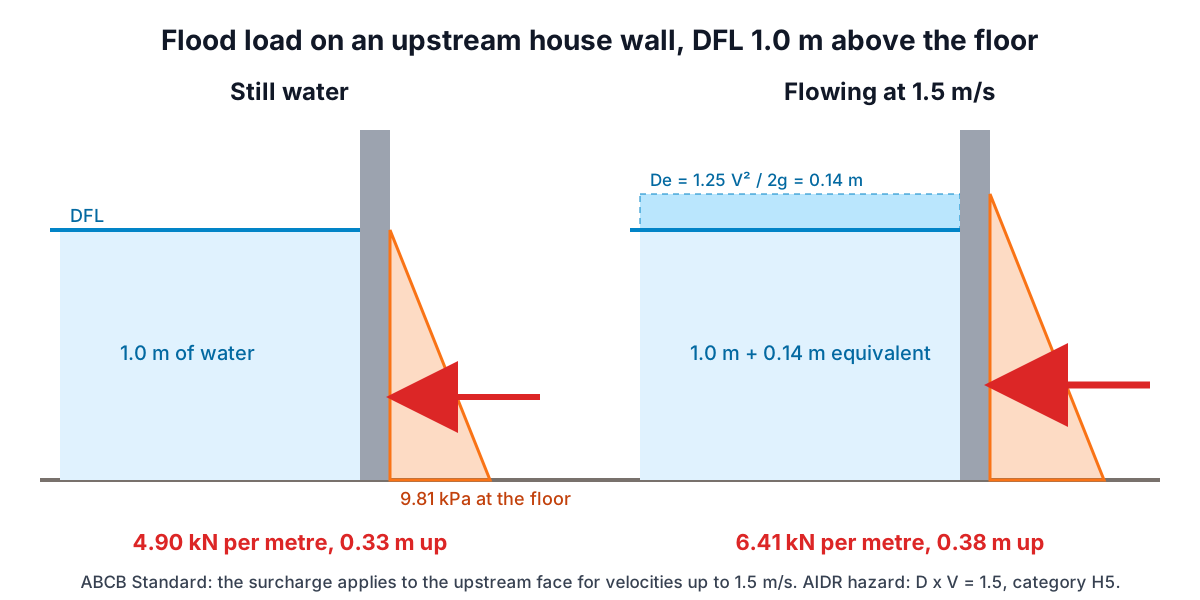
The Standard applies the surcharge only to the face upstream of the flow; faces parallel to the flow or downstream take the DFL hydrostatic pressure. Above 1.5 m/s, or for a building more than 12 times as wide as it is high, it calls for a full engineering analysis rather than the simple surcharge.
What the hazard category says
The Australian Disaster Resilience Guideline 7-3 on flood hazard classifies floodwater by depth and velocity together. The same 1.0 m at 1.5 m/s gives D x V = 1.5 m²/s, above the H4 limit of 1.0 and below the H5 limit of 4.0, so it is H5: unsafe for vehicles and people, with all building types vulnerable to structural damage and some weaker types vulnerable to failure. Still water 1.0 m deep with almost no flow stays in H3 (D x V under 0.6 and depth under 1.2 m), unsafe for vehicles, children and the elderly. The static load sets the minimum; the velocity decides whether the house is likely to survive it.
Mistakes to avoid
- Measuring along the pipe or slope. Only vertical height counts for head and pressure.
- Putting the force at mid-height. On a wall from the surface down it acts at one third height.
- Forgetting uplift. Water pushes up on floors and slabs as well as sideways on walls.
- Treating moving floodwater as still. Add the ABCB surcharge, and use the hazard category to judge whether the static check is enough.
- Using 10 kPa per metre for design. It is 9.81; the rule of thumb is 2% high.
For the contents of a tank, the Australian tank volume calculator gives litres for the same dimensions. The Australian guide to water pipe sizing covers what happens to head once water flows, and the pump power guide turns head into pump duty.
Frequently asked questions
How many kPa is 1 metre head?
About 9.81 kPa for fresh water, so 15 metres head is 147 kPa and 52 metres is about 510 kPa. Divide kPa by 100 for bar.
What load does a 1.8 m deep pool put on its wall?
About 15.9 kN per metre of wall when full, acting 0.6 m above the floor. The bigger risk is often the empty shell: with groundwater 1.2 m above the floor, the uplift is 11.8 kPa, 376.6 kN on a 4 m x 8 m floor, which is why some in-ground pools are fitted with hydrostatic relief valves.
How does the ABCB Standard treat moving floodwater?
For velocities up to 1.5 m/s it converts the flow into an extra depth, De = 1.25 V² / 2g, added to the defined flood level on the upstream face. At 1.5 m/s that is 0.143 m, raising the load on a wall holding back 1.0 m of water from 4.90 to 6.41 kN per metre. Faster flows need a full engineering analysis.
What is the minimum mains water pressure in Sydney?
Sydney Water's Operating Licence requires at least 15 metres head at the point of connection to a property, about 147 kPa. It reports a network average of 52 metres, about 510 kPa.
Sources and further reading
- Construction of buildings in flood hazard areas (ABCB Standard), Australian Building Codes Board. Hydrostatic and hydrodynamic actions, the surcharge depth, the 1.0 m DFL basis and flood load factors.
- Australian Disaster Resilience Guideline 7-3: Flood Hazard, Australian Institute for Disaster Resilience. Hazard categories H1 to H6 by depth and velocity.
- Water Pressure Management Program, Sydney Water. The 15 m minimum, the 52 m average and the usual range.
- Rainwater tanks, Sydney Water. Why most tanks need a pump.
- CODATA value: standard acceleration of gravity, National Institute of Standards and Technology. 9.80665 m/s².
- CODATA value: standard atmosphere, National Institute of Standards and Technology. 101 325 Pa.
Open the Hydrostatic Pressure Calculator
More Fluid Mechanics
Every tool in the Fluid Mechanics section, free and in your browser.