
Punching Force in kN and Tonnes for S275, S355 and SWG Sheet
Punching force for S275 and S355 plate and SWG sheet in kN and tonnes, the long-ton trap in old charts, and which UK punching machines are power presses.
By Redbison Dev · · 9 min read
United Kingdom edition. Written for UK fabrication: S275 and S355 strengths from BS EN 10025-2, SWG sheet thicknesses, the 2,240 lb British ton in old tons-per-square-inch charts, and the PUWER rules on power presses, turret punches and ironworkers. US edition
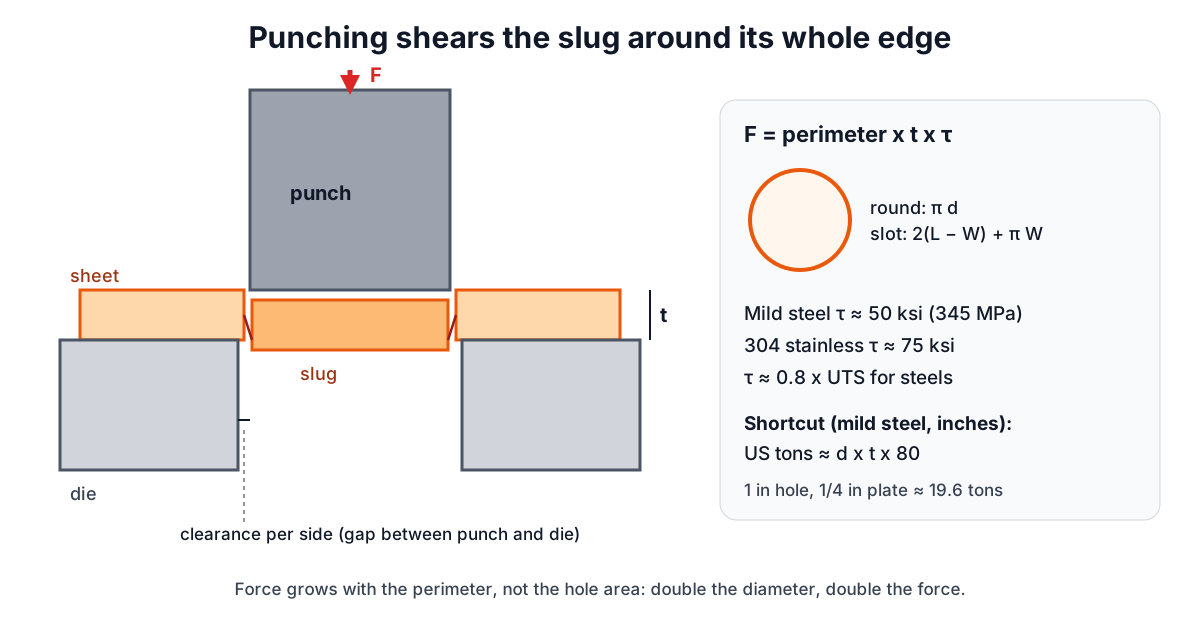
To punch a hole, the press must shear the whole cut edge through the full thickness: force = cut perimeter × thickness × shear strength. A 22 mm hole for an M20 bolt in 10 mm S275 plate has a cut edge of 69.1 mm, and at 0.8 of the grade's 410 N/mm² minimum tensile strength it needs 226.7 kN, about 23.1 tonnes. The same hole in S355 needs 26.5 tonnes. This edition works those numbers for British steel grades and sheet gauges with the Punching Force Calculator (UK), and covers two things specific to UK shops: charts quoted in British tons, and the PUWER rules that apply to the machine doing the punching.
The formula in N/mm² and tonnes
F (N) = perimeter (mm) × thickness (mm) × shear strength (N/mm²)
tonnes = F / 9,806.65      kN = F / 1,000
Force follows the perimeter, not the area. A 44 mm hole needs twice the force of a 22 mm hole in the same plate, and doubling the plate thickness doubles it again. Perimeters for the shapes on a typical drawing:
| Shape | Cut perimeter |
|---|---|
| Round hole, diameter d | π × d |
| Square, side a | 4a |
| Rectangle, a × b | 2(a + b) |
| Slot, overall length L, width W | 2(L − W) + π × W |
| Several punches in one stroke | add every perimeter that cuts together |
Shear strength for British steel grades
BS EN 10025-2 specifies structural steel by yield and tensile strength, not shear strength. The minimum tensile strength for plate from 3 mm to 100 mm thick is 410 N/mm² for S275 and 470 N/mm² for S355 (Steel Construction Institute). The usual bridge for steel is shear strength ≈ 0.8 × tensile strength:
| Material | Tensile strength | Shear strength used |
|---|---|---|
| S275, BS EN 10025-2 minimum | 410 N/mm² | 328 N/mm² |
| S355, BS EN 10025-2 minimum | 470 N/mm² | 376 N/mm² |
| Generic mild steel, punching chart value | 345 N/mm² | |
| Stainless 304, annealed (chart value) | 517 N/mm² | |
| Aluminium 5052-H32 (published typical value) | 138 N/mm² |
Those are minimums. Delivered plate is often stronger, and the inspection certificate gives the tested tensile strength for your batch, so enter that figure where you have it. The calculator's "Estimate from tensile strength" option does the 0.8 step for you.
The British ton in old punching charts
Punching tables often give mild steel as "25 tons per square inch". Check which ton. In UK law the ton is 2,240 lb (Weights and Measures Act 1985, Schedule 1); the US short ton, used in most American charts, is 2,000 lb. The difference is 12%:
| Basis | Shear strength | 22 mm hole in 10 mm plate |
|---|---|---|
| 25 US tons/in² (50,000 psi) | 345 N/mm² | 238.5 kN, 24.3 t |
| 25 British tons/in² (56,000 psi) | 386 N/mm² | 266.9 kN, 27.2 t |
| S275 at 0.8 × 410 N/mm² | 328 N/mm² | 226.7 kN, 23.1 t |
| S355 at 0.8 × 470 N/mm² | 376 N/mm² | 259.9 kN, 26.5 t |
A machine rated in "tons" may also mean metric tonnes (1,000 kg), British tons or US tons, depending on its origin. Convert its rating to kN before comparing it with the calculator's answer.
For quick checks in metric, the ironworker rule becomes: tonnes ≈ d (mm) × t (mm) × 0.11 for mild steel at 345 N/mm². For the 22 mm hole in 10 mm plate that gives 24.2 t against 24.3 t from the full formula.
Sheet in SWG
Sheet drawings in the UK often call up Standard Wire Gauge. The thicknesses used most for punched panels and enclosures:
| SWG | mm |
|---|---|
| 22 | 0.711 |
| 20 | 0.914 |
| 18 | 1.219 |
| 16 | 1.626 |
| 14 | 2.032 |
| 12 | 2.642 |
| 10 | 3.251 |
A drawing marked "16 gauge" from a US supplier may mean the US manufacturers' gauge rather than SWG, so confirm the thickness in mm; the Sheet Metal Gauge Converter shows both.
Worked examples
Base plate on an ironworker. A 22 mm hole in 10 mm S275: perimeter π × 22 = 69.12 mm, force 69.12 × 10 × 328 = 226.7 kN, 23.1 t. Allow at least 20% for punch wear and harder plate and you are looking for a station good for about 28 t; in S355 the same margin takes you past 30 t.
Slots in an enclosure panel. Six 25 × 10 mm slots in 16 SWG (1.626 mm) mild steel, all in one stroke of a multi-tool: each slot's perimeter is 2(25 − 10) + π × 10 = 61.42 mm and needs 34.45 kN (3.51 t). All six together need 206.7 kN, 21.1 t. Step the punch lengths in two groups of three and the peak drops to 103.4 kN, 10.5 t, which fits a much smaller press.
Stainless cut-out. A 100 × 60 mm rectangular cut-out in 18 SWG (1.219 mm) 304 stainless: perimeter 320 mm, force 320 × 1.219 × 517 = 201.7 kN, 20.6 t. Stainless needs a hole diameter of about twice the thickness or more; mild steel about one thickness. An 8 mm hole in 10 mm plate breaks that rule even in mild steel, so drill it or cut it by laser.
Which UK punching machines are power presses
Sizing the force is half the job; the machine also has to be legal to run. The Provision and Use of Work Equipment Regulations 1998 (PUWER) add thorough examination and inspection duties for power presses (regulations 32 and 33), defined in regulation 2 as "a press or press brake for the working of metal by means of tools, or for die proving, which is power driven and which embodies a flywheel and clutch" (PUWER regulation 2).
- Thorough examination. A power press and its guards must be thoroughly examined at least every 12 months if it has fixed guards only, and at least every 6 months otherwise (regulation 32).
- Inspection each shift. A person appointed in writing must inspect and test the guards and protection devices after tools are set or adjusted, and the press must not be used after the fourth hour of a working period unless that has been done (regulation 33).
- Exclusions. Regulations 32 to 35 do not apply to guillotines or to "a combination punching and shearing machine, turret punch press or similar machine for punching, shearing or cropping" (Schedule 2).
So a flywheel-and-clutch press running a piercing or blanking tool needs the power press examinations, while an ironworker or a turret punch does not. The general PUWER duties on guarding, maintenance and training apply to all of them. The HSE's guidance Safe use of power presses (L112) explains how to meet these duties; your insurer's engineering inspector or a competent person should make the call on any particular machine.
What moves the real force
- Clearance. Tight clearance raises force and wear; generous clearance leaves a bigger burr. Use your tooling supplier's table for the grade and thickness.
- Punch wear. A rounded edge needs more force than a sharp one, which is why a 20% or larger margin is normal.
- Shear angle. A ground angle or rooftop face cuts part of the perimeter at a time and lowers the peak force.
- Stripping. Pulling the punch back out of the sheet takes extra force, which the stripper and the press must handle.
Tools for this job
- Punching Force Calculator (UK): choose "Estimate from tensile strength", enter 410 N/mm² and 0.8, a 22 mm round hole and 10 mm thickness to repeat the base plate example.
- Sheet Metal Gauge Converter: SWG to mm, and the US gauges that get confused with it.
- Hydraulic Cylinder Calculator: force from pressure and bore, to check a hydraulic punch.
- For bending the same part, see press brake tonnage, V-die width and the air-bent radius.
Frequently asked questions
What shear strength should I use for S355 when punching?
About 376 N/mm², which is 0.8 of the 470 N/mm² minimum tensile strength in BS EN 10025-2 for plate from 3 mm to 100 mm thick. If the inspection certificate shows a higher tensile strength, multiply that by 0.8 instead.
Does "25 tons per square inch" mean British or US tons?
It depends on where the chart came from. A British ton is 2,240 lb, so 25 British tons per square inch is 56,000 psi, about 386 N/mm². In US tons it is 50,000 psi, about 345 N/mm². The British figure gives a force about 12% higher.
Is an ironworker a power press under PUWER?
No. Schedule 2 of PUWER lists combination punching and shearing machines, turret punch presses and similar machines for punching, shearing or cropping among the presses to which the power press examination rules in regulations 32 to 35 do not apply. The general PUWER duties still apply.
How many tonnes to punch a 22 mm hole in 10 mm plate?
About 23.1 tonnes in S275 at its minimum tensile strength, 26.5 tonnes in S355, and 24.3 tonnes with the 345 N/mm² chart value for generic mild steel, before any margin for wear.
Sources and further reading
- Steel material properties, Steel Construction Institute (steelconstruction.info). Minimum yield and tensile strengths for S275 and S355 to BS EN 10025-2.
- Weights and Measures Act 1985, Schedule 1, legislation.gov.uk. The ton as 2,240 pounds.
- Provision and Use of Work Equipment Regulations 1998, Schedule 2, legislation.gov.uk. Power presses excluded from regulations 32 to 35, including turret punch presses.
- Provision and Use of Work Equipment Regulations 1998, regulation 32, legislation.gov.uk. Thorough examination every 6 or 12 months.
- Safe use of power presses (L112), Health and Safety Executive. Approved Code of Practice and guidance for PUWER as applied to power presses.
- Standard wire gauge, Wikipedia. SWG thicknesses in inches and mm.
- ASM Handbook Volume 14B: Metalworking: Sheet Forming, ASM International. Piercing and blanking force.
Open the Punching Force Calculator
More Sheet Metal & Welding
Every tool in the Sheet Metal & Welding section, free and in your browser.