
Punching Force in Tonnes for MS Plate and SWG Sheet
Work out punching tonnage for PS 4798 structural plate and SWG sheet in mm and tonnes, and why the 400 to 550 N/mm² tensile range changes the press you need.
By Redbison Dev · · 9 min read
Pakistan edition. Written for Pakistani workshops: shear strength from the PS 4798 tensile range, PS-ISO 3573 and 3574 sheet in SWG, force in metric tonnes, and how to size a press when the plate comes without a test certificate. US edition
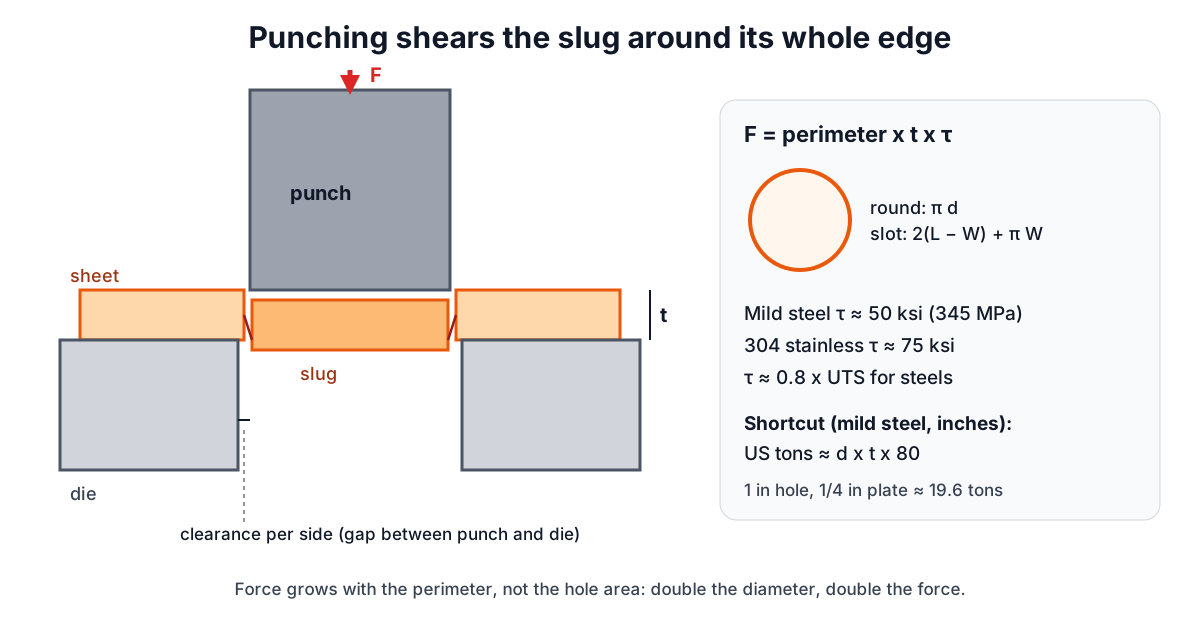
The force to punch a hole is the cut perimeter × the plate thickness × the shear strength of the steel. For an 18 mm hole in 8 mm structural plate the cut edge is 56.55 mm long. What makes the answer uncertain in Pakistan is the plate itself: PS 4798, the national standard for carbon structural steel, allows a tensile strength anywhere from 400 to 550 N/mm², so the same hole needs between 14.8 and 20.3 tonnes. This edition shows how to size a press or ironworker for that range with the Punching Force Calculator (Tonnes, MS Plate and Sheet), and works the sheet sizes Pakistani shops use.
The formula in mm and tonnes
F (N) = cut perimeter (mm) × thickness (mm) × shear strength (N/mm²)
F (tonnes) = F (N) / 9,806.65
| Shape | Cut perimeter |
|---|---|
| Round hole, diameter d | π × d |
| Square, side a | 4a |
| Rectangle, a × b | 2(a + b) |
| Slot, overall length L, width W | 2(L − W) + π × W |
| Several punches in one stroke | add all the perimeters |
The area of the hole does not appear. A 36 mm hole needs twice the force of an 18 mm hole, and 16 mm plate twice the force of 8 mm plate.
What PS 4798 tells you, and what it does not
PS 4798:2017, Carbon Structural Steel, is based on ASTM A36/A36M-14 and covers plates, shapes and bars. Its Table 2 sets a tensile strength of 400 to 550 MPa (58 to 80 ksi) and a minimum yield point of 250 MPa. Structural steel to PS 4798 is on the PSQCA list of items that must meet Pakistan Standards, as are hot-rolled sheet (PS-ISO 3573) and cold-reduced sheet (PS-ISO 3574).
The standard does not give shear strength. The usual estimate for steel is 0.8 × tensile strength (some references use 0.75), so:
| Basis | Shear strength | 18 mm hole in 8 mm | 22 mm hole in 10 mm | 26 mm hole in 12 mm |
|---|---|---|---|---|
| PS 4798 minimum, 400 × 0.8 | 320 N/mm² | 14.76 t | 22.55 t | 31.98 t |
| Chart value for mild steel | 345 N/mm² | 15.92 t | 24.31 t | 34.48 t |
| PS 4798 maximum, 550 × 0.8 | 440 N/mm² | 20.30 t | 31.01 t | 43.98 t |
The spread is about 37% between the bottom and top of the range. A press or ironworker chosen on the chart value can stall on a hard batch.
With a mill test certificate, enter its tensile strength in the calculator's "Estimate from tensile strength" option and the force follows in proportion. Without one, size on the 550 N/mm² upper limit. That is the approach the calculator's Pakistan version opens on, and it keeps a job from stopping halfway through a batch.
Sheet by SWG
Sheet is often ordered by gauge. For punching, convert to mm first:
| SWG | Thickness |
|---|---|
| 24 | 0.559 mm |
| 22 | 0.711 mm |
| 20 | 0.914 mm |
| 18 | 1.219 mm |
| 16 | 1.626 mm |
| 14 | 2.032 mm |
The mild steel preset of 345 N/mm² suits commercial-quality hot-rolled and cold-reduced sheet. Galvanised sheet is punched like its base steel, since the zinc layer is thin. The Sheet Metal Gauge Converter has the full table.
Worked examples
Bolt holes in a base plate. A 26 mm hole for an M24 bolt in 12 mm PS 4798 plate: perimeter π × 26 = 81.68 mm. At 440 N/mm² the force is 81.68 × 12 × 440 = 431.3 kN, 44.0 tonnes; at 320 N/mm², 32.0 tonnes. Before buying a 40 tonne ironworker for this job, get certificates for the plate or drill these holes.
Slots in sheet. Six 25 × 12 mm slots in 22 SWG (0.711 mm) sheet in one stroke: each slot's perimeter is 2(25 − 12) + π × 12 = 63.70 mm, so all six need 93.75 kN, 9.56 tonnes. Make three punches slightly shorter than the other three and the peak drops to 4.78 tonnes, because only three slots cut at a time.
A large cut-out in thin sheet. A 50 mm square in 1.2 mm sheet has a 200 mm edge and needs 82.8 kN, 8.44 tonnes: more than the slots above, even in thin material.
A hole too small to punch. A 10 mm hole in 12 mm plate is smaller than the plate thickness. The usual rule is a hole at least as wide as the thickness in mild steel and about twice the thickness in stainless; below that, the punch becomes slender and tends to break. The calculator flags this case.
Margin, clearance and tooling
- Leave headroom. The formula assumes sharp tooling and the strength you entered. Blunt punches, too little clearance and hard plate all push the force up; leave at least 20% between the calculated force and the machine's rating.
- Clearance. The gap between punch and die is set per side as a share of thickness, from the tooling maker's table. Too tight raises the force; too loose leaves a heavy burr.
- Shear angle. A punch face ground at an angle cuts part of the edge at a time and lowers the peak force, at the cost of a slightly bent slug.
- Rated tonnes. A machine plate may give capacity in metric tonnes or US tons (2,000 lb). Convert both to kN before comparing: 1 tonne is 9.81 kN, 1 US ton is 8.90 kN.
Fencing and guarding on presses and ironworkers come under provincial workplace safety law; check the rules for your province with the labour department.
Tools for this job
- Punching Force Calculator (Tonnes, MS Plate and Sheet): opens on an 18 mm hole in 8 mm plate at 550 N/mm² × 0.8; change the tensile strength to 400 to see the lower bound.
- Sheet Metal Gauge Converter: SWG and other gauges to mm.
- Hydraulic Cylinder Calculator: the force a hydraulic punch or press delivers from its pressure and bore.
- For bending the part after punching, see press brake tonnage, V-die width and the air-bent radius.
Frequently asked questions
What shear strength should I use for MS plate in Pakistan?
For PS 4798 structural plate, take 0.8 of the tensile strength: 320 N/mm² at the 400 N/mm² minimum and 440 N/mm² at the 550 N/mm² maximum. With a mill certificate, use its tested tensile strength; without one, use the upper value.
How many tonnes to punch a 22 mm hole in 10 mm plate?
Between 22.6 and 31.0 tonnes for PS 4798 plate, depending on where its tensile strength falls in the 400 to 550 N/mm² range, and 24.3 tonnes at the 345 N/mm² chart value for mild steel.
Why does my press stall on some plate and not others?
Plate within the same standard can differ in strength by over a third. A press sized on the low end of the range runs out of force on harder plate, and a worn punch adds more. Size on the upper tensile limit unless you have a certificate.
Can I punch two holes at once on a single-hole press?
Only if the press can deliver the sum of both forces. Two 18 mm holes in 8 mm plate at 440 N/mm² need about 40.6 tonnes together.
Sources and further reading
- PS 4798:2017 (Rev) Carbon Structural Steel, Pakistan Standards and Quality Control Authority. Based on ASTM A36/A36M-14; Table 2 tensile strength 400 to 550 MPa, minimum yield point 250 MPa.
- List of compulsory items to meet Pakistan Standards, PSQCA. Structural steel PS 4798, PS-ISO 3573 hot-rolled sheet and PS-ISO 3574 cold-reduced sheet.
- Standard wire gauge, Wikipedia. SWG thicknesses in inches and mm.
- Punching, Wikipedia. The perimeter × thickness × shear strength estimate.
- ASM Handbook Volume 14B: Metalworking: Sheet Forming, ASM International. Piercing and blanking force.
Open the Punching Force Calculator
More Sheet Metal & Welding
Every tool in the Sheet Metal & Welding section, free and in your browser.