
Calorie Deficit for Weight Loss: How Much to Cut in the UK
The NHS 1 to 2 lb a week pace, the 600 kcal deficit NHS dietitians use, where NICE draws the low-calorie line, and why loss slows as you go.
By Redbison Dev · · 6 min read
United Kingdom edition. Built around NHS and NICE guidance (1 to 2 lb a week, about 600 kcal a day less, low-energy diets of 800 to 1,200 kcal only with specialist support), with examples in kilograms and stones and energy in kcal and kJ as on UK labels. US edition
The NHS advises losing weight at 1 to 2 lb (0.5 to 1 kg) a week, and NHS Scotland's diabetes service puts the usual cut at around 600 kcal a day less than your body needs to maintain its weight. The UK calorie deficit planner works this out for you, but the date it gives is the earliest you could get there, not a promise. This guide explains how the arithmetic works, where it goes wrong after a few weeks, and the points at which NICE says a diet needs professional support.
It is general information. If you have diabetes and take insulin or tablets that can cause hypos, are pregnant, are under 18, or have had an eating disorder, speak to your GP before cutting calories.
The numbers the NHS uses
| Guidance | Figure | Source |
|---|---|---|
| Average daily energy | 2,000 kcal women, 2,500 kcal men | NHS, Government Dietary Recommendations |
| Safe rate of loss | 1 to 2 lb (0.5 to 1 kg) a week | NHS weight loss tips; NHS Scotland |
| Typical deficit | about 600 kcal a day less than you need | NHS Scotland, My Diabetes My Way |
| Low-energy diet | 800 to 1,200 kcal a day | NICE NG246, recommendation 1.16.8 |
| Very-low-energy diet | under 800 kcal a day | NICE NG246, 1.16.9 |
The 2,000 and 2,500 kcal figures are averages for the population, capped by Public Health England to help address overweight. Your own maintenance number depends on your size, age and activity and can be several hundred kcal either side.
Why a deficit becomes weight loss, and why it slows
Fat tissue stores roughly 7,700 kcal per kilogram, or about 3,500 kcal per pound. A steady 500 kcal a day deficit is 3,500 kcal a week, so on paper you lose about 1 lb a week. The planner uses exactly that rule.
The flaw is that your body uses less energy as it gets smaller. Under the Mifflin-St Jeor equation the planner uses, each kilogram lost lowers your resting rate by 10 kcal, and by more once your activity level multiplies it. Kevin Hall's model, published in The Lancet in 2011, shows the real curve bending away from the straight line over months.
Worked example: from 12 stone to 11
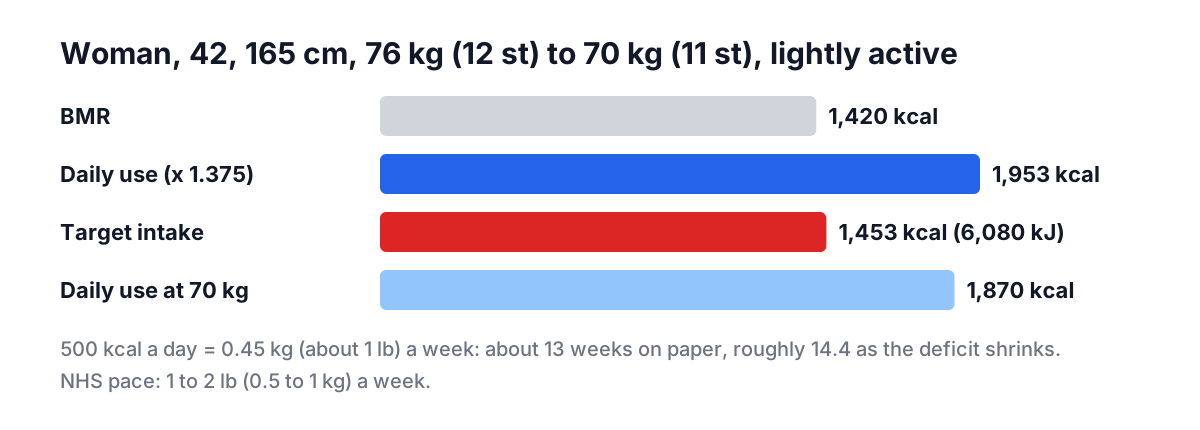
A 42-year-old woman, 165 cm, 76 kg (about 12 st), lightly active, aiming for 70 kg (11 st) with the moderate setting:
| Step | Value |
|---|---|
| Resting rate (BMR) | 1,420 kcal |
| Daily use (TDEE, x 1.375) | 1,953 kcal |
| Target intake | 1,453 kcal (6,080 kJ) |
| Deficit | 500 kcal a day |
| Rate on paper | 0.45 kg (about 1 lb) a week |
| Time on paper | about 13 weeks (93 days) |
Six kilograms is 8% of her weight, under the 10% first goal the planner allows. Now run the planner again at 70 kg, as if she were starting the next stage: her daily use is 1,870 kcal, 83 kcal lower. If she kept eating 1,453 kcal, her deficit by the end would be about 417 kcal, not 500, and the last kilograms come more slowly. Averaging that shrinking deficit, about 458 kcal a day, stretches 13 weeks to roughly 14.4. Re-running the planner every 3 to 4 kg keeps the target honest.
Her 500 kcal cut is a little smaller than the 600 kcal the NHS Scotland service describes, which is why her pace sits at the slow end of the NHS range. To reach 600 she could eat about 100 kcal less (1,353 kcal, still above the planner's 1,200 kcal floor) or add activity; activity keeps her intake further from the 1,200 kcal top of NICE's low-energy-diet range.
The 1,200 kcal floor and what NICE says about it
The planner will not set a target below 1,200 kcal for women or 1,500 kcal for men. Those floors are common practice, but the UK puts a sharper frame around them. NICE NG246 defines low-energy diets as 800 to 1,200 kcal a day and recommends considering them only as part of a multicomponent programme with long-term support from a specialist weight management service, or a service for a long-term condition such as type 2 diabetes. Very-low-energy diets, under 800 kcal, are for people with a clinically assessed need to lose weight quickly, for example before surgery.
So a woman whose planner target lands on 1,200 kcal is at the top edge of what NICE calls a low-energy diet. That is not forbidden, but it is the point where the NHS would expect support around you, and where moving more is usually the better lever.
Worked example: a man who hits the floor
A 50-year-old man, 180 cm, 98 kg, sedentary, wants to reach 90 kg on the aggressive setting:
| Step | Sedentary | Lightly active |
|---|---|---|
| Daily use | 2,232 kcal | 2,558 kcal |
| Target intake | 1,500 kcal (floor) | 1,808 kcal |
| Actual deficit | 732 kcal | 750 kcal |
| Rate | 0.67 kg a week | 0.68 kg a week |
| Time | about 12 weeks | about 12 weeks |
Sedentary, the full 750 kcal cut would take him below 1,500 kcal, so the planner holds the floor. If he walks enough to count as lightly active, the same pace comes with 308 kcal more food a day. The NHS activity guideline for adults, at least 150 minutes of moderate activity a week, is a realistic way to get there.
Stones, pounds and kilojoules
Most UK scales show stones and pounds, and most UK food labels show both kJ and kcal. A few conversions help:
- 1 stone is 14 lb or 6.35 kg. Losing a stone at 1 lb a week takes 14 weeks on paper, and a little longer in practice.
- 500 kcal is about 2,090 kJ; the 1,453 kcal target above is about 6,080 kJ.
- Weigh at the same time each week, ideally first thing. Daily weights move by a pound or two with salt, water and the time of your last meal.
Common UK mistakes
- Planning to the date. The planner's date comes from the straight-line rule. Add a fortnight or two to any plan longer than three months.
- Choosing "moderate" activity for a desk job with a weekend walk. That setting adds about 250 kcal a day for the woman above (her 1,420 kcal BMR times the 0.175 gap between the two factors) and quietly erases half of her deficit. The UK calorie guide explains how to choose.
- Cutting protein with calories. Keep protein up to protect muscle; the UK protein calculator gives a target.
- Treating 1,200 kcal as a goal. It is a floor. If your target lands there, add movement before cutting further.
Tools for this job
- Calorie deficit planner (UK): daily kcal and kJ target, weekly pace and a goal date.
- Calorie calculator (UK): your maintenance figure before you set a deficit.
- Macro calculator (UK): turns the target into protein, carbohydrate and fat against UK advice.
- BMI calculator (UK), with the NICE lower thresholds, to set a sensible end point. The UK body composition guide covers the waist-to-height rule.
Frequently asked questions
How many calories should I cut to lose 1 to 2 lb a week?
About 500 to 1,000 kcal a day on the static rule. NHS Scotland's guidance puts the usual figure at around 600 kcal a day less than you need, which gives roughly 1 to 1.5 lb a week at first. Your loss will slow as your weight falls.
Is 1,200 calories a day safe in the UK?
For many women it is the lowest target a self-guided plan should set. NICE classes 800 to 1,200 kcal a day as a low-energy diet and recommends it only with support from a specialist weight management service, so if your plan lands at 1,200 kcal, talk to your GP practice about support or add activity instead.
How long does it take to lose a stone?
At 1 lb a week, 14 weeks on paper. Because your energy needs fall as you lose weight, expect it to take a week or two longer, and longer again for a second stone unless you re-run the plan and adjust.
What is the NHS recommended calorie intake for weight loss?
There is no single NHS number. The NHS uses 2,000 kcal for an average woman and 2,500 kcal for an average man to maintain weight, and advises losing 1 to 2 lb a week. The planner works out a target from your own height, weight, age and activity.
Sources and further reading
- Tips to help you lose weight, NHS. Aim to lose 1 to 2 lb (0.5 to 1 kg) a week.
- Understanding calories, NHS. 2,000 and 2,500 kcal averages and kJ on labels.
- What can I do to lose weight?, NHS Scotland, My Diabetes My Way. About 600 kcal a day less, and very low calorie diets.
- Overweight and obesity management (NG246): physical activity and diet, NICE. Energy deficit, low-energy and very-low-energy diets (1.16.3 to 1.16.9).
- Physical activity guidelines for adults aged 19 to 64, NHS. At least 150 minutes of moderate activity a week.
- Government Dietary Recommendations, Public Health England, 2016. Energy reference values and the cap at 2,000 and 2,500 kcal.
- Quantification of the effect of energy imbalance on bodyweight, The Lancet, 2011. Hall and colleagues.
- A new predictive equation for resting energy expenditure in healthy individuals, The American Journal of Clinical Nutrition, 1990. Mifflin, St Jeor and colleagues.
Open the Calorie Deficit Planner
More Fitness Calculators
Every tool in the Fitness Calculators section, free and in your browser.
- BMI Calculator
- Calorie Calculator
- Protein Calculator
- Hydration Calculator
- Calorie Deficit Planner
- Body Fat Calculator
- Ideal Weight Calculator
- Running Pace Calculator
- Target Heart Rate Calculator
- One Rep Max Calculator
- Barbell Plate Calculator
- RPE Calculator
- Interval Timer
- Calories Burned Calculator
- Body Surface Area Calculator
- Waist-to-Hip Ratio Calculator
- VO2 Max Calculator
- Steps to Distance & Calories Calculator