
Heating Oil Tank Litres from a Dipstick: Dip Charts (UK)
Turn a dipstick reading into litres of heating oil for box and round tanks, build a dip chart for your stick, and check the 3,500 litre rule and a 110% bund.
By Redbison Dev · · 10 min read
United Kingdom edition. Written for UK homes and businesses that store heating oil: litres and millimetres with imperial gallons for old tanks, dip charts for steel and cylindrical tanks, the Control of Pollution (Oil Storage) (England) Regulations 2001 thresholds and the 110% bund rule. US edition
Homes off the gas grid buy heating oil by the litre and usually find out how much is left by dipping the tank. Turning that reading into litres is easy for a box-shaped steel tank, where litres rise in a straight line with depth, and easy to get wrong for a round tank lying on its side, where a quarter of the height holds less than a fifth of the oil. This edition gives the formulas for both, a dip chart you can copy onto a stick, the capacity limit at which the oil storage rules apply to a home in England, and how to size a bund. Every figure comes from the Oil Tank Volume Calculator (UK).
Measure the inside, in millimetres
Take the inside length, width and height of a box tank, or the inside diameter and length of a round one. Steel walls are thin, but a measurement over flanges or seams overstates capacity. For a plastic bunded tank, the inner tank has rounded corners, ribs and often a sloping base, so the outside dimensions say little; use the maker's capacity and contents chart for that model instead of a formula.
Depth is measured from the lowest inside point to the oil surface. Dip at the same place each time, ideally the middle, because a tank that leans a little reads differently at each end.
Box-shaped tanks: litres are proportional to depth
For a rectangular tank, volume = length x width x depth. With dimensions in metres the answer is in cubic metres; multiply by 1,000 for litres.
A steel tank 1,800 x 1,100 x 1,100 mm inside:
- Brim-full capacity: 1.8 x 1.1 x 1.1 = 2.178 m³ = 2,178 litres (479 imperial gallons).
- Each 100 mm of dip is 1.8 x 1.1 x 0.1 = 198 litres.
- A 400 mm dip is 792 litres, 36.4% full; a 250 mm dip is 495 litres.
The space above the oil at 400 mm is 1,386 litres, the most a delivery could add before the tank is brim full. Order less than that so the tank is never filled to the top.
Round tanks on their side: use the circular segment
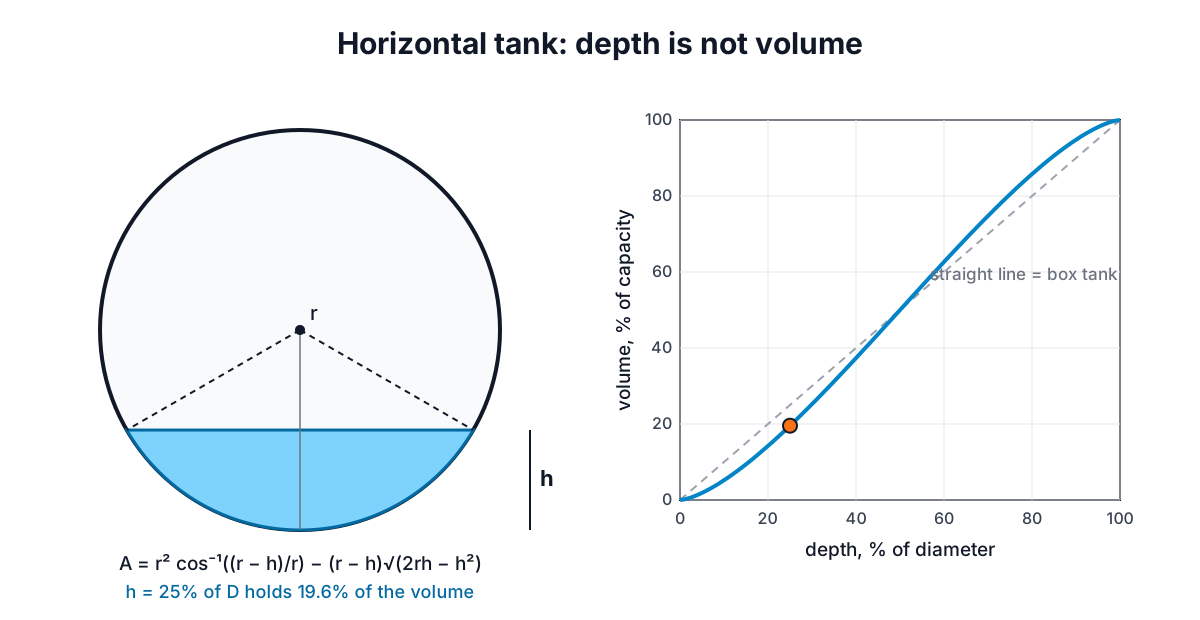
A cylinder lying down holds a circular segment of oil. With inside radius r, depth h and length L:
V = L x [ r² cos⁻¹((r − h) / r) − (r − h) √(2rh − h²) ]
The curve is S-shaped: near the bottom the oil surface is narrow, so each millimetre adds little; around the middle the surface is as wide as the tank, so each millimetre adds most.
Worked example: a dip chart for a 1,200 mm round tank
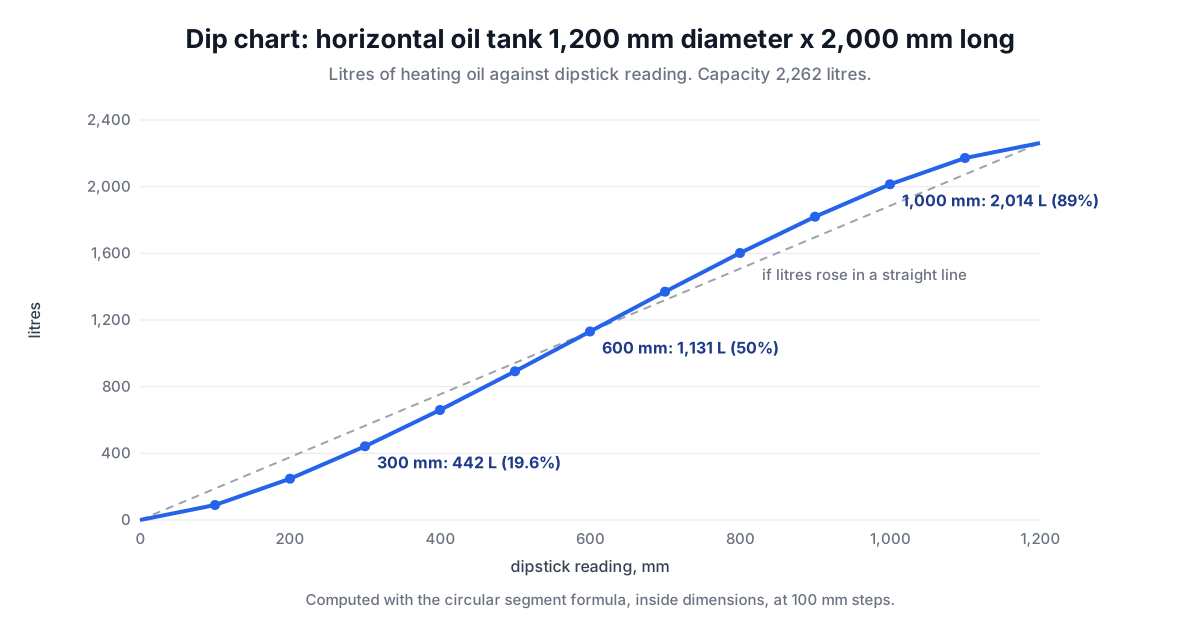
A horizontal steel tank 1,200 mm in diameter and 2,000 mm long holds 2,262 litres brim full (π x 0.6² x 2.0 = 2.262 m³). In the calculator choose horizontal cylinder, enter 1,200 mm and 2,000 mm, and set the dip chart step to 100 mm:
| Dip (mm) | Litres | % full |
|---|---|---|
| 100 | 90 | 4.0 |
| 200 | 248 | 11.0 |
| 300 | 442 | 19.6 |
| 400 | 660 | 29.2 |
| 500 | 892 | 39.4 |
| 600 | 1,131 | 50.0 |
| 700 | 1,370 | 60.6 |
| 800 | 1,602 | 70.8 |
| 900 | 1,820 | 80.4 |
| 1,000 | 2,014 | 89.0 |
| 1,100 | 2,172 | 96.0 |
| 1,200 | 2,262 | 100.0 |
Reading the chart:
- At a 300 mm dip, a quarter of the height, there are only 442 litres, under a fifth of the tank. Guessing "a quarter full" would overstate the oil by about 120 litres.
- The low-level mark worth knowing: 500 litres sits at about 327 mm (use the calculator's "depth for a volume" field).
- To leave a margin, the dip at 90% of capacity is about 1,012 mm. From a 300 mm dip, a delivery that brings the tank to 90% is 2,036 − 442 = about 1,594 litres.
Mark the stick at the depths that matter to you (500 litres, 1,000 litres, the 90% line) rather than at round millimetres.
When the oil storage rules apply to a home
In England, regulation 2 of the Control of Pollution (Oil Storage) (England) Regulations 2001 excludes containers with a storage capacity of 200 litres or less, and oil stored at a private dwelling in a container of 3,500 litres or less. GOV.UK's guidance on storing oil at a home or business, which applies to England and Wales, puts it the other way round: the rules apply to a container of 3,501 litres or more at a home, and 201 litres or more at a business or public building.
A tank's capacity, not the oil in it, decides. Two round tanks 1,400 mm in diameter show how close the line can be:
| Tank | Capacity | Rules at a home in England? |
|---|---|---|
| 1,400 mm x 2,250 mm long | 3,464 litres | No (3,500 litres or less) |
| 1,400 mm x 2,300 mm long | 3,541 litres | Yes |
Fifty millimetres of length moves the tank across the threshold. If your tank carries a nominal capacity on its plate, that is the figure to use. Scotland and Northern Ireland have their own rules; GOV.UK links to them.
Sizing a bund
Where the rules apply, GOV.UK says a bund around a single container must hold 110% of the container's capacity. For several fixed tanks in one bund, it must hold the greater of 110% of the largest container or a quarter of the combined capacity. Fixed tanks must be bunded; a drip tray is not enough.
For the 3,541 litre tank above:
- Required bund capacity: 3,541 x 1.1 = 3,895 litres.
- For a masonry bund 2,600 x 1,800 mm inside, the calculator's rectangular shape gives the depth that holds 3,895 litres: about 832 mm.
- Add for anything that takes up space inside the bund (the tank's supports, and the tank's own volume below the top of the bund wall if it stands on the bund floor), because those reduce what the bund can hold.
The same guidance requires an automatic overfill prevention device when the vent pipe and tank cannot be seen from the fill point, a drip tray at a remote fill point, and sight gauges with a valve that closes automatically when not in use.
Gallons on older tanks and cisterns
Older UK tanks and cold water cisterns may be marked in gallons, and those are imperial gallons of 4.54609 litres, not the 3.785 litre US gallon. A 2,500 litre tank is 549.9 imperial gallons; a "1,000 gallon" tank is 4,546 litres. Choose UK gal as the volume unit in the calculator to compare with a plate in gallons.
Common mistakes
- Assuming litres follow depth in a round tank. Apart from empty and full, they match only at exactly half the diameter.
- Using outside dimensions of a plastic or bunded tank.
- Dipping a sloping tank at one end. A small tilt changes the reading most when the tank is nearly empty.
- Checking the 3,500 litre threshold with the oil in the tank instead of the capacity.
- Sizing a bund for the tank alone when other containers share it.
Tools for this job
- Oil Tank Volume Calculator (UK): litres from a dip, a printable dip chart and the depth for any volume.
- Volume Calculator: other solids and shapes.
- Hydrostatic Pressure Calculator: the pressure on a tank or bund wall; see the hydrostatic pressure guide.
- Unit Converter: litres, imperial gallons and cubic metres.
Frequently asked questions
How do I work out how much heating oil is left from a dipstick?
Measure the oil depth and the tank's inside dimensions. For a box tank, litres = length x width x depth (in metres) x 1,000. For a round tank on its side, use the circular segment formula or the calculator; a 300 mm dip in a 1,200 mm tank 2,000 mm long is 442 litres, not a quarter of the tank.
Do the oil storage regulations apply to my home's tank?
In England, not if the container's capacity is 3,500 litres or less. Above that, at a home, they do, including the 110% bund. At a business they apply from 201 litres.
How big must a bund be for an oil tank?
110% of the tank's capacity for a single tank. A 3,541 litre tank needs a bund holding 3,895 litres, which is about 832 mm deep inside a 2,600 x 1,800 mm masonry bund before allowing for anything inside it.
Can I use a formula for a plastic bunded oil tank?
Only roughly. The inner tank's ribs, rounded corners and sloping base mean the outside dimensions overstate the volume. Use the manufacturer's contents chart for that model or a gauge set up for it.
Sources and further reading
- Storing oil at a home or business, GOV.UK. Thresholds of 3,501 litres at a home and 201 litres elsewhere, the 110% bund rule, multiple containers, overfill prevention and sight gauges.
- The Control of Pollution (Oil Storage) (England) Regulations 2001, regulation 2, legislation.gov.uk. Exclusions for containers of 200 litres or less and private dwellings with containers of 3,500 litres or less.
- Circular Segment, Wolfram MathWorld. The segment area formula behind horizontal tank volumes.
- Spherical Cap, Wolfram MathWorld. The cap volume for spherical and domed ends.
- NIST Guide to the SI, Appendix B.9, National Institute of Standards and Technology. Exact factors for the imperial and US gallon.
Open the Tank Volume Calculator
More Fluid Mechanics
Every tool in the Fluid Mechanics section, free and in your browser.