
Rainwater Tank Litres from the Water Level: Formulas (AU)
Work out litres in a round or slimline rainwater tank from the water level, how much a rain event adds, tank weight, and the Sydney Water size and approval guide.
By Redbison Dev · · 10 min read

Australia edition. Written for Australian rainwater tanks: round poly and slimline tanks in millimetres and litres, roof catch in litres per millimetre of rain, tank weight on its base, and Sydney Water's guidance on size, approvals up to 10,000 litres, pumps and inspections. US edition
If you have a rainwater tank, the usual question is how many litres are left in a dry spell. For an upright round tank or a slimline tank the answer is pleasantly simple: the litres rise in a straight line with the water level, so 40% of the height is 40% of the water. Tanks lying on their side, and the domed ends of some poly tanks, are the exception. This edition gives the formulas, works through the common Australian tank shapes, shows how much a rain event adds, and covers what Sydney Water says about size, weight and approvals. Try each one in the Rainwater Tank Volume Calculator (Australia).
Upright round tanks
For a vertical cylinder with inside diameter D and water depth h:
litres = π x (D/2)² x h x 1,000 (D and h in metres)
A round poly tank 1,850 mm across and 2,000 mm high inside:
- Capacity: π x 0.925² x 2.0 = 5.376 m³ = 5,376 litres.
- Every 100 mm of water is 268.8 litres.
- With water 800 mm deep: 2,150 litres, exactly 40% full because 800 mm is 40% of the height.
- The "depth for a volume" field turns it round: 2,000 litres sits at 744 mm, a useful level for a float switch to bring in mains top-up.
Measure inside the tank if you can, through the inlet strainer with a tape or using a clear tube on the outlet. Corrugated and ribbed tanks lose a little volume to the ribs, so if the maker's rated capacity differs from your measurement, trust the maker for the total and use the calculator for the level.
Slimline tanks
A slimline tank down the side of the house is a box, so litres = length x width x depth x 1,000. One 2,000 x 700 x 1,800 mm inside:
- Capacity 2,520 litres; every 100 mm of water is 140 litres.
- At 600 mm deep: 840 litres, a third full.
How much a rain event adds
One millimetre of rain on one square metre of roof is one litre of water, before losses to first-flush devices, gutters and overflow. Sydney Water's rainwater tanks page suggests connecting at least 75% of your roof.
Worked example: a 150 m² roof with 75% connected (112.5 m²) and 10 mm of rain.
- Catch: 112.5 x 10 = 1,125 litres at most.
- In the 1,850 mm round tank, 1,125 litres raises the level by about 419 mm, from 800 mm to about 1,219 mm.
- The tank then holds about 3,275 litres, 61% full.
That is why a tank with a small catchment refills slowly even in a wet week: the roof, not the tank, sets the ceiling.
Size, weight and approvals
Sydney Water's page makes three points worth checking before you buy:
- Size. If price is a factor, it suggests a minimum tank size of 2,000 litres connected to 75% or more of your roof area. The 2,520 litre slimline above meets that; a 1,500 litre tank would not.
- Weight. 1,000 litres weighs 1 tonne, so the site needs a safe, stable foundation. The 5,376 litre round tank carries about 5.4 tonnes of water when full.
- Approval. Tanks that store a maximum of 10,000 litres don't normally need council approval, provided set conditions are met; your council may have extra requirements. It points to the NSW Housing Code. Other states and councils set their own rules, so ask locally outside Sydney Water's area.
Two round tanks show where the 10,000 litre line falls:
| Tank (inside) | Capacity | Litres per 100 mm | Water weight full |
|---|---|---|---|
| 2,300 mm x 2,200 mm high | 9,140 litres | 415.5 | about 9.1 tonnes |
| 3,600 mm x 2,400 mm high | 24,429 litres | 1,017.9 | about 24.4 tonnes |
The second is a rural or acreage size, well above 10,000 litres, so check approval before ordering. In it, 10,000 litres sits at about 982 mm.
Plumbing tank water into the house
Sydney Water says most tanks need a pump to match your drinking water pressure. If the tank supplies a toilet, washing machine or hot water system, or is topped up from the drinking water supply, your plumber must book and pay for an NSW Fair Trading inspection, and you may need a property-specific backflow device. It also says a properly installed and plumbed tank could save up to 40% of your drinking water supply.
Tanks on their side and other shapes
Some rural tanks and old fuel tanks lie on their side, and then depth stops being proportional to volume. The liquid forms a circular segment:
V = L x [ r² cos⁻¹((r − h) / r) − (r − h) √(2rh − h²) ]
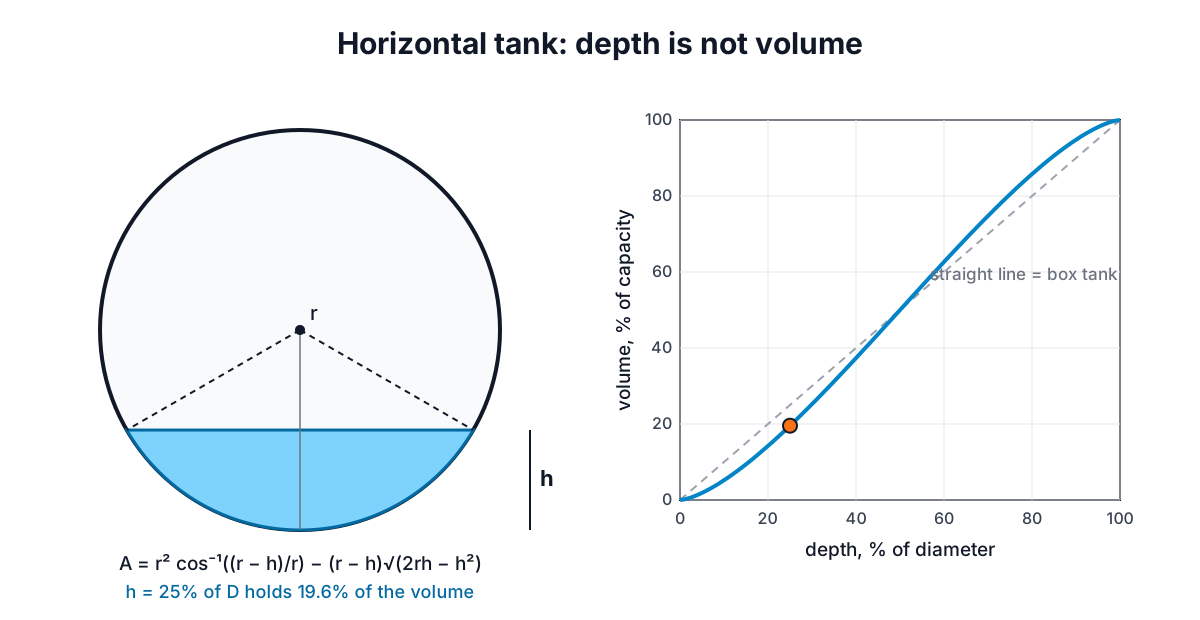
A horizontal tank 1,200 mm in diameter and 2,400 mm long holds 2,714 litres; at 300 mm deep, a quarter of the height, it holds only 531 litres, 19.6%. Choose "horizontal cylinder" in the calculator for any tank lying down. Poly tanks with domed tops and bottoms are close to proportional through the straight-sided middle but not in the domes; for those, use the maker's chart near empty and near full.
Dip charts for a level stick
For a tank you check often, print a dip chart from the calculator at 100 mm steps and mark a stick or the side of a sight tube with litres. For an upright tank every mark is the same number of litres apart, so you need only one figure (268.8 litres per 100 mm for the 1,850 mm tank). For a horizontal tank the marks bunch up near the middle, so print the whole table.
Common mistakes
- Using the outside diameter of a ribbed poly tank.
- Forgetting the outlet height. Water below the outlet is not usable; measure usable depth from the outlet up.
- Assuming a horizontal tank is proportional. A quarter of the height is under a fifth of the volume.
- Ignoring weight on a stand or slab. Allow a tonne per 1,000 litres plus the tank.
Tools for this job
- Rainwater Tank Volume Calculator (Australia): litres at any level, depth for a target volume and a printable dip chart.
- Hydrostatic Pressure Calculator: the pressure a tank gives at a tap below it; the hydrostatic pressure guide explains the physics.
- Volume Calculator: other shapes.
- Unit Converter: litres, cubic metres and gallons.
Frequently asked questions
How many litres are in my round water tank?
π x radius² x water depth, in metres, times 1,000. A tank 1,850 mm across with water 800 mm deep holds 2,150 litres, and every 100 mm of depth is 268.8 litres.
How much water will 10 mm of rain put in my tank?
About 1 litre per square metre of connected roof per millimetre, before losses. With 112.5 m² of roof connected, 10 mm of rain is up to 1,125 litres, which raises the level in an 1,850 mm round tank by about 419 mm.
Do I need council approval for a rainwater tank?
In Sydney Water's area, tanks up to 10,000 litres don't normally need council approval if set conditions are met; check the NSW Housing Code and your council. Elsewhere, ask your council.
How heavy is a full rainwater tank?
About a tonne per 1,000 litres of water, plus the tank. A 5,376 litre tank carries about 5.4 tonnes of water when full.
Sources and further reading
- Rainwater tanks, Sydney Water. Minimum 2,000 litres connected to 75% of roof, 1,000 litres weighs 1 tonne, approval up to 10,000 litres, pumps, inspections, backflow and up to 40% savings.
- Circular Segment, Wolfram MathWorld. The formula for a tank lying on its side.
- Spherical Cap, Wolfram MathWorld. The volume of domed tank ends.
- NIST Guide to the SI, Appendix B.9, National Institute of Standards and Technology. Exact factors for litres, cubic metres and gallons.
- Water Pressure Management Program, Sydney Water. Network average of 52 metres head and a 15 metres head minimum at the connection, the pressure a tank pump is compared with.
Open the Tank Volume Calculator
More Fluid Mechanics
Every tool in the Fluid Mechanics section, free and in your browser.