
Water Tank Litres from the Water Level: Formulas (SA)
Litres in a round or rectangular water tank from the level, how long a backup tank lasts, rain catch per roof, and the Cape Town approval and air-gap rules.
By Redbison Dev · · 10 min read

South Africa edition. Written for South African homes with rainwater or backup tanks: millimetres and litres in local number format, days of supply during an interruption, and the City of Cape Town's guidelines on approvals, stands, site-built tanks, air gaps and permitted uses of rainwater. US edition
If your home has a water tank, to catch rain off the roof or as a reserve for when the municipal supply is interrupted, the question is the same either way: how many litres are left, and how long will they last? For an upright round tank, or a rectangular one, the answer is simple: the litres rise in a straight line with the water level. This edition gives the formulas, works through a backup tank during an outage, shows how much a shower of rain adds, and covers the City of Cape Town's rules on which tanks need approval. Every figure comes from the Water Tank Volume Calculator (South Africa).
Upright round tanks
For a vertical cylinder with inside diameter D and water depth h, in metres:
litres = π x (D/2)² x h x 1 000
A round plastic tank 1 800 mm across and 2 000 mm high inside:
- Capacity: π x 0,9² x 2,0 = 5,089 m³ = 5 089 litres.
- Every 10 mm of depth is 25,4 litres; every 100 mm is 254 litres.
- With water 600 mm deep: 1 527 litres, 30% full.
Measure inside if you can. Ribbed tanks lose a little volume to the ribs, so if the rated capacity on the tank differs from your measurement, trust the rating for the total and use the calculator for the level.
Worked example: how long a backup tank lasts
The supply is off and the tank above reads 600 mm. Suppose the household uses 350 litres a day while the taps are dry (a premise for the example; use your own meter readings).
- Water in the tank: 1 527 litres.
- Days of supply: 1 527 / 350 = 4,4 days.
- Water below the outlet does not reach the house. If the outlet is 100 mm above the floor of the tank, the usable water is 1 527 − 254 = 1 272 litres (from the unrounded 1 526,8 and 254,5), or 3,6 days.
To set a refill or alarm level, use the calculator's "depth for a volume" field: one day's 350 litres in this tank is about 138 mm of depth.
How much rain fills it
The City of Cape Town's page on alternative water sources gives the rule of thumb: if 5 mm of rain falls on a 100 m² roof, you can collect 500 litres. That is one litre per square metre per millimetre, before losses.
In the 1 800 mm tank, 500 litres raises the level by 196 mm, from 600 mm to about 796 mm. The same page notes that in a winter rainfall area a 5 000 litre tank used mainly for toilet flushing could save up to 15% a year.
Which tanks need approval in Cape Town
The City's guidelines for the installation of alternative water systems (section 6) require building compliance approval for:
- any storage tank with a capacity of more than 10 000 litres per single tank;
- tanks of more than 1 000 litres built on site from masonry, concrete, steel and similar;
- any tank on a supporting structure more than 1 m above the surrounding ground;
- any installation the City's building control officer considers needs it.
The calculator makes the capacity tests quick:
| Tank (inside) | Capacity | Approval in Cape Town? |
|---|---|---|
| Round, 2 200 mm x 2 600 mm high | 9 883 litres | Not on size alone |
| Round, 2 200 mm x 2 700 mm high | 10 264 litres | Yes, over 10 000 litres |
| Round, 1 000 mm x 1 300 mm high on a 1,5 m stand | 1 021 litres | Yes, stand over 1 m |
| Rectangular brick or concrete, 2 000 x 1 500 x 1 200 mm | 3 600 litres | Yes, site-built over 1 000 litres |
A hundred millimetres of height moves the 2 200 mm tank across the line. For the tank on a stand, weight is the other reason for care: the 1 021 litres of water alone is about a tonne, sitting 1,5 m up.
On storage, the guidelines say on-site storage is covered by the Department of Water and Sanitation's general authorisation (Notice 538 of 2016) under the National Water Act, and that storage above the general authorisation limits needs registration and may need a licence; they suggest confirming current limits with the DWS regional office.
Top-up from the municipal supply: the air gap
If the tank is also filled from the municipal supply, the guidelines require an air gap: an unobstructed vertical space between where municipal water enters the tank and the level at which the tank would overflow. It must be twice the supply pipe diameter and never less than 25 mm.
- A 20 mm supply pipe needs at least 40 mm of air gap.
- A 10 mm pipe still needs 25 mm, the minimum.
Set the float valve so the highest water level sits that far below the inlet, and check that the overflow can carry the full inflow.
What the water can be used for
The City's page says rainwater should not be used for drinking, food preparation or body washing, and notes that it can contain particles including droppings from rodents and birds. It can be used for laundry, gardens, cleaning outdoor surfaces, topping up a pool and feeding a toilet cistern. Signage is required when harvesting rainwater, and a system plumbed into the home needs the City's permission through its application process.
Tanks lying on their side
A tank lying down does not fill in a straight line. The water forms a circular segment:
V = L x [ r² cos⁻¹((r − h) / r) − (r − h) √(2rh − h²) ]
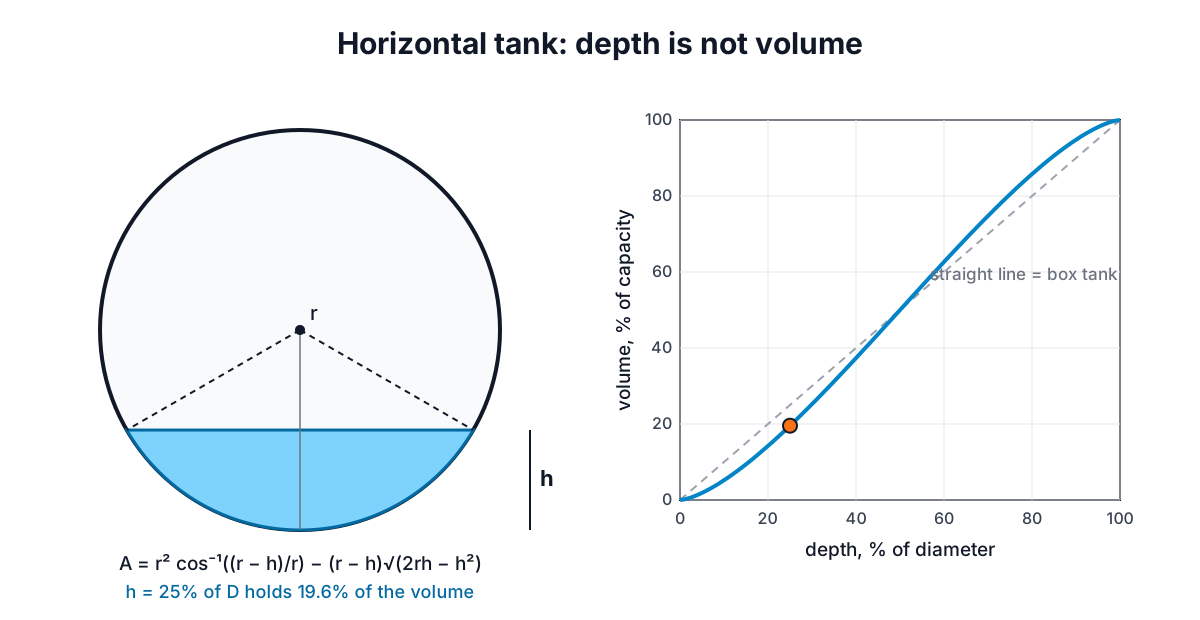
A horizontal tank 1 000 mm in diameter and 1 500 mm long holds 1 178 litres; at 250 mm deep, a quarter of the height, it holds only 230 litres, 19,6%. Choose "horizontal cylinder" in the calculator for it, and print the dip chart to mark a stick.
Common mistakes
- Counting water below the outlet as usable during an outage.
- Using the outside diameter of a ribbed tank.
- Building a tall stand without approval because the tank is small.
- Skipping the air gap on a tank topped up from the municipal supply.
- Assuming a tank on its side is proportional. A quarter of the height is under a fifth of the water.
Tools for this job
- Water Tank Volume Calculator (South Africa): litres at any level, depth for a volume and a dip chart.
- Hydrostatic Pressure Calculator: the pressure a tank on a stand gives at a tap; see the hydrostatic pressure guide.
- Volume Calculator: other shapes.
- Unit Converter: litres and cubic metres.
Frequently asked questions
How many litres are in my water tank?
For an upright round tank, π x radius² x water depth in metres, times 1 000. A tank 1 800 mm across holds 25,4 litres for every 10 mm of depth, so 600 mm of water is 1 527 litres.
How long will my backup tank last when the water is off?
Divide the usable litres by your daily use. At 350 litres a day, 1 527 litres lasts about 4,4 days, or 3,6 days if the bottom 100 mm is below the outlet.
Do I need approval for a water tank in Cape Town?
Yes for a single tank over 10 000 litres, a site-built tank over 1 000 litres, any tank on a stand more than 1 m above the ground, or where the building control officer requires it. Plumbing rainwater into the house also needs the City's permission.
Can I drink rainwater from my tank in Cape Town?
The City says rainwater should not be used for drinking, food preparation or body washing. It can be used for toilets, laundry, gardens, pools and cleaning.
Sources and further reading
- Alternative water sources, City of Cape Town. 500 litres from 5 mm of rain on 100 m², permitted uses, signage and permission for plumbed systems.
- Guidelines for the installation of alternative water systems in Cape Town, City of Cape Town. Section 6 approvals (10 000 litres, site-built over 1 000 litres, stands over 1 m), the DWS general authorisation, the air gap and the 15% saving example.
- Circular Segment, Wolfram MathWorld. The formula for a tank lying on its side.
- Spherical Cap, Wolfram MathWorld. Domed tank ends.
- NIST Guide to the SI, Appendix B.9, National Institute of Standards and Technology. Exact factors for litres and cubic metres.
Open the Tank Volume Calculator
More Fluid Mechanics
Every tool in the Fluid Mechanics section, free and in your browser.