
Earthwork Calculation: Cutting, Filling and Plot Levelling
Calculate earthwork in cutting and filling in cum from reduced levels or chainage sections, with IS 1200 measurement rules, borrow earth, lead and lift.
By Redbison Dev · · 11 min read
India edition. Quantities in cum from reduced levels, IS 1200 (Part 1) rules for measurement, borrow pits, lead and lift, a plot-filling example and a road embankment measured by chainage. US edition
Two earthwork questions come up again and again on Indian sites. An owner with a plot below road level wants to know how much earth to bring in before the plinth, and an engineer preparing an estimate or a running bill needs the cutting and filling quantities in cubic metres, measured the way the contract says. Both start from reduced levels (RLs) taken with an auto level or total station, and both are answered by the earthwork cutting and filling calculator. This guide shows the working, the IS 1200 rules behind the measurement, and where the quantity on paper differs from the quantity that arrives in the tipper.
What IS 1200 says about measuring earthwork
Most Indian schedules of rates and tender documents measure earthwork to IS 1200 (Part 1), the Bureau of Indian Standards method of measurement for earthwork. The points that matter for a calculation are:
- Measured in the ground, not loose. Clause 4.1 says earthwork is measured in cubic metres from the authorised dimensions, "without allowance for increase in bulk". Bulking affects how many trucks you need, not what is paid.
- Levels before and after. For uneven ground, clause 4.2 asks for levels before the start, after site clearance and after completion, and the cutting quantity is worked out from them. Filling is computed from the levels of the original ground and of the compacted fill (clause 4.3.1).
- Borrow earth. Fill brought from a borrow pit is measured as excavation in the pit (clause 4.3.3), not as fill.
- Stacks. Where material is measured in stacks, an agreed percentage is deducted for voids, fixed in advance.
- Lead. Clause 5.1 measures lead, the carrying distance, in units of 50 m up to 250 m. Leads above 250 m and up to 500 m are a separate item, then 500 m units, then 1 km units beyond 5 km.
- Lift. Excavation up to 1.5 m below ground is part of the main item; extra lift is measured in units of 1.5 m (clause 5.2).
So the calculator's "cut" is exactly the quantity IS 1200 pays for, and its "fill" is the consolidated quantity. The swell and shrinkage boxes are there for planning the haulage.
Plot filling from reduced levels
The calculator's Indian example is a 15 m x 15 m plot (about 2,420 sq ft) sitting below the road. Levels on a 5 m grid run from 100.45 m at the road corner down to 99.80 m at the back, and the plot is to be filled to 100.60 m before the plinth is started.
Each 5 m x 5 m square is a block of earth whose depth is the mean of its four corner depths below 100.60. Where a square has some corners in cutting and some in filling, the calculator splits it so that both quantities are counted instead of cancelling out:
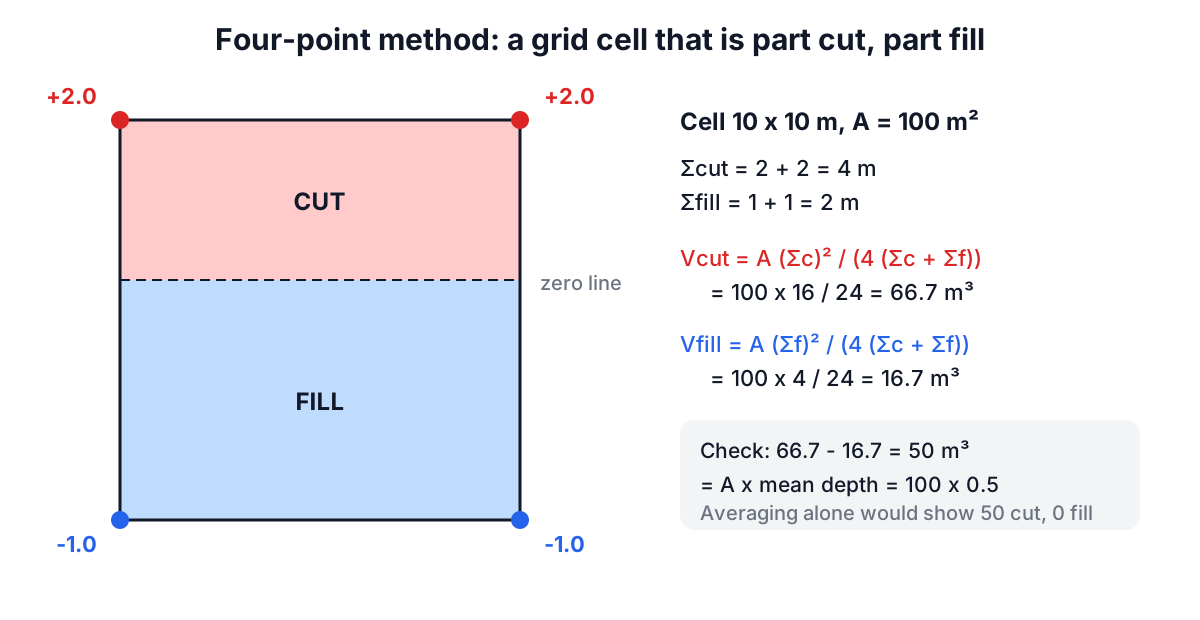
Nine squares add up to:
| Formation level | Cutting | Filling (consolidated) | Earth to bring (measured in the borrow pit) | Loose, at 25% bulking |
|---|---|---|---|---|
| 100.60 m | 0 | 107.5 cum | 119.4 cum | 149.3 cum |
| 100.30 m | 1.1 cum | 41.1 cum | 44.6 cum net import | 55.7 cum |
| 100.15 m | 10.2 cum | 16.4 cum | 8.1 cum net import | 10.1 cum |
At 100.60 m every square is in filling, so all 107.5 cum has to come from outside. Because compacted fill is denser than the same earth in the pit, at 10% shrinkage it takes 107.5 / 0.9 = 119.4 cum of borrow earth, and that earth loosens by about a quarter in the vehicle, so roughly 149 cum is carried.
Lowering the formation saves earth but has a cost of its own: the plinth must still stand above the road and the drain, or the house will collect water from the street every monsoon. Fix the plinth level first, then use the table to see what each choice of formation means in earth.
Converting to truckloads and brass
Suppliers rarely sell earth by the cum measured in the pit. Dumpers and tractor trolleys are loaded loose, so the loose figure is the one to use when counting trips. In Maharashtra and some neighbouring states, murrum and earth are traded by the brass, which is 100 cubic feet or 2.832 cum. The 149.3 cum of loose earth for the plot is about 52.7 brass.
If your supplier quotes per trip, ask how many cum or brass a trip carries for this material and divide. Keep the measurement sheets for the bill separate: the contract quantity is still the 119.4 cum in the borrow pit or the 107.5 cum consolidated, whichever the item specifies.
A road embankment by chainage
Roads, bunds and canals are measured from cross-sections at regular chainages. At each section the cutting area and filling area are taken from the drawing, and the volume between sections is worked out from those areas. Here is a village approach road built up on an embankment, with sections every 30 m:
| Chainage | Cutting area | Filling area |
|---|---|---|
| 0 | 0 | 8.4 m² |
| 30 | 0 | 11.2 m² |
| 60 | 1.6 m² | 6.3 m² |
| 90 | 4.8 m² | 1.2 m² |
| 120 | 7.5 m² | 0 |
The calculator gives two answers:
- Trapezoidal (average end area) method: 304.5 cum of cutting and 687.0 cum of filling.
- Prismoidal formula, which needs an odd number of equally spaced sections: 299.0 cum of cutting and 706.0 cum of filling.
The 19 cum difference in filling is about 3%. IS 1200 tells you to compute quantities from levels and sections but does not choose the formula, so follow the method the contract or the department's practice specifies. The trapezoidal method has the practical advantage that it works with any spacing and any number of sections.
The road is short of earth. At 10% shrinkage the 706.0 cum of compacted filling needs 784.4 cum of earth in place, and the cutting supplies only 299.0, so about 485 cum must come from a borrow area, about 607 cum loose. That borrow earth is then paid as excavation in the pit, with its own lead.
Lead, lift and what changes the cost
With the quantity fixed, cost depends on how far and how high the earth moves:
- Most schedules include a lead of 50 m and a lift of 1.5 m in the basic earthwork item. A borrow area 400 m away therefore attracts a separate lead item, because IS 1200 treats leads above 250 m and up to 500 m as their own unit.
- Excavation deeper than 1.5 m below ground earns extra lift in 1.5 m steps, which matters for foundations, sumps and septic tanks.
- Rock, hard murrum and soft soil are separate classifications with different rates, so measure them separately where the levels show a change of strata.
Common mistakes
- Paying for loose volume. Measuring the heap delivered on site, without the agreed voids deduction, overstates the quantity by the bulking.
- Ignoring the top layer. Vegetation, roots and black cotton topsoil are removed before filling and are not suitable fill under a floor.
- Filling in one go. The shrinkage figure assumes the fill is laid in layers, watered and compacted. Dumped and levelled earth settles for years.
- Too few levels. The grid method assumes the ground is flat between points; take extra levels at every bund, pit and change of slope.
Tools for this job
The earthwork cutting and filling calculator handles grids, cross-sections and bulking. The Slope Calculator converts level differences into gradients for drains and ramps, and the Concrete Calculator takes over at the footings. For the stone and murrum layers that follow the earthwork, the Gravel and Mulch Calculator estimates volume and tonnage, and the guide to grid, end area and prismoidal methods explains the formulas in more detail.
Frequently asked questions
How much earth is needed to fill a 15 m x 15 m plot?
It depends on the levels. For the example plot with RLs from 99.80 to 100.45 m filled to 100.60 m, the consolidated filling is 107.5 cum. At 10% shrinkage that needs 119.4 cum of earth measured in the borrow pit, or about 149 cum loose in the vehicles.
Is earthwork paid on loose or compacted quantity?
IS 1200 (Part 1) measures excavation in the ground without any allowance for bulking, and filling from levels of the compacted fill. Earth brought from a borrow pit is measured as excavation in the pit. Material measured in stacks gets an agreed deduction for voids.
What is the difference between the trapezoidal and prismoidal formula?
The trapezoidal (average end area) formula multiplies each interval by the mean of its two end areas. The prismoidal formula also uses the middle section and needs an odd number of equally spaced sections. On the example road they give 687.0 and 706.0 cum of filling.
How is lead measured in earthwork?
Over the shortest practicable route, in units of 50 m up to 250 m. Leads above 250 m and up to 500 m form a separate item, then the unit becomes 500 m, and beyond 5 km it is 1 km.
Sources and further reading
- IS 1200 (Part 1):1992, Methods of measurement of building and civil engineering works: Earthwork, Bureau of Indian Standards (public copy). Clauses 4.1 to 4.3 on measurement and 5.1 and 5.2 on lead and lift.
- Technical specifications for civil works, Part 2, State Bank of India. Earthwork items measured to IS 1200 with disposal within a 50 m lead.
- Earthwork Design, US Federal Highway Administration. Average end area volumes and shrink and swell factors.
- DLMF 3.5: Quadrature, National Institute of Standards and Technology. Simpson's rule behind the prismoidal formula.
- Prismatoid, Wolfram MathWorld. The prismoidal volume formula.
Open the Cut and Fill Calculator
More Civil & Structural
Every tool in the Civil & Structural section, free and in your browser.