
Cut and Fill on a Sloping Block: Pad Levels and Spoil
Work out cut and fill for a house pad on a sloping block, why equal volumes still leave you short, and the NCC limits on fill under a slab.
By Redbison Dev · · 11 min read

Australia edition. Metric levels and cubic metres for a sloping-block house pad, the NCC 2025 Housing Provisions limits on controlled and rolled fill under slabs, and the NSW EPA rules for moving excavated natural material. US edition
Building on a sloping block in Australia almost always starts with a cut and fill pad: dig into the high side, place fill on the low side, and set the slab on the level platform in between. The questions a builder, owner or excavator asks are practical ones. At what pad level do cut and fill balance? How much spoil has to go if they do not? And how deep can the fill be before the slab needs an engineer? The Australian cut and fill calculator answers the first two from your levels; the National Construction Code answers the third.
Levels and the pad
A contour or spot-level survey of the building platform is the starting point, ideally on a grid of 5 m or less with extra levels at any break of slope. The pad level is the underside of the slab system: finished floor level less the slab, sand bed or stone layer below it. Depth at each point is natural surface level minus pad level, positive for cut, negative for fill.
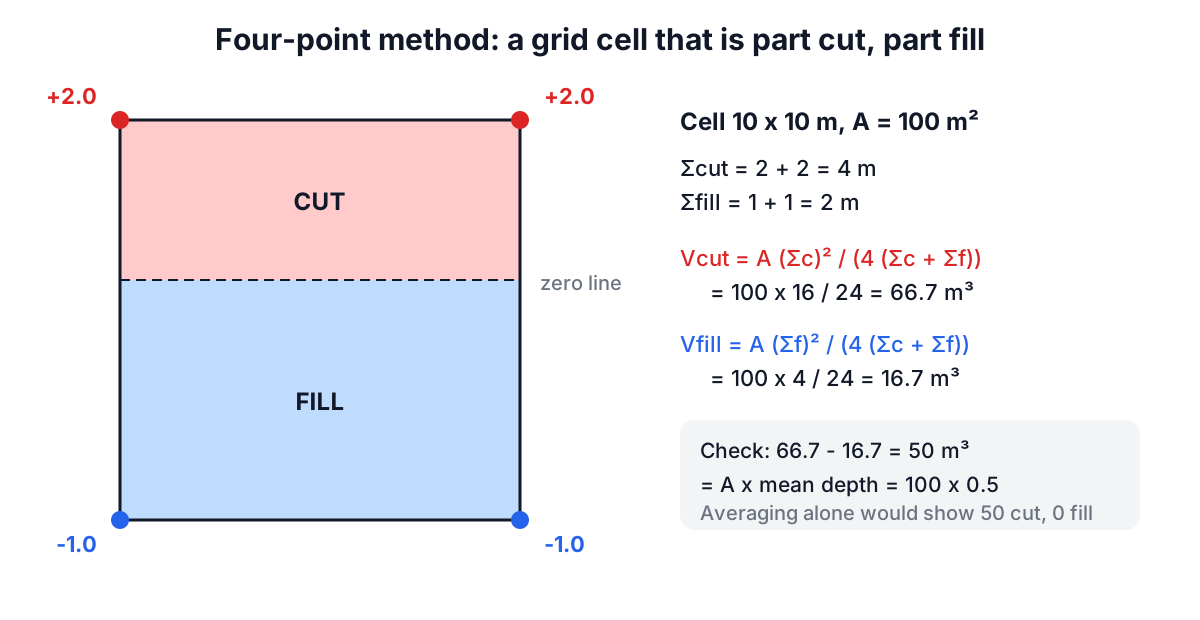
The calculator treats each grid square as a block of soil whose depth is the average of its four corners, splits squares that cross from cut to fill so both are counted, and adds them up. This is how a split square works:
The default block: a 15 x 10 m pad
The Australian example is a 15 x 10 m house pad, 150 m², on a block falling 1.1 m across it: levels run from 52.40 m on the high corner to 51.30 m on the low corner, surveyed on a 5 m grid. With 25% bulking for spoil and 10% compaction shrinkage for fill:
| Pad level | Cut (in the ground) | Fill (compacted) | Deepest fill | Balance in the ground | Loose |
|---|---|---|---|---|---|
| 51.85 m | 17.1 m³ | 17.1 m³ | 0.55 m | short 1.9 m³ | import 2.4 m³ |
| 51.75 m | 25.5 m³ | 10.5 m³ | 0.45 m | spare 13.8 m³ | spoil 17.3 m³ |
| 51.70 m | 30.2 m³ | 7.7 m³ | 0.40 m | spare 21.6 m³ | spoil 27.1 m³ |
| 51.60 m | 41.0 m³ | 3.5 m³ | 0.30 m | spare 37.1 m³ | spoil 46.4 m³ |
Why equal cut and fill still leaves you short
At 51.85 m the cut and fill are both 17.1 m³, which looks like the perfect balance. It is not. Fill is placed in layers and compacted, so it ends up denser than it was in the ground, and 17.1 m³ of compacted fill needs 17.1 / 0.9 = 19.0 m³ of cut soil. The pad is 1.9 m³ short in the ground, about 2.4 m³ once loosened in a truck.
That gap is small here, but on a larger pad it is the classic reason a "balanced" design ends with a load of fill being trucked in. Balance on compacted fill, not on raw volumes.
How deep can fill under a slab be?
This is where Australian rules shape the pad level. The ABCB Housing Provisions in NCC 2025, clause 4.2.4, say fill under a slab on ground must be controlled fill or rolled fill, with limits on depth and layer thickness:
| Fill type | Sand | Clay |
|---|---|---|
| Controlled fill | up to 800 mm, in layers of 300 mm or less, by vibrating plate or roller | up to 400 mm, in layers of 150 mm or less, by mechanical roller |
| Rolled fill | up to 600 mm, in layers of 300 mm or less, rolled with an excavator or similar | up to 300 mm, in layers of 150 mm or less |
The clause also asks for a level layer of clean quarry sand at least 20 mm deep on top of the fill (or a graded stone termite management system). Fill deeper than these limits falls outside the deemed-to-satisfy housing provisions and needs to be designed and placed to the engineering route the Code points to, which in practice means an engineer's specification and compaction testing.
Now look at the table again. At 51.85 m the deepest fill, at the low corner, is 0.55 m. If the fill is clay, that is beyond the 400 mm controlled fill limit. At 51.70 m the deepest fill is exactly 0.40 m, so a clay pad at that level stays inside the limit, at the cost of 21.6 m³ of spare cut and 27.1 m³ of loose spoil to take away. Raising the pad and paying an engineer for deeper fill, or lowering it and paying for spoil removal and a taller cut batter or retaining wall, is the real trade-off on most sloping blocks.
The site classification under AS 2870 matters too. The Housing Provisions describe classes from A (sand and rock with little ground movement) through S, M, H and E for increasingly reactive clay, to P for problem sites, and note that filled sites are classified according to AS 2870. Your soil report sets the class and the slab design follows from it.
Where the spoil goes
Spoil removal is priced per load or per tonne, and a load is loose volume. At 51.60 m the 37.1 m³ of spare cut becomes 46.4 m³ in the truck. Ask your excavator what a load holds for your soil before turning cubic metres into trips.
If the soil is clean natural material, it may have a second life. In NSW, the EPA's excavated natural material order and exemption allow soil that meets the testing and chemical requirements to be applied to other land as engineering fill or in earthworks, with the person receiving it keeping records for six years. Material that does not qualify is waste and must go to a lawful facility. Other states have their own fill rules, so check with your state environment regulator before soil leaves the block.
Driveways and long cuts
Driveways and access tracks are better measured as cross-sections at chainages than as a grid. Enter the cut and fill area at each chainage and the calculator gives the average end area volume and, for an odd number of equally spaced sections, the prismoidal (Simpson's rule) volume. The two can differ by several per cent; for quotes, use the method your contract or engineer specifies.
Mistakes that cost money on a sloping block
- Forgetting the slab build-up. Using finished floor level as the pad level undercounts cut by the full slab and sand depth over the whole house.
- Treating topsoil as fill. Strip it, stockpile it for the garden, and do not count it in the balance.
- Ignoring batters. A cut into the high side needs a stable batter or a retaining wall, which takes extra digging beyond the pad edge. Council and state planning rules often limit cut and fill near boundaries.
- Too coarse a grid. A 10 m grid on a 15 m pad can miss the very slope you are building on.
Tools for this job
The Australian cut and fill calculator handles grids, chainages and bulking. The Slope Calculator turns level differences into the gradient of a block or driveway, the Concrete Calculator estimates the slab and footings once the pad is set, and the Gravel and Mulch Calculator sizes stone and sand layers. For the paving afterwards, Asphalt Tonnage for Driveways covers the surface.
Frequently asked questions
How much fill can go under a house slab without an engineer?
Under NCC 2025 Housing Provisions clause 4.2.4, controlled fill can be up to 800 mm of sand in 300 mm layers or 400 mm of clay in 150 mm layers, and rolled fill up to 600 mm of sand or 300 mm of clay. Deeper fill needs to be designed and placed to the Code's engineering route.
Why is my sloping block short of fill when cut equals fill?
Because compacted fill needs more than its own volume of dug soil. With 10% shrinkage, 17.1 m³ of fill needs 19.0 m³ of cut, so equal volumes leave you 1.9 m³ short.
What pad level keeps clay fill within the 400 mm limit?
On the example block, a pad at 51.70 m puts the deepest fill at exactly 0.40 m. That leaves 21.6 m³ of spare cut, about 27.1 m³ of loose spoil to remove at 25% bulking.
Can I give my excavated soil away as fill in NSW?
Only if it qualifies as excavated natural material under the NSW EPA order and exemption, which sets testing and chemical requirements and requires the receiver to keep records for six years. Otherwise it is waste and goes to a lawful facility.
Sources and further reading
- Housing Provisions Part 4.2: Footings, slabs and associated elements, Australian Building Codes Board, NCC 2025. Clause 4.2.4 on controlled and rolled fill; clause 4.2.2 on site classification.
- Resource recovery exemption: excavated natural material, NSW Environment Protection Authority. Use as engineering fill and six-year records.
- Current resource recovery orders and exemptions, NSW Environment Protection Authority.
- Earthwork Design, US Federal Highway Administration. Shrink and swell factors and average end area volumes.
- DLMF 3.5: Quadrature, National Institute of Standards and Technology. Simpson's rule behind the prismoidal method.
Open the Cut and Fill Calculator
More Civil & Structural
Every tool in the Civil & Structural section, free and in your browser.