
Cut and Fill in Canada: Grading Volumes and Excess Soil
Grading cut and fill in cubic metres and cubic yards from an elevation grid or stations, plus Ontario's excess soil rules for loads that leave the site.
By Redbison Dev · · 11 min read

Canada edition. Metric elevations with cubic yards alongside for trucking, stationing in the 0+000 form, and Ontario Regulation 406/19 on excess soil, including the 2,000 m³ planning trigger and the 2027 landfill restriction. US edition
Grading plans in Canada are drawn in metres, yet the trucking quote that follows is often in cubic yards, and in Ontario the soil that leaves the site now carries paperwork of its own. A useful earthwork estimate therefore answers three questions: how much cut and fill the pad needs in bank and compacted volume, how many cubic yards of loose material the trucks will move, and whether the export is large enough to trigger provincial excess soil rules. This guide answers all three with the Canadian cut and fill calculator, using a commercial pad and then a short road measured by stations.
Elevations, pad elevation and what "cut" means
The topographic survey gives existing elevations on a grid or at shots across the site. The grading plan gives the proposed elevation of the pad, which for an estimate is the subgrade: the top of the prepared ground under the granular base and asphalt or slab. Cut or fill at each point is existing minus proposed. A positive value is cut; a negative one is fill.
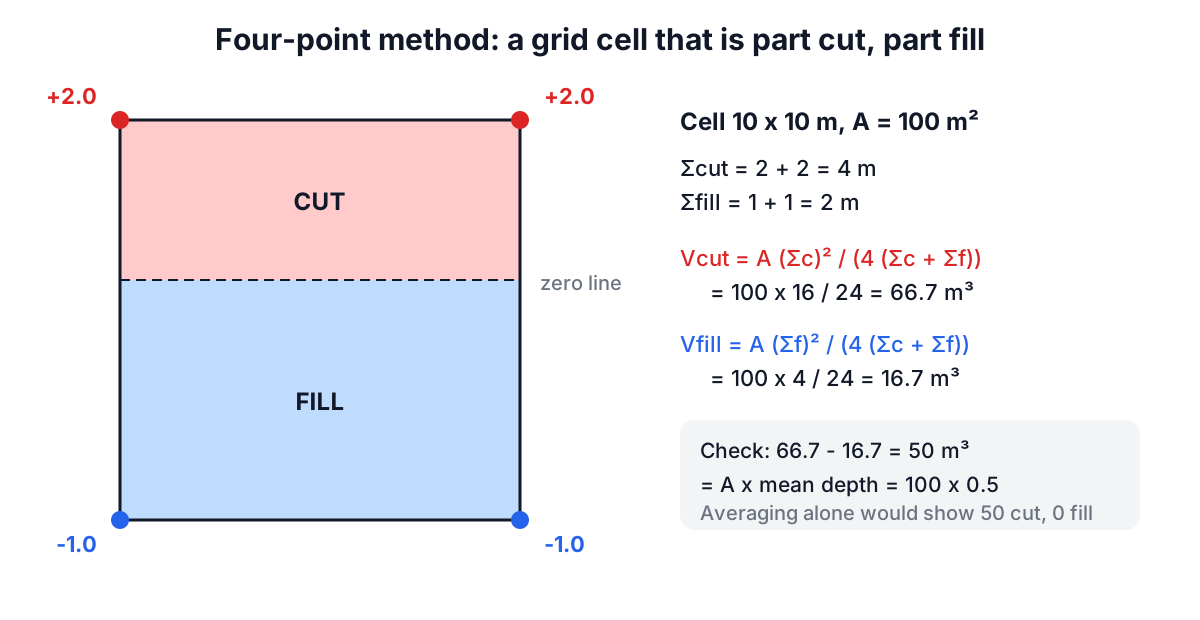
The calculator splits the site into grid cells, uses the four corner depths of each, and splits any cell that changes from cut to fill so both are counted. It reports cut as bank volume (in place) and fill as compacted volume, then applies swell and shrinkage to find the export or import.
A 40 x 30 m commercial pad
The Canadian default is a 40 x 30 m pad, 1,200 m², surveyed on a 10 m grid with elevations from 210.6 m down to 209.3 m. Here is how the pad elevation changes the earthwork, at 25% swell and 10% shrinkage:
| Pad elevation | Cut (bank) | Fill (compacted) | Surplus (bank) | Export (loose) | Export (loose) |
|---|---|---|---|---|---|
| 209.70 m | 324.7 m³ | 44.7 m³ | 275.0 m³ | 343.8 m³ | 449.7 yd³ |
| 209.80 m | 240.7 m³ | 80.7 m³ | 151.0 m³ | 188.8 m³ | 246.9 yd³ |
| 209.90 m | 168.1 m³ | 128.1 m³ | 25.8 m³ | 32.2 m³ | 42.1 yd³ |
| 210.00 m | 109.2 m³ | 189.2 m³ | -101.0 m³ | import 126.3 m³ | import 165.2 yd³ |
Two patterns stand out. First, at 209.90 m the cut is 40 m³ larger than the fill, yet the site barely balances, because 128.1 m³ of compacted fill needs 142.4 m³ of cut once 10% shrinkage is allowed for. Second, each 100 mm change in pad elevation over 1,200 m² moves the balance by roughly 120 m³ of bank soil, about 150 m³ loose, or 16 loads in trucks carrying 12 yd³.
For trucking, convert the loose figure. At 209.80 m the export is 188.8 m³, or 246.9 yd³ (one cubic metre is 1.308 cubic yards). If your hauler's trucks carry about 12 yd³ of loose soil each, that is 21 loads. Use the number the hauler gives you for the actual material: wet clay may be limited by weight long before the box is full.
When soil leaves the site in Ontario
Ontario Regulation 406/19, On-Site and Excess Soil Management, governs soil that leaves a project. Its reuse planning requirements took effect on January 1, 2023. In outline, from the Ontario government's fact sheets:
- The 2,000 m³ trigger. Projects in a settlement area that generate 2,000 m³ or more of excess soil must meet the planning requirements. Projects whose whole site was most recently used for residential, agricultural, parkland or institutional purposes, and rural projects outside settlement areas, are generally excluded from that trigger. Enhanced investigation sites, such as former gas stations or industrial land, can trigger at lower volumes.
- Registry notice. The project leader files a notice in the Excess Soil Registry before any excess soil leaves, and updates it when new deposit sites are added and within 30 days of completion.
- Qualified person. A professional engineer or professional geoscientist completes or supervises the assessment of past uses, the sampling plan and the soil characterization.
- Tracking. A system must account for every load's quality, quantity and destination. A hauling record travels with each load, is updated on arrival and is kept for two years.
- Landfill restriction. From January 1, 2027, excess soil that meets Table 2.1 standards or cleaner generally cannot be sent to a landfill or dump, subject to exceptions.
Against those rules, the pad exports between 25.8 and 275.0 m³ of bank soil depending on its elevation, far below the 2,000 m³ trigger. A project of that size still has to send soil to a site that can lawfully accept it, and once the 2027 restriction applies, clean soil will need a reuse destination rather than a landfill. That makes the balanced option at 209.90 m worth a serious look.
Other provinces set their own rules for soil movement and fill sites, and many municipalities have fill or site alteration bylaws, so check locally outside Ontario.
A short road by stations
Roads and ditches are measured from cross-sections at stations along the centreline, written 0+000, 0+020 and so on. At each station the designer measures the cut area and the fill area between existing ground and the template. Here is an 80 m access road leaving a cut into a fill:
| Station | Cut area | Fill area |
|---|---|---|
| 0+000 | 18.6 m² | 0 |
| 0+020 | 12.4 m² | 0 |
| 0+040 | 5.2 m² | 2.1 m² |
| 0+060 | 0.8 m² | 9.4 m² |
| 0+080 | 0 | 14.7 m² |
- Average end area: 554.0 m³ of cut and 377.0 m³ of fill.
- Prismoidal (Simpson's) rule, with five equally spaced stations: 545.3 m³ of cut and 376.7 m³ of fill.
Average end area runs higher on the cut because the cut tapers towards zero, the shape in which the method overestimates most. Payment usually follows the method named in the contract specification, which for road work is often average end area, so use the prismoidal figure as a check rather than an argument.
With 10% shrinkage the prismoidal fill needs 418.5 m³ of bank cut, leaving 126.8 m³ surplus in place, about 158.5 m³ (207.3 yd³) loose to export.
Practical points on Canadian sites
- Topsoil. Strip and stockpile it separately. Topsoil reused directly as topsoil is one of the exemptions in the Ontario rules, but it is never structural fill.
- Frozen ground. Frozen soil cannot be compacted properly and should not be placed as fill, so winter grading changes both the schedule and the usable volume.
- Swell factors. 20 to 30% is a reasonable starting range for common earth; clay and blasted rock run higher. A geotechnical report beats any rule of thumb on a large site.
- Imperial drawings. Older residential plans may show elevations in feet. Switch the calculator to imperial and it reports in cubic yards directly.
Tools for this job
The Canadian cut and fill calculator handles the grid, the stations and the swell. The Slope Calculator checks driveway and swale grades, and the Gravel and Mulch Calculator estimates granular base once subgrade is reached. For paving afterwards, the Asphalt Tonnage guide works through the surface course, and the US edition of this guide has a drawing of the four-point method for cells that are part cut and part fill.
Frequently asked questions
How do I convert cubic metres of soil to cubic yards?
Multiply by 1.308. The pad's export of 188.8 m³ loose is 246.9 yd³. Convert the loose volume, not the bank volume, when counting truckloads.
Does Ontario's excess soil regulation apply to a house or small commercial site?
The planning requirements apply to projects in settlement areas that generate 2,000 m³ or more of excess soil, with exclusions for sites most recently used for residential, agricultural, parkland or institutional purposes. Smaller projects still have to send soil to a site that can lawfully receive it.
What changes for excess soil in Ontario on January 1, 2027?
From that date, excess soil meeting Table 2.1 standards or cleaner generally cannot be taken to a landfill or dump, subject to exceptions. Clean soil will need a reuse site, so balancing the cut and fill on site becomes more valuable.
Why does my site need fill when the cut is bigger?
Because compacted fill needs more bank material than its own volume. At 10% shrinkage, 128.1 m³ of fill takes 142.4 m³ of cut, so a pad with 168.1 m³ of cut is left with only 25.8 m³ to spare.
Sources and further reading
- Excess soil management and reuse requirements: project areas, Government of Ontario. The 2,000 m³ trigger, Registry notices, qualified persons, hauling records and the 2027 landfill restriction.
- Bringing excess soil to a reuse site, Government of Ontario.
- O. Reg. 406/19: On-Site and Excess Soil Management, Government of Ontario (e-Laws).
- Earthwork Design, US Federal Highway Administration. Average end area volumes and shrink and swell factors.
- DLMF 3.5: Quadrature, National Institute of Standards and Technology. Simpson's rule behind the prismoidal calculation.
Open the Cut and Fill Calculator
More Civil & Structural
Every tool in the Civil & Structural section, free and in your browser.