
Cut and Fill Volumes UK: Levels, Muck Away and Tipping
Work out dig and fill volumes from a grid of levels or chainage sections, add bulking for muck away, and see how landfill tax per tonne changes the bill.
By Redbison Dev · · 11 min read

United Kingdom edition. Levels in metres, volumes in cubic metres, sections by chainage, muck away after bulking, and the HMRC landfill tax rates for 2026 to 2028 with the CL:AIRE route for reusing clean soil. US edition
On a British site the earthworks sum nearly always ends in a muck away quote. You dig, you keep what you can reuse as fill, and whatever is left goes off site in tippers or grab lorries at a price set by loose volume, weight and what the material is. So the useful answer is not just "how many cubic metres", but how many in the ground, how many on the lorry, and how many tonnes at the tip. This edition works through all three with the UK cut and fill calculator, starting from a small extension pad and ending with a farm track measured by chainage.
What the survey gives you
Most domestic and small commercial jobs start with a level survey: spot levels on a regular grid, reduced to ordnance datum or to a site datum such as a manhole cover. Against that sits the formation level from the drawings. Formation is the prepared ground that the sub-base or slab build-up sits on, so if an extension floor has 100 mm of slab, 50 mm of insulation and 150 mm of Type 1 under the finished floor level, formation is 300 mm lower than the FFL and that is the level you dig to.
At every survey point the sum is simply ground level minus formation level. A positive answer is dig, a negative one is fill. The calculator does this at each point, then works square by square.
The extension pad, square by square
The default UK example is a 12 x 8 m pad surveyed on a 4 m grid: three rows of four levels, falling from 45.80 m at the top corner to 45.15 m at the bottom. That makes six squares of 16 m², 96 m² in all.
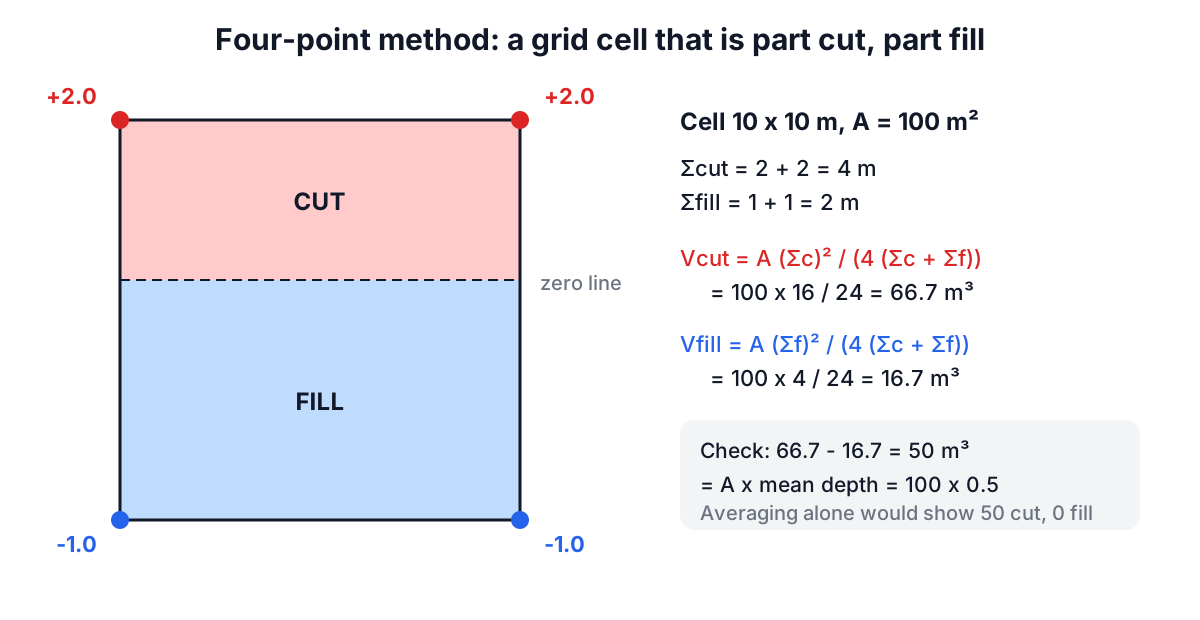
Each square whose four corners are all dig contributes its area times the mean of its four depths. A square whose corners straddle the formation is split with the four-point formulas, so the dig and the fill inside it are both counted instead of cancelling out. On a 10 x 10 m square with two corners 2.0 m above formation and two 1.0 m below, averaging alone would show 50 m³ of dig and no fill; the split gives 66.7 m³ of dig and 16.7 m³ of fill:
At three formation levels, with 25% bulking and 10% shrinkage:
| Formation level | Dig (in the ground) | Fill (compacted) | Surplus in the ground | Muck away at 25% bulking |
|---|---|---|---|---|
| 45.20 m | 26.4 m³ | 0.03 m³ | 26.4 m³ | 33.0 m³ |
| 45.30 m | 17.4 m³ | 0.6 m³ | 16.7 m³ | 20.9 m³ |
| 45.40 m | 9.9 m³ | 2.7 m³ | 6.9 m³ | 8.6 m³ |
Every 100 mm the pad goes up takes roughly 10 m³ out of the dig. Whether you can raise it depends on the damp-proof course, the threshold of the existing house, steps to the garden and drainage falls, so the table is a set of options to discuss with the designer rather than a decision.
Bulking and compaction, in the words of the trade
Groundworkers usually say bulking for what textbooks call swell. Soil dug from the ground loosens and takes up more room in the lorry: 26.4 m³ in the ground at 25% bulking is 33.0 m³ loose, which is the figure a muck away firm wants. Clay and sandy soils often bulk by 20 to 30%; broken rock and chalk can bulk much more, so a site investigation report is worth reading on anything larger than a garden.
Fill goes the other way. Placed in layers and compacted, it ends up denser than it was in the ground, so a metre of compacted fill uses more than a metre of dug soil. At 10% shrinkage the 2.7 m³ of fill at 45.40 m needs 3.0 m³ of dig, which is why the surplus there is 6.9 m³ rather than 7.2 m³.
From cubic metres to tonnes and landfill tax
Tips and transfer stations weigh what you bring, and landfill tax is charged per tonne. The Health and Safety Executive notes in its excavations guidance that a cubic metre of soil can weigh more than 1.5 tonnes, so 1.5 t/m³ in the ground is a sensible lower figure for a first estimate. The weighbridge ticket is the real answer.
HMRC's landfill tax rates, which apply to sites in England and Northern Ireland, are:
| From | Standard rate | Lower rate (qualifying inert material) |
|---|---|---|
| 1 April 2025 | £126.15 per tonne | £4.05 per tonne |
| 1 April 2026 | £130.75 per tonne | £8.65 per tonne |
| 1 April 2027 | £136.70 per tonne | £14.60 per tonne |
Take the pad at 45.20 m: 26.4 m³ at 1.5 t/m³ is 39.6 tonnes. If it qualifies as inert at the lower rate, the tax in the 2026 to 2027 year is 39.6 x £8.65 = £342.54, rising to £578.16 at the April 2027 rate. If the same load were charged at the standard rate, perhaps because it is mixed with rubble, timber or contaminated ground, it would be 39.6 x £130.75 = £5,177.70. The landfill operator pays the tax and recovers it in its charges, which is why clean, separated soil is so much cheaper to get rid of. HMRC's general guide applies to landfill sites in England and Northern Ireland: Landfill Tax was devolved to Scotland from 1 April 2015, and sites in Wales pay Landfill Disposals Tax instead, so check the rate where the tip is.
The cheapest muck away is often none. Under the CL:AIRE Definition of Waste Code of Practice, clean natural soil can be reused on the site where it was dug, moved directly to another site that needs it, or shared within a cluster of projects, without being treated as waste, provided the scheme's conditions are met. On larger jobs that can turn a cost into a saving for the receiving site.
A farm track by chainage
Linear work, such as an access road, a track or a drainage channel, is set out along a centreline and surveyed as cross-sections at chainages. At each one the engineer measures the area of dig and the area of fill between existing ground and the design profile. Here is a track cut into a hillside, with sections every 20 m:
| Chainage | Dig area | Fill area |
|---|---|---|
| 0+000 | 4.2 m² | 0.6 m² |
| 0+020 | 6.8 m² | 0 |
| 0+040 | 5.1 m² | 0.9 m² |
| 0+060 | 2.4 m² | 3.5 m² |
| 0+080 | 0 | 5.8 m² |
The calculator's cross-section mode gives both standard answers:
- Average end area (each 20 m length times the mean of its two end areas): 328.0 m³ of dig, 152.0 m³ of fill.
- Prismoidal rule (Simpson's rule, possible because the five sections are equally spaced): 341.3 m³ of dig, 148.0 m³ of fill.
Notice that here the prismoidal rule gives more dig, not less. Average end area overstates volume where the section shrinks to a point and understates it where the areas bulge between the ends, as they do around chainage 0+020. Neither method is "the" right one in a contract: the bill of quantities or the method of measurement it names decides which is paid, so read it before arguing about 13 m³.
Balancing the track at 10% shrinkage, the 148.0 m³ of fill needs 164.4 m³ of dig, leaving 176.9 m³ surplus in the ground, about 221 m³ loose. That is a lot of lorries for a farm, so the usual next step is to see whether the surplus can be spread on the same land, which brings you back to the CL:AIRE code.
Things that move the numbers on UK sites
- Topsoil. Strip it first and stockpile it for reuse. It is a separate item on almost every quote and must never go under a slab.
- Soft spots and made ground. Old foundations, buried rubble and organic material dug out of the formation are not fill and often go off site at a different rate.
- Water. Wet clay compacts badly and bulks unpredictably; a winter dig can produce more loose volume and less usable fill than the same dig in summer.
- Safety. HSE's guidance is that no ground can be relied on to stand unsupported, that support must be decided before digging starts, and that spoil and plant must be kept back from the edge. A competent person inspects excavations at the start of each shift. Trench and basement work beyond the calculator's scope needs a temporary works design.
Tools for this job
The UK cut and fill calculator does the grid, the cross-sections and the bulking. The Slope Calculator turns level differences into gradients for drives and drainage, and the Gravel and Mulch Calculator sizes the sub-base once formation is reached. If you are tarmacking afterwards, Asphalt Tonnage for Driveways covers the surfacing.
Frequently asked questions
How do I estimate muck away from a dig?
Work out the dig in the ground from your levels, take off whatever you will reuse as fill (allowing for compaction), then add bulking, usually 20 to 30% for soil, to get the loose volume the lorries carry. The 12 x 8 m pad at 45.20 m is 26.4 m³ in the ground and 33.0 m³ loose.
How heavy is a cubic metre of soil?
HSE's excavation guidance says a cubic metre of soil can weigh more than 1.5 tonnes. Clay, wet ground and stony soil are heavier, so use 1.5 t/m³ only as a starting point and rely on weighbridge tickets for the final account.
Which landfill tax rate applies to soil?
The lower rate applies to qualifying inert material such as uncontaminated natural soil and stones: £8.65 a tonne from 1 April 2026 and £14.60 from 1 April 2027 in England and Northern Ireland. Mixed or contaminated loads pay the standard rate of £130.75 a tonne from 1 April 2026.
Should I use average end area or the prismoidal rule?
Use whichever the contract's method of measurement specifies. For checking, run both: on the farm track example they differ by 13 m³ of dig, and the prismoidal rule is the more accurate when sections are evenly spaced and the area changes smoothly.
Sources and further reading
- Landfill Tax rates, HM Revenue and Customs. Standard and lower rates from 1 April 2025, 2026 and 2027.
- Excise Notice LFT1: a general guide to Landfill Tax, HM Revenue and Customs. Applies to landfill sites in England and Northern Ireland; devolved to Scotland from 1 April 2015; Landfill Disposals Tax in Wales.
- Excavations, Health and Safety Executive. Support, spoil, inspection and the weight of soil.
- Definition of Waste: Code of Practice, CL:AIRE. Reuse of clean excavated material on site, by direct transfer and in clusters.
- Earthwork Design, US Federal Highway Administration. Average end area and shrink and swell factors.
- DLMF 3.5: Quadrature, National Institute of Standards and Technology. Simpson's rule behind the prismoidal calculation.
Open the Cut and Fill Calculator
More Civil & Structural
Every tool in the Civil & Structural section, free and in your browser.