
EV vs Petrol Car Running Cost per km in India
Electric against petrol and diesel cars in rupees: cost per km, home and public charging per unit, break-even on the extra price, and CO2 on India's grid.
By Redbison Dev · · 10 min read
India edition. Written for Indian buyers: rupees, km and mileage in km/l, petrol at ₹102.12 and diesel at ₹95.20 a litre in Delhi (PPAC, 6 November 2026), home charging priced per unit, and the CEA grid factor of 0.675 kg CO2 per kWh for FY 2025-26. US edition
A petrol car giving 16 km/l on petrol at ₹102.12 a litre costs ₹6.38 per km in fuel. An electric car using 13 kWh per 100 km costs ₹0.98 per km charged at home at ₹7.5 a unit, and ₹2.86 per km even if every charge is at a ₹22 public fast charger. At these prices an EV is cheaper per km than petrol even on public chargers, so the real question is how many years of driving it takes to recover a higher on-road price.
This edition works through the numbers with the India EV vs petrol calculator: fuel per km, electricity per unit and slab, upkeep, the break-even, and CO2 on India's grid. Fuel prices are from PPAC for Delhi; your city's prices and your DISCOM's tariff will differ, so enter your own. The calculator opens with slightly different defaults (15 km/l, 14 kWh/100 km, ₹8 a unit at home, ₹20 public, 90% home, ₹13 lakh EV, ₹1.5 and ₹0.8 upkeep per km); enter the figures below to reproduce these tables.
Petrol and diesel per km
India measures fuel economy as "mileage" in km per litre, and the calculator works the same way:
litres a year = km / mileage = 12,000 / 16 = 750 litres
750 x ₹102.12 = ₹76,590 a year, or ₹6.38 per km
The Petroleum Planning and Analysis Cell lists the Delhi retail price on 6 November 2026 at ₹102.12 a litre for petrol and ₹95.20 for diesel. A diesel car at 20 km/l costs ₹4.76 per km, which is why the EV case is weaker against diesel. Use your real city mileage; test-cycle figures in brochures can be higher than what you get in traffic.
Electricity per unit: home, slab and public
For an EV, multiply the units used by the price per unit (1 unit = 1 kWh):
units a year = km x kWh per 100 km / 100 = 12,000 x 13 / 100 = 1,560 units
Consumption measured at the wall includes charging losses; a figure from the car's own display is measured from the battery, so add about 10% to it.
Where your domestic tariff is charged in slabs, the price of charging is the rate of the slab your extra units fall into, not the average on your bill. 1,560 units a year is about 130 units a month on top of your household use, which can push you into a higher slab. Ask your DISCOM whether it offers a separate EV connection or time-of-day rates.
| Charging pattern | Price per unit | Cost per km | Electricity a year, 12,000 km |
|---|---|---|---|
| All at home at ₹7.5 | ₹7.50 | ₹0.98 | ₹11,700 |
| 85% home at ₹7.5, 15% public at ₹22 | ₹9.68 blended | ₹1.26 | ₹15,093 |
| 85% home at ₹10 (higher slab), 15% public | ₹11.80 blended | ₹1.53 | ₹18,408 |
| All public at ₹22 | ₹22.00 | ₹2.86 | ₹34,320 |
| Petrol, 16 km/l at ₹102.12 | ₹6.38 | ₹76,590 fuel |
Putting it together: the yearly saving
The calculator adds upkeep per km. These are assumptions to replace with your service quotes: ₹1.2 per km for the petrol car (servicing, oil, filters, brakes, tyres) and ₹0.7 for the EV (no engine oil or clutch, less brake wear, but heavier tyres).
| 12,000 km a year | Petrol, 16 km/l | EV, 85% home |
|---|---|---|
| Energy | ₹76,590 | ₹15,093 |
| Upkeep | ₹14,400 | ₹8,400 |
| Total a year | ₹90,990 | ₹23,493 |
| Per km | ₹7.58 | ₹1.96 |
The EV saves ₹67,497 a year.
Break-even on the extra on-road price
Compare on-road prices from real quotes, because GST, road tax and registration charges can differ between EVs and petrol cars and between states, and some state EV policies waive part of them. With a ₹10 lakh petrol car against a ₹14 lakh EV, the ₹4 lakh gap is recovered in ₹4,00,000 / ₹67,497 = 5.9 years. After eight years the EV is ₹1,39,976 ahead.
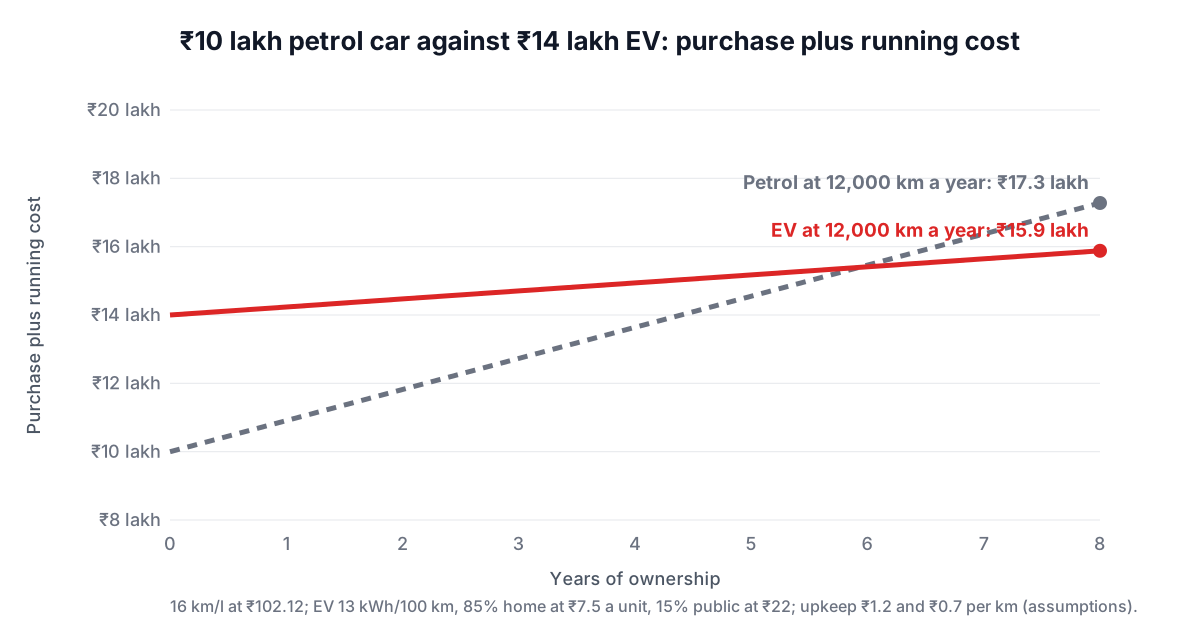
How far you drive decides almost everything:
| Change from 12,000 km, 85% home | Saving a year | Break-even |
|---|---|---|
| 20,000 km a year | ₹1,12,495 | 3.6 years |
| 6,000 km a year | ₹33,749 | 11.9 years |
| All charging at home at ₹7.5 | ₹70,890 | 5.6 years |
| Home charging at ₹10 (higher slab) | ₹64,182 | 6.2 years |
| All public charging at ₹22 | ₹48,270 | 8.3 years |
| Against a 20 km/l diesel car at ₹95.20 | ₹48,027 | 8.3 years |
| 40,000 km a year (cab use), 60% home | ₹2,06,140 | 1.9 years |
A family car doing 6,000 km a year needs almost 12 years to recover a ₹4 lakh premium, while a car on the road all day recovers it in under two years.
CO2 on India's grid
The Central Electricity Authority's CO2 Baseline Database (version 22.0, August 2026) gives a weighted average emission factor of 0.675 tonnes of CO2 per MWh for FY 2025-26, down from 0.774 in FY 2013-14. At 0.675 kg per unit the EV's 1,560 units emit about 1.05 tonnes a year, against about 1.74 tonnes from the petrol car's 750 litres using the calculator's tailpipe factor. With a grid factor this high the EV's advantage is smaller than on a cleaner grid, but it grows as the factor falls. Charging from your own rooftop solar would cut it further. Battery manufacture is not included in either figure.
What the comparison leaves out
- Insurance, which can be higher for an EV; add the yearly difference to upkeep.
- Resale value and battery warranty, which vary by model; read the battery warranty terms before buying.
- Financing: interest on the extra ₹4 lakh adds to the gap; the India car loan calculator shows the EMI and interest.
- Home charger installation and any extra sanctioned load from your DISCOM, a one-off cost to add to the EV price.
- CNG cars, a third option in many cities; enter a CNG car's cost per km as a petrol-equivalent if you want to compare.
Tools for this job
- The India EV vs petrol calculator runs every scenario above with your km, mileage and tariff.
- The India EV charging calculator works out units and time per charge, explained in the guide on how long an EV takes to charge.
- The India fuel cost calculator prices a trip in petrol or diesel.
- The India electricity cost calculator checks what home charging adds to the monthly bill, and the India EMI guide explains the loan side.
Frequently asked questions
What is the running cost of an electric car per km in India?
Divide the units per 100 km by 100 and multiply by your rate per unit. At 13 kWh per 100 km and ₹7.5 a unit it is ₹0.98 per km; at ₹22 on a public fast charger, ₹2.86. A 16 km/l petrol car on ₹102.12 petrol costs ₹6.38 per km in fuel.
How many units does it take to charge an EV?
Roughly the battery capacity you refill plus charging losses. At 13 kWh per 100 km measured at the wall, 12,000 km a year takes about 1,560 units, about 130 a month.
How many years does it take to recover the extra cost of an EV?
Divide the extra on-road price by the yearly saving. A ₹4 lakh premium takes 5.9 years at 12,000 km a year with mostly home charging, 3.6 years at 20,000 km and 11.9 years at 6,000 km.
Is an EV cheaper to run than a diesel car?
Yes, but by less. A 20 km/l diesel at ₹95.20 costs ₹4.76 per km in fuel, so the EV saves about ₹48,027 a year at 12,000 km and takes 8.3 years to recover a ₹4 lakh premium.
Sources and further reading
- Important news: retail selling prices of petrol and diesel, Petroleum Planning and Analysis Cell, Ministry of Petroleum and Natural Gas. Delhi prices on 6 November 2026.
- RSP of petrol and diesel in metro cities since 16.6.2017, Petroleum Planning and Analysis Cell. Daily table for Delhi, Mumbai, Chennai and Kolkata: Delhi petrol ₹102.12 and diesel ₹95.20 on 6 November 2026.
- CO2 Baseline Database for the Indian Power Sector, User Guide version 22.0, Central Electricity Authority. Weighted average grid factor of 0.675 tCO2/MWh for FY 2025-26.
- GHG Emission Factors Hub, US Environmental Protection Agency. The tailpipe CO2 per litre of petrol the calculator uses.
- FOTW #1190: battery electric vehicles have lower scheduled maintenance costs, US Department of Energy. Why EV servicing costs less per km.
Open the EV vs Gas Cost Calculator
More Energy & Sustainability
Every tool in the Energy & Sustainability section, free and in your browser.