
Power Factor Correction and kVAh Billing: APFC Sizing
Why a low power factor raises a kVAh electricity bill, how to size an APFC panel in kVAR at 415 V and 50 Hz, capacitor µF, leading PF and detuned banks.
By Redbison Dev · · 10 min read

India edition. Written for Indian HT and LT industrial consumers: kVAh billing as MERC directed for Maharashtra, the 0.95 lag minimum in CPWD's electrical specifications, APFC panels at 415 V and 50 Hz, and capacitor ratings against the bus voltage. US edition
Under kVAh billing your power factor is no longer a separate line on the bill; it is built into every unit. A plant that uses 30,000 kWh in a month at a power factor of 0.78 is billed for 38,462 kVAh. Raise the power factor to 0.99 and the same work is billed as 30,303 kVAh, 8,159 fewer units every month. For a 150 kW load that takes about 99 kVAR of capacitors, usually in an APFC panel. This edition explains the billing, sizes the panel with the power factor correction calculator for India, and covers the leading power factor and harmonic problems that catch panels sized only for the bill.
kVAh billing: power factor inside every unit
MSEDCL's presentation on kVAh billing sets out the arithmetic. Active energy (kWh) does the work; reactive energy (kVArh) builds the magnetic fields in motors, fans and air conditioners; and apparent energy combines them:
kVAh = √(kWh² + kVArh²)
power factor = kWh ÷ kVAh
Billed units are therefore kWh ÷ PF. Under kWh billing, power factor was monitored separately through an incentive and penalty mechanism; under kVAh billing, the same presentation notes, the incentive or penalty is built in, and a consumer drawing or injecting more reactive power pays more.
In Maharashtra, MERC's ruling in Case No. 195 of 2017 set out the move, and MSEDCL's commercial circular on the MYT order in Case No. 322 of 2019 records that kVAh billing for HT consumers took effect from 1 April 2020. The same order set 1 April 2023 only as a target for LT consumers above 20 kW, once meters were converted, so check MSEDCL's current tariff order to see whether your LT category is now billed on kVAh. The commission also directed MSEDCL to print the month's power factor on bills, computed from both lagging and leading reactive energy. Other states set their own basis in their tariff orders, so check yours: the right target is different if you are still billed in kWh with a PF incentive or surcharge.
| Power factor | kVAh billed per 1,000 kWh | For 30,000 kWh a month |
|---|---|---|
| 0.78 | 1,282 | 38,462 |
| 0.95 | 1,053 | 31,579 |
| 0.99 | 1,010 | 30,303 |
The jump from 0.95 to 0.99 is still worth 1,276 units a month in this example, which is a reason for kVAh consumers to aim above the old 0.95 target.
Sizing the APFC panel
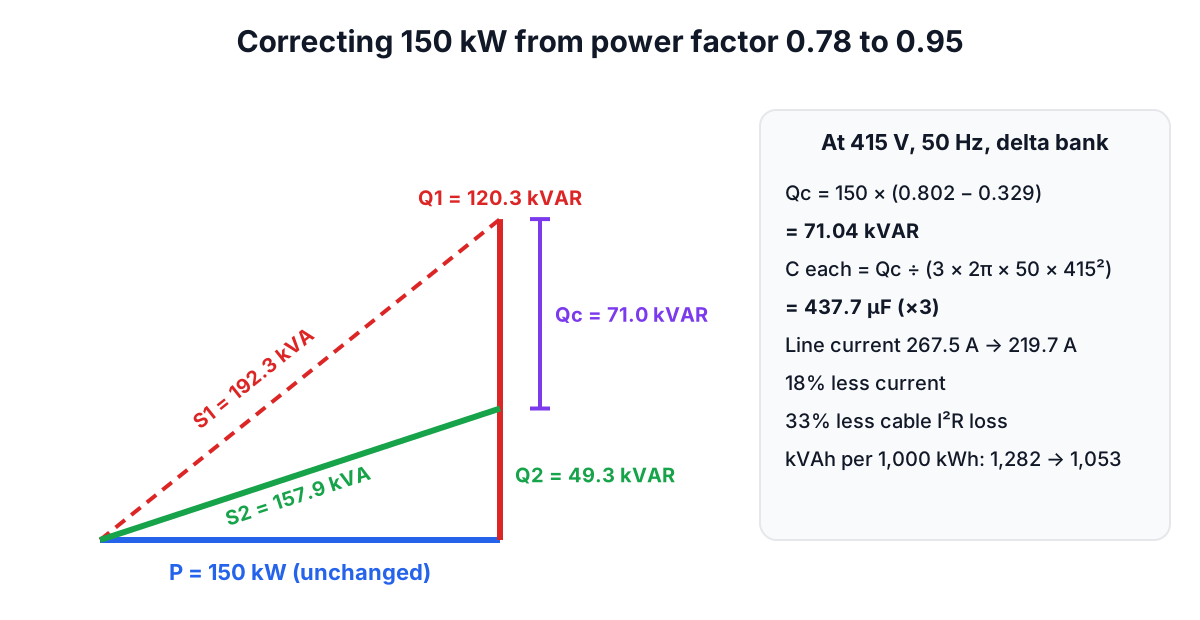
A capacitor supplies leading kVAR that cancels the lagging kVAR drawn by motors. Real power does not change, so:
kVAR = kW × (tan φ1 − tan φ2), φ = cos⁻¹(PF)
For a 150 kW load at 0.78, tan φ1 = 0.802. To 0.95 (tan φ2 = 0.329) the panel needs 71.04 kVAR; to 0.99 (tan φ2 = 0.142) it needs 98.97 kVAR.
| Target | Panel | Line current at 415 V | kVA |
|---|---|---|---|
| None (0.78) | 0 | 267.5 A | 192.3 |
| 0.95 | 71.04 kVAR | 219.7 A | 157.9 |
| 0.99 | 98.97 kVAR | 210.8 A | 151.5 |
Choose the next standard panel size, about 100 kVAR here, and split it into steps the controller can switch as machines start and stop. A smaller LT workshop of 60 kW at 0.82 needs 33.33 kVAR to reach 0.99, which suits a panel of about 35 kVAR in 5 kVAR steps.
From kVAR to microfarads at 415 V
LT panels are commonly delta-connected, with each capacitor across the 415 V line voltage:
C (each) = kVAR × 1,000 ÷ (3 × 2π × 50 × 415²)
The 71.04 kVAR bank is 437.7 µF per capacitor; the 33.33 kVAR workshop panel is 205.3 µF. A star bank would need three times the capacitance at 240 V per unit. For a single-phase 3.7 kW (5 HP) motor at 240 V and PF 0.72, correction to 0.95 needs 2.35 kVAR, a 129.9 µF capacitor, and the current falls from 21.4 A to 16.2 A.
Rated voltage against bus voltage
Capacitor kVAR is stated at nameplate voltage and falls with the square of the applied voltage. A 440 V capacitor on a 415 V bus gives (415 ÷ 440)² = 89% of its rating, so a nominal 100 kVAR panel of 440 V units delivers about 89 kVAR. Size from the bus voltage, not the nameplate.
What the current reduction buys
CPWD's General Specifications for Electrical Works ask for a power factor of not less than 0.95 lag at the point of connection, maintained by properly designed APFC panels, and tabulate what improvement does: from 0.7 to 0.9, load current falls 23.7% and transformer losses 40%; from 0.8 to 1.0, current falls 20% and losses 36%. In the 150 kW example, correction to 0.95 cuts current by 17.9% and cable losses by about 33%. MSEDCL's presentation makes the same point about transformer capacity: at 440 V, 100 kW at 0.7 draws 142 kVA, against 100 kVA at unity.
Leading power factor costs too
A fixed bank sized for full load becomes too large when machines stop at lunch or at night, and the power factor goes leading. CPWD warns that leading power factor raises voltage, increases transformer core losses and can drive the transformer into saturation, producing harmonics that heat and fail capacitors. Under kVAh billing it also costs units, because the reactive energy counts whichever way it flows, and MSEDCL's bills compute PF from both lagging and leading kVArh. An APFC controller that switches steps out as load falls is the fix.
Harmonics and detuned panels
Drives, UPS units, LED drivers and rectifiers draw harmonic currents. A plain capacitor panel and the supply transformer can resonate near the 5th or 7th harmonic (250 or 350 Hz), amplifying it until fuses blow and capacitors fail; MSEDCL lists harmonic resonance among the demerits of a leading or lagging power factor. Where non-linear loads are a large share of the plant, specify detuned capacitors with series reactors; a 7% reactor puts the resonance at 50 ÷ √0.07 = 189 Hz, below the 5th harmonic.
Frequently asked questions
How does power factor affect a kVAh bill?
Billed kVAh equals kWh divided by power factor, so every unit you use is scaled up by a low PF. 1,000 kWh at 0.78 is billed as 1,282 kVAh; at 0.99 it is 1,010 kVAh.
How much kVAR do I need for my APFC panel?
Multiply your average kW by tan φ1 − tan φ2. For 150 kW from 0.78 to 0.99 that is 150 × 0.660 = 98.97 kVAR; choose the next standard size and split it into steps.
What is the minimum power factor I should maintain?
CPWD's specifications ask for not less than 0.95 lag at the point of connection. Under kVAh billing, staying close to unity without going leading gives the lowest bill; your state's tariff order sets the billing basis for your category.
Why does my 440 V capacitor give less kVAR than its rating?
Because kVAR falls with the square of voltage. On a 415 V bus a 440 V unit gives 89% of its rated kVAR.
Sources and further reading
- kVAh billing implementation (MERC Case No. 195 of 2017), Maharashtra State Electricity Distribution Co. Ltd. The kVAh formula, kWh against kVAh billing and the effect of PF on current and transformer size.
- Commercial circular on the MERC MYT order (Case No. 322 of 2019), MSEDCL. kVAh billing for HT consumers from 1 April 2020 and the 1 April 2023 target for LT consumers above 20 kW.
- General Specifications for Electrical Works, Part I: Internal (2013), Central Public Works Department. Clause 2.6: 0.95 lag minimum, current and loss reductions, leading PF, APFC panels.
- Reducing power factor cost, US Department of Energy. Why low power factor costs money and how capacitors help.
- Service and Installation Rules of NSW, Section 6, NSW Government. A published table of kVAR multipliers to check the tan φ arithmetic against.
Open the Power Factor Correction Calculator
More Electrical
Every tool in the Electrical section, free and in your browser.