
Power Factor Correction in South Africa: Eskom kVArh Charges
Size a capacitor bank in kVAr for a 400 V, 50 Hz supply, work out Eskom's winter reactive energy charge above 30% of kWh, and see what the kVA saving is worth.
By Redbison Dev · · 10 min read

South Africa edition. Written for South African business supplies: Eskom's 2026/27 reactive energy charge on Miniflex, Megaflex and Ruraflex (kVArh above 30% of kWh, June to August only), capacity charges per kVA, the Distribution Network Code's 0.9 minimum, and 400 V, 50 Hz capacitor sizing. US edition
A 90 kW workshop running at a power factor of 0.78 on Eskom's Miniflex tariff records about 16 046 kVArh of reactive energy for every 20 000 kWh it uses. In a June billing period that leaves 10 046 kVArh above Eskom's 30% allowance, charged at 15.02 c/kVArh: R 1 508,85 before VAT for the month, and about three times that over the June to August high-demand season. A 46 kVAr capacitor bank lifts the power factor to 0.96 and the charge falls to zero. This edition works through the South African version of the problem with the South African power factor correction calculator: how the Eskom charge is measured on each tariff, how to size a bank for 400 V and 50 Hz, and what the kVA saving is worth.
Power factor on a South African supply
Power factor is the share of the current that does useful work: PF = kW ÷ kVA = cos φ. Motors, compressors, pumps, welders and lightly loaded transformers draw magnetising current that lags the voltage and delivers no energy, but it still heats cables and transformers and still has to be supplied. That reactive part is measured in kVAr, and over time in kVArh.
Two different rules apply in South Africa, and they are easy to confuse.
| Rule | Who sets it | Threshold | What happens below it |
|---|---|---|---|
| Distribution Network Code, clause 6.3 | NERSA / Eskom Distribution | 0.9 lagging, and never leading unless agreed | A compliance problem for customers above 100 kVA, to correct within a reasonable time |
| Reactive energy charge | Eskom tariff booklet 2026/27 | kVArh above 30% of kWh, described as 0.96 or less | A c/kVArh charge in June, July and August only |
The code's 0.9 is the legal floor; the tariff's 0.96 is where the money starts. Mathematically, kVArh equal to 30% of kWh is a power factor of 0.9578, which the booklet rounds to 0.96.
How Eskom measures the charge
The 2026/27 Tariffs and Charges Booklet, effective 1 April 2026 for Eskom's direct customers, charges reactive energy supplied in excess of 30% of the kWh. It applies only in the high-demand season, 1 June to 31 August, and the low-season rate is zero. How the excess is measured depends on the tariff:
| Tariff (non-local authority) | Who it is for | How the excess is worked out | High-season rate before VAT |
|---|---|---|---|
| Megaflex | Urban customers with an NMD above 1 MVA | Per 30-minute period in peak and standard hours, added up for the month | 34.49 c/kVArh |
| Miniflex | Urban customers with an NMD from 16 kVA to 5 MVA | On the billing-period totals | 15.02 c/kVArh |
| Ruraflex | Rural customers with an NMD from 16 kVA | On the billing-period totals | 21.57 c/kVArh |
Municipal tariffs are set by each municipality, so if the municipality supplies you, check its tariff schedule instead.
The excess for any period is:
excess kVArh = kWh × tan(arccos PF) − 0.30 × kWh
For the 90 kW workshop using 20 000 kWh in a June billing period on Miniflex:
| Power factor | kVArh recorded | Allowance (30%) | Excess | Charge before VAT |
|---|---|---|---|---|
| 0.78 | 16 046 | 6 000 | 10 046 | R 1 508,85 |
| 0.85 | 12 395 | 6 000 | 6 395 | R 960,51 |
| 0.90 | 9 686 | 6 000 | 3 686 | R 553,70 |
| 0.96 | 5 833 | 6 000 | 0 | R 0,00 |
Reaching 0.90 satisfies the Distribution Network Code but still leaves a charge. Reaching 0.96 removes it.
Megaflex: every half-hour counts
On Megaflex the 30% test is applied to each 30-minute period in peak and standard hours. Suppose a large site's capacitor step drops out during the morning peak and one half-hour runs at an average of 400 kW and PF 0.94. That half-hour records 200 kWh and 72.59 kVArh; the allowance is 60 kVArh, so 12.59 kVArh is charged at 34.49 c, R 4,34. It looks small, but it repeats every half-hour the bank is out, while a monthly average power factor of 0.97 would hide it. On Megaflex, size the steps for the peak-hour load, not the monthly average.
Sizing the bank
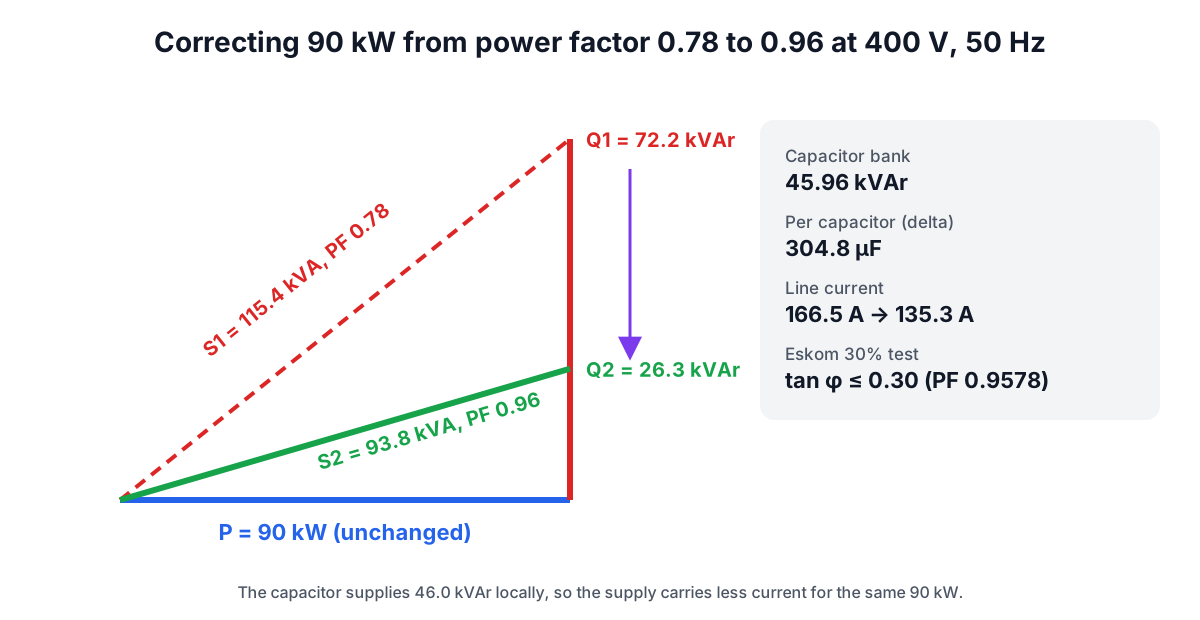
The capacitor supplies the difference in reactive power between the present and the target power factor:
Qc = P × (tan φ1 − tan φ2)
For the workshop, 90 kW from 0.78 to 0.96:
| Quantity | Before | After |
|---|---|---|
| Reactive power | 72.2 kVAr | 26.3 kVAr |
| Apparent power | 115.4 kVA | 93.8 kVA |
| Line current at 400 V | 166.5 A | 135.3 A |
The bank needs 45.96 kVAr. Current falls by 18.7% and losses in the cable upstream of the capacitors by about 34%. The calculator's tool example, a 250 kW load from 0.85 to 0.96, needs 82.02 kVAr and drops line current from 424.5 A to 375.9 A.
Capacitance at 50 Hz
South Africa runs at 50 Hz, and the frequency sets the capacitance. For a delta bank, each of the three capacitors sits across the 400 V line voltage:
C = Qc ÷ (3 × 2π × 50 × 400²)
For 45.96 kVAr that is 304.8 µF per capacitor. Entering 60 Hz by mistake would understate the capacitance by a sixth. Capacitor output also falls with the square of the voltage: a unit rated at 440 V gives (400 ÷ 440)² = 82.6% of its nameplate kVAr on a 400 V supply, so check the rating when you compare quotes.
A farm pump on Ruraflex
A 45 kW irrigation pump at PF 0.80 on Ruraflex using 30 000 kWh in July records 22 500 kVArh. The allowance is 9 000, so 13 500 kVArh is charged at 21.57 c: R 2 911,95 before VAT for that month. Correcting the pump to 0.96 takes 20.62 kVAr, and a capacitor switched with the motor (sized within the motor maker's limit, so it cannot self-excite after the motor is switched off) follows the pump on and off.
What the kVA saving is worth
The reactive charge is only one line. Miniflex also charges per kVA per month on the annual utilised capacity, which the booklet defines as the higher of the notified maximum demand (NMD) and the measured maximum demand over a rolling 12 months. For a supply below 500 V in the transmission zone of 300 km or less, the 2026/27 non-local-authority rates before VAT are R 54,22 per kVA for network capacity and R 5,29 per kVA for generation capacity, R 59,51 in all.
The workshop's correction removes about 21.6 kVA of demand. If its NMD can be lowered to match under Eskom's NMD rules, that is worth about R 1 287 a month before VAT, every month of the year, not just in winter. If the site is growing instead, the freed kVA is headroom that may avoid an NMD increase or an excess network capacity charge for exceeding it.
Harmonics and detuned banks
Variable speed drives, UPS systems, LED drivers and rectifiers draw harmonic currents, and a capacitor bank can resonate with the supply transformer near the 5th or 7th harmonic. The Distribution Network Code requires distributors and customers to meet NRS 048 and NERSA's power quality directive on voltage harmonics, so a bank that amplifies harmonics is a compliance issue as well as a reliability one. Where non-linear load is a large share of the total, ask for a detuned bank with series reactors; the common 7% detuning puts the tuning point at 50 ÷ √0.07 = 189 Hz, below the 5th harmonic at 250 Hz.
Before you install
- Measure first. Use a power logger or your Eskom bill's kWh and kVArh by period, not motor nameplates.
- Tell the distributor. Clause 6.3(3) of the Distribution Network Code says a participant installing shunt capacitors to meet the power factor requirement shall inform the relevant distributor.
- Do not go leading. The same clause says power factor must not go leading unless agreed. On sites that idle at night or over weekends, use automatic step switching.
- Plan for winter. The charge only runs June to August, so a bank installed by the end of May pays from the first high-season bill.
Use a registered electrical contractor for the installation; a capacitor bank stores charge after it is switched off and needs discharge resistors and safe isolation.
Tools for this job
- South African power factor correction calculator: kVAr, µF per capacitor, current and kVA at 400 V and 50 Hz.
- South African three-phase power calculator: kW and kVA from measured amps.
- South African transformer calculator: what the freed kVA means for a transformer.
- South African electricity cost calculator: the energy side of the bill.
- Related reading: the three-phase power formula and transformer sizing in kVA.
Frequently asked questions
At what power factor does Eskom charge for reactive energy?
On Megaflex, Miniflex and Ruraflex, the 2026/27 booklet charges for reactive energy above 30% of the kWh, which it describes as a power factor of 0.96 or less. The exact break-even is 0.9578. The charge applies only from 1 June to 31 August.
How much is Eskom's reactive energy charge?
For non-local-authority customers in 2026/27, the high-season rate before VAT is 34.49 c/kVArh on Megaflex, 15.02 c/kVArh on Miniflex and 21.57 c/kVArh on Ruraflex, and zero in the low season. Municipal tariffs are set by each municipality.
Is a power factor of 0.9 good enough?
It meets the Distribution Network Code minimum for customers above 100 kVA, but not the tariff. At 0.90, a Miniflex site using 20 000 kWh in a June billing period still pays for 3 686 kVArh, about R 554 before VAT.
How many kVAr do I need to go from 0.78 to 0.96 on 90 kW?
45.96 kVAr. At 400 V and 50 Hz in delta that is 304.8 µF per capacitor, and line current falls from 166.5 A to 135.3 A.
Does correcting power factor lower my demand charges?
It lowers the kVA you draw for the same kW. On Miniflex, capacity charges are per kVA of annual utilised capacity, the higher of your NMD and measured maximum demand, so the saving shows once the NMD is adjusted or when it avoids an increase.
Sources and further reading
- Tariffs and Charges Booklet 2026/2027, Eskom Distribution. Reactive energy charge rules and rates, the high-demand season, annual utilised capacity and Miniflex capacity charges.
- 2026/2027 tariff increase, Eskom Distribution. Effective dates: 1 April 2026 for direct customers, 1 July 2026 for municipal tariffs.
- Tariffs and charges, Eskom Distribution. Residential, urban, rural and municipal tariff documents.
- South African Distribution Network Code, version 6.2, NERSA / Eskom Distribution. Clause 6.2 on NRS 048 and clause 6.3 on load power factor.
- Reducing Power Factor Cost, US Department of Energy. Why low power factor costs money and how capacitors correct it.
Open the Power Factor Correction Calculator
More Electrical
Every tool in the Electrical section, free and in your browser.