
Lump Sum vs Dollar-Cost Averaging in a TFSA or RRSP
Invest a lump sum or spread it out? The math in Canadian dollars for TFSA room, RRSP season and a windfall, with CRA limits and what waiting cash earns.
By Redbison Dev · · 6 min read
Canada edition. Written for Canadian investors: the SIP idea as pre-authorized monthly contributions, amounts in CAD, CRA's 2026 TFSA and RRSP limits, RRSP deadline timing and CDIC cover for cash waiting to be invested. US edition
Put the 2026 TFSA dollar limit of $7,000 into a fund in January and, at a steady 6% a year, it is worth $22,449.95 after 20 years. Spread the same $7,000 over the year at $583.33 a month and it is worth $21,880.30. Investing at once comes out $569.65 ahead when markets rise steadily, and a Vanguard study of rolling one-year periods, which included Canada's S&P/TSX Composite from 1985 to 2022, found a lump sum beat cost averaging in 61.6% to 73.7% of periods depending on the market. Spreading the money out can still be the right call for some investors. This edition works through both with Canadian accounts and dollars.
In India this question is called "SIP versus lump sum." In Canada, the monthly version is usually a pre-authorized contribution (PAC) plan or "dollar-cost averaging." Every figure below comes from the Canadian investment calculator, which projects monthly contributions or a lump sum at a steady return. It is arithmetic, not a recommendation of any fund or dealer.
The two calculations
Monthly contributions are treated as invested at the start of each month and compounded monthly, the future value of an annuity due:
FV = P × [((1 + i)^n − 1) / i] × (1 + i)
P is the monthly amount, i the yearly return divided by 12, and n the number of months. $500 a month for 25 years at 6% gives $348,229.47 from $150,000 contributed; at 4% it is $257,921.66.
A lump sum compounds yearly: value = amount × (1 + rate)^(months / 12). To compare spreading money out with investing at once, run the monthly amount over the phasing period and then let that value grow as a lump sum for the rest of the term. That is how every phasing figure here was produced. Because the calculator compounds monthly contributions monthly and lump sums yearly, the phased options are flattered slightly.
January TFSA room: all at once or over the year?
TFSA room arrives on January 1. CRA's contribution room rules add each year's dollar limit ($7,000 for 2026) to any unused room carried forward and to the amounts you withdrew the year before, which come back as new room on January 1 of the following year.
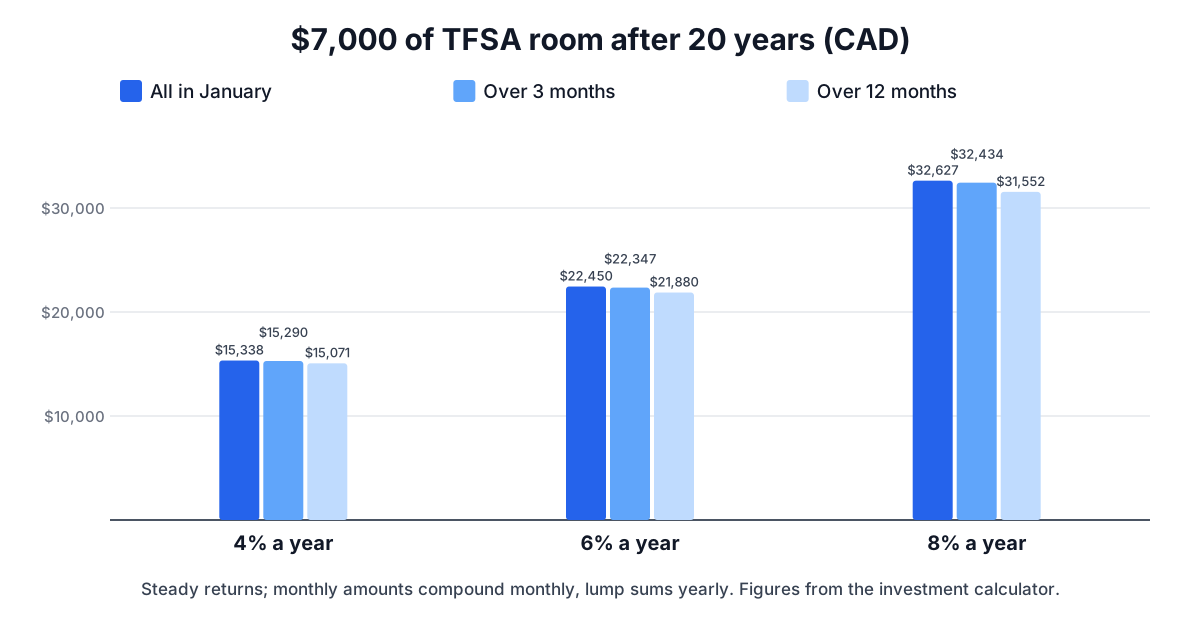
| Steady return | All in January | Over 3 months | Over 12 months |
|---|---|---|---|
| 4% a year | $15,337.86 | $15,289.69 | $15,071.42 |
| 6% a year | $22,449.95 | $22,347.28 | $21,880.30 |
| 8% a year | $32,626.70 | $32,433.59 | $31,551.54 |
Over a decade of new room the gap repeats. Investing $7,000 every January for ten years at 6% ends at $97,801.50; contributing $583.33 a month over the same ten years ends at $96,074.27. The difference is real but small, and it only exists if you have the $7,000 in January. Most people contribute from each paycheque, so the PAC is not a choice against a lump sum; it is how the money arrives.
RRSP season: the late lump sum
RRSP timing often runs the other way: one contribution just before the deadline, claimed on the previous year's return. For the 2025 return, CRA's RRSP deduction rules counted contributions made from March 4, 2025 to March 2, 2026, and the deduction limit is the lesser of 18% of the previous year's earned income or the annual limit. CRA's limits table puts the RRSP dollar limit at $33,810 for 2026 and $35,390 for 2027.
Compare three ways to put $6,000 into an RRSP for the 2026 tax year, all measured 10 years after January 2026 at 6%:
| How the $6,000 goes in | Value after 10 years |
|---|---|
| Lump sum in January 2026 | $10,745.09 |
| $500 a month by PAC, January to December 2026 | $10,472.44 |
| Lump sum at the deadline, around March 1, 2027 | $10,038.91 |
The deadline lump sum is the latest of the three, 14 months after the January option, so it ends lowest. A monthly PAC sits in between and has the advantage of being automatic. The tax deduction can be the same in all three cases, with one catch: anything paid in January or February 2026 falls in CRA's window for the 2025 return, so it is reported on that return's Schedule 7. If you do not deduct it for 2025, CRA's page on unused RRSP contributions shows it carried on your notice of assessment as available to deduct in a later year, so you can claim it for 2026.
A windfall: spreading it out and the cash in between
Say you receive $60,000 from an inheritance and have the TFSA and RRSP room to shelter it. Over 10 years:
| Steady return | All at once | Over 3 months | Over 6 months | Over 12 months |
|---|---|---|---|---|
| 4% a year | $88,814.66 | $88,535.69 | $88,111.65 | $87,271.82 |
| 6% a year | $107,450.86 | $106,959.45 | $106,207.20 | $104,724.38 |
| 8% a year | $129,535.50 | $128,768.80 | $127,586.52 | $125,266.88 |
At 6%, three months of phasing gives up $491.41, six months $1,243.66 and twelve months $2,726.48. The same pattern shows in Vanguard's research: the longer the averaging period, the more often the lump sum wins.
These figures assume the waiting money earns nothing, which overstates the cost. Cash in a high-interest savings account or a GIC earns interest while it waits, and the Bank of Canada's policy interest rate was 2.50% after its October 28, 2026 decision. Eligible deposits are protected by CDIC up to $100,000 in each category at each member institution, with TFSAs, RRSPs and FHSAs each a separate category, according to CDIC's coverage page. Mutual funds, stocks, bonds and ETFs are not covered.
Why phasing still makes sense for some people
The steady-return table hides the case phasing exists for: a fall soon after you invest. If the whole $60,000 goes in and the market drops 20% that spring, all of it takes the loss. A monthly investor would still have most of the money in cash and would buy more units at lower prices. In the periods Vanguard did not count as lump-sum wins, cost averaging came out ahead, and an early fall is the situation where that happens. No one knows in advance which period they are in.
Dollar-cost averaging also lowers the average cost per unit whenever prices move around:
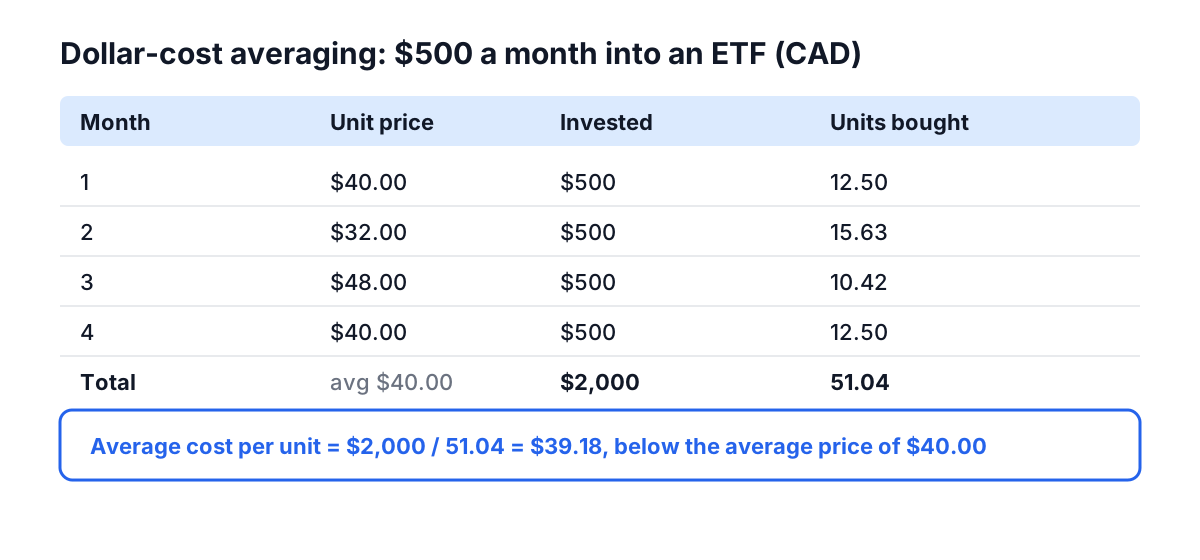
The average cost ($39.18) is below the average price ($40.00) because it is the harmonic mean of the prices. The benefit is modest and disappears in a market that only rises.
So phasing is a trade: a slightly lower expected result for less regret if markets fall early. If a big early drop would make you sell, which locks in the loss, a three- to six-month plan is the better plan for you even though it is not the better average.
A practical way to decide
- Money that arrives with each paycheque: set up a PAC into your TFSA, RRSP or FHSA. Use the calculator to size it for your goal and test 4%, 6% and 8%.
- Room you can fill in January: filling it early wins on average; the cost of waiting is small, so do not let the choice delay you.
- RRSP contributions: a PAC during the year usually beats a deadline lump sum, and the deduction is the same.
- A windfall: invest once it is in the right account, or phase it over three to six months if an early fall would make you sell, keeping the waiting cash in an insured deposit.
- Fees: enter a return after the management expense ratio. On $500 a month for 25 years, the difference between 6% and 4% is $90,307.81.
For the growth formula behind both modes, see the compound interest guide for Canada. The US edition of this guide covers the same math without Canadian accounts. If your situation involves large sums, US-listed holdings, or a tax position you are unsure of, a fee-only planner or tax professional can look at the whole picture.
Frequently asked questions
Should I put my whole TFSA contribution in on January 1?
If you have the money, investing early in the year gives it longer to grow tax-free. $7,000 at a steady 6% is worth $22,449.95 after 20 years if invested in January, against $21,880.30 if contributed monthly over the year. If you contribute from each paycheque, a monthly PAC is the natural route.
Is dollar-cost averaging better than a lump sum in Canada?
On average, no: Vanguard's study, which included the S&P/TSX Composite from 1985 to 2022, found a lump sum ahead in 61.6% to 73.7% of rolling one-year periods depending on the market. Dollar-cost averaging does better when markets fall soon after you start, and it reduces regret.
Is a lump sum at the RRSP deadline a good idea?
It counts for the previous tax year, so the deduction is the same, but the money goes in late. Over 10 years at 6%, $6,000 contributed around March 1, 2027 for the 2026 year ends at $10,038.91, against $10,472.44 by monthly PAC through 2026 and $10,745.09 in January 2026.
Where should I keep money while I phase in a lump sum?
In an insured deposit such as a high-interest savings account or a short GIC. CDIC covers eligible deposits up to $100,000 per category at each member institution, and deposits held in a TFSA or RRSP are separate categories. Funds, stocks and ETFs are not covered.
How long should I take to phase in a windfall?
There is no rule, but in a rising market the cost grows with the period. On $60,000 over 10 years at 6%, three months of phasing gave up $491.41 and twelve months $2,726.48, before counting the interest the waiting cash earns.
Sources and further reading
- MP, DB, RRSP, DPSP, ALDA, TFSA limits, YMPE and the YAMPE, Canada Revenue Agency. TFSA $7,000 for 2026; RRSP $33,810 for 2026 and $35,390 for 2027.
- Calculate your TFSA contribution room, Canada Revenue Agency. Carry-forward and re-contribution of withdrawals.
- How contributions affect your RRSP deduction limit, Canada Revenue Agency. 18% of earned income; the March 4, 2025 to March 2, 2026 window for the 2025 return.
- What to do with unused RRSP, PRPP or SPP contributions, Canada Revenue Agency. Schedule 7 reporting and unused contributions available to deduct later.
- What's covered, Canada Deposit Insurance Corporation. $100,000 per category per member institution.
- Policy interest rate, Bank of Canada. 2.50% after the October 28, 2026 decision.
- The truth about cost averaging, Vanguard. Lump sum against cost averaging, rolling one-year periods, including the S&P/TSX Composite.
- 6.6 Methods of Savings, OpenStax. Future value of regular deposits.
Open the Investment Calculator
More Calculators
Every tool in the Calculators section, free and in your browser.
- Investment Calculator
- Compound Interest Calculator
- Simple Interest Calculator
- Interest Calculator
- EMI Calculator
- Retirement Calculator
- Time-Weighted Return Calculator
- Savings Goal Calculator
- Inflation Calculator
- CAGR Calculator
- ROI Calculator
- Present and Future Value Calculator
- NPV and IRR Calculator
- 401(k) Calculator
- Roth IRA Calculator
- APY and CD Calculator
- SIP Calculator
- Annuity Calculator
- Bond Price and Yield Calculator
- Currency Converter
- Dividend Calculator
- Stock Average Calculator
- RMD Calculator