
Lump Sum vs Regular Savings Plan: Singapore Maths
Invest a lump sum or use a regular savings plan? Figures in S$ for SRS top-ups, CPFIS against the 2.5% and 4% CPF rates, and where to park cash while phasing.
By Redbison Dev · · 6 min read
Singapore edition. Written for Singapore investors: the SIP idea as a regular savings plan, amounts in S$, SRS caps and December top-up timing, CPF interest as the hurdle for CPFIS, and Singapore Savings Bonds for cash in waiting. US edition
Put the full S$15,300 SRS contribution in at the start of the year and, at a steady 5% a year, it is worth S$24,922.09 after ten years. Spread it at S$1,275 a month and it is worth S$24,388.08. Top it up in December, the last month that still counts for that year's relief, and it is worth S$23,832.02. In a market that rises steadily, money invested earlier ends higher, and a Vanguard study of rolling one-year periods across several markets and the MSCI World index found a lump sum beat cost averaging in 61.6% to 73.7% of periods. In Singapore two more benchmarks sit in the background: the CPF interest you give up if you invest CPF savings, and the near-risk-free return on cash parked in Singapore Savings Bonds while you phase in.
The monthly version of this question is called a SIP in India; in Singapore it is a regular savings plan (RSP) with a bank or broker, a monthly robo-adviser deposit, or simply dollar cost averaging. Every projection below comes from the Singapore investment calculator. It is arithmetic at a steady return, not a recommendation of any product.
How each option is worked out
Regular monthly investing treats each payment as invested at the start of its month and compounds monthly, the future value of an annuity due:
FV = P × [((1 + i)^n − 1) / i] × (1 + i)
P is the monthly amount, i the yearly return divided by 12, and n the number of months. S$800 a month for 15 years at 6% gives S$233,818.24 from S$144,000 invested.
A lump sum compounds yearly: value = amount × (1 + rate)^(months / 12). To compare phasing with investing at once, the monthly amount runs over the phasing months and the result then grows as a lump sum for the rest of the term. The calculator compounds monthly amounts monthly and lump sums yearly, which flatters phasing slightly.
SRS: January, monthly or December?
IRAS sets the yearly SRS contribution cap at S$15,300 for Singapore Citizens and Permanent Residents and S$35,700 for foreigners. SRS relief counts towards the overall personal income tax relief cap of S$80,000 a year of assessment. Relief is given in the Year of Assessment after the year of contribution, so a top-up any time in 2026 counts for YA 2027, and only 50% of withdrawals are taxable at retirement. A December top-up therefore earns the same relief as a January one, but it is the latest point at which you can make it.
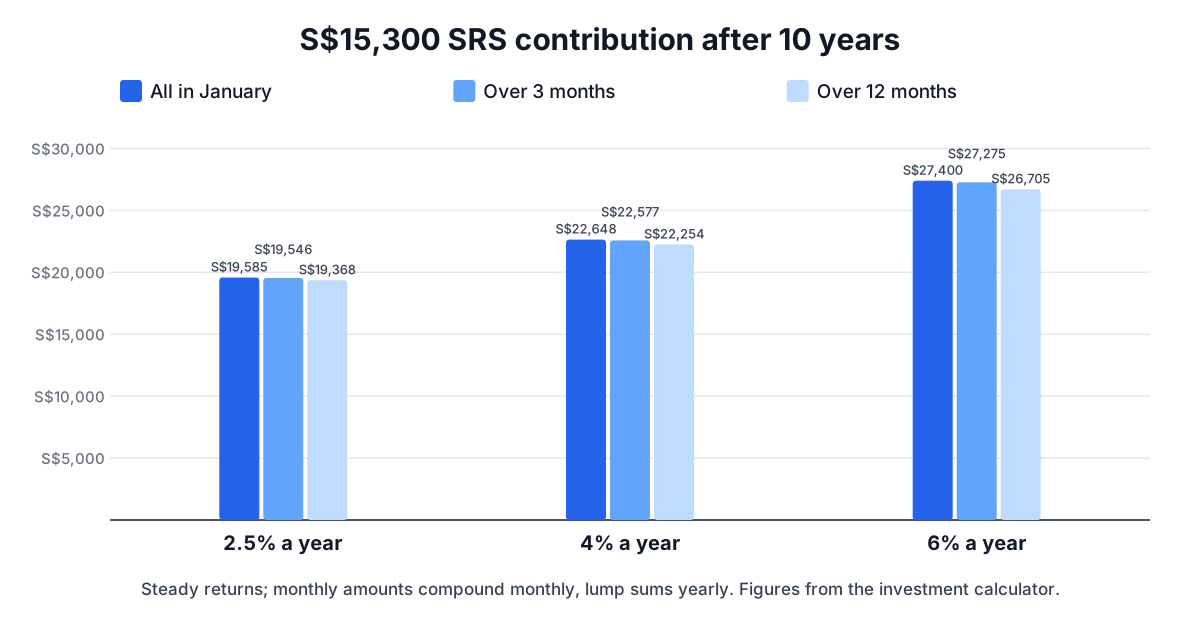
| Steady return | All in January | Over 3 months | Over 12 months |
|---|---|---|---|
| 2.5% a year | S$19,585.29 | S$19,545.98 | S$19,368.34 |
| 4% a year | S$22,647.74 | S$22,576.60 | S$22,254.31 |
| 6% a year | S$27,399.97 | S$27,274.66 | S$26,704.72 |
Repeat it for 20 years at 5% and the habit matters more. Contributing S$15,300 every January ends at S$531,204.55; S$1,275 a month ends at S$526,251.54; S$15,300 every December ends at S$507,970.23. The December habit costs S$23,234.32 against January for the same contributions and the same tax relief. These figures assume the SRS money is invested as soon as it goes in; cash left uninvested in an SRS account does not earn the assumed return.
CPFIS: the hurdle is 2.5% or 4%, not zero
Investing CPF savings is the Singapore version of "should I invest this lump sum?". CPF Board lets you invest Ordinary Account savings above S$20,000 and Special Account savings above S$40,000, with up to 35% of investible savings in stocks and 10% in gold, and its advice is to invest only if you are confident of earning more than the CPF interest. For 1 October to 31 December 2026, the CPF interest rates are 2.5% a year on the OA and 4% on the SA, MediSave and Retirement Accounts, with the 4% floor extended to 31 December 2027 and extra interest on the first S$60,000 of combined balances (OA capped at S$20,000).
Take an OA of S$50,000, so S$30,000 is investible. Over ten years:
| Where the S$30,000 goes | Value after 10 years |
|---|---|
| Stays in the OA at 2.5% | S$38,402.54 |
| Invested at once, 4% after fees | S$44,407.33 |
| Invested at once, 5% after fees | S$48,866.84 |
| Phased over 12 months at 5% | S$47,819.76 |
The real gain from investing is the gap above the OA line, not the whole growth: S$6,004.79 at 4% and S$10,464.30 at 5% over ten years. A fund that returns less than 2.5% after fees leaves you behind money that would have earned the OA rate with no risk. And because the first S$20,000 of OA money (within the first S$60,000 of combined balances) earns extra interest, the hurdle on smaller balances is higher than 2.5%.
Phasing CPFIS money has a feature cash-funded phasing lacks: the part not yet invested keeps earning OA interest. That makes a gradual approach cheaper than the table above suggests.
Parking cash while you phase
If you hold a bonus or a property sale and choose to invest over several months, the waiting money can earn a near-risk-free return. Singapore Savings Bonds start from S$500, can be held for up to ten years and can be redeemed in any month with no penalty, with principal and accrued interest paid by the second business day of the following month. Their step-up coupons track Singapore Government Securities yields, and MAS announces each issue's rates when applications open. The redemption lag means SSBs suit a phase-in over several months rather than weeks.
Why phasing still has a place
The steady-return tables hide the case phasing is for: a sharp fall soon after you invest. If a S$100,000 bonus goes in at once and the market falls 20% in the first quarter, all of it takes the loss. A monthly investor would still hold most of it in cash and would buy units at lower prices. In the periods Vanguard did not count as lump-sum wins, cost averaging came out ahead, and an early fall is when that happens.
Regular investing also lowers your average cost per unit when prices move:
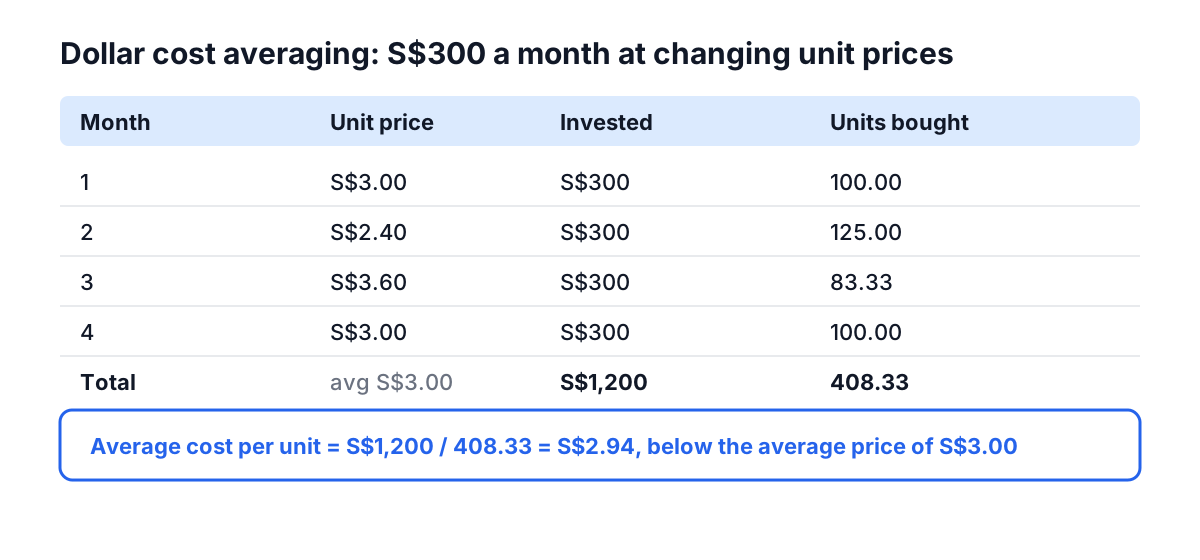
The average cost (S$2.94) sits below the average price (S$3.00) because it is the harmonic mean of the prices. The benefit is modest and disappears in a market that only rises.
Tax rarely tips the balance for individuals. IRAS states that gains from the sale of shares and financial instruments in Singapore are generally not taxable; trading for profit can be treated differently. Fees matter more: a plan returning 6% before a 1.5% yearly fee is a 4.5% plan.
A practical way to decide
- Salary money: a regular savings plan or monthly robo-adviser deposit matches how the money arrives. Size it for your goal and test 2.5%, 4% and 6%.
- SRS: if you have the cash early in the year, an early top-up gives the same relief and more time invested; if not, monthly contributions beat a December lump.
- CPF savings: compare any investment against the OA or SA rate after fees, not against zero.
- A windfall: invest it once you have decided where, or phase it over three to six months with the waiting money in SSBs or a fixed deposit if an early fall would make you sell.
For a CPF-specific projection, the compound interest guide for Singapore covers the growth formula, and the US edition of this guide has the general maths. For large sums or CPF decisions near retirement, a licensed financial adviser representative can look at your whole position.
Frequently asked questions
Should I top up my SRS in January or December?
Both count for the same Year of Assessment if made in the same calendar year, so the tax relief is identical. January gives the money eleven more months invested: S$15,300 at 5% is worth S$24,922.09 after ten years from January against S$23,832.02 from December.
Is a regular savings plan better than a lump sum in Singapore?
On average, a lump sum invested at once has ended higher; Vanguard found lump sums ahead in 61.6% to 73.7% of rolling one-year periods across the markets it studied. A regular plan suits money that arrives monthly and softens the effect of an early fall.
What return do I need to beat my CPF OA?
At least 2.5% a year after all fees, the OA rate for the last quarter of 2026, and more on balances that earn the extra interest. For SA savings the hurdle is 4%.
Where can I keep cash while I invest a lump sum gradually?
Singapore Savings Bonds start from S$500 and can be redeemed in any month without penalty, with the money paid by the second business day of the following month. A fixed deposit or high-interest savings account also works for shorter periods.
Do I pay tax on gains from a regular savings plan?
For most individuals, no. IRAS says gains from selling shares and financial instruments in Singapore are generally not taxable, unless you are trading. Fees, not tax, are usually the larger drag.
Sources and further reading
- Investing your CPF savings, CPF Board. S$20,000 OA and S$40,000 SA set-asides, 35% stock and 10% gold limits.
- Earning attractive interest, CPF Board. Rates for 1 October to 31 December 2026 and the 4% floor to 31 December 2027.
- Supplementary Retirement Scheme (SRS) relief, IRAS. S$15,300 and S$35,700 caps, the S$80,000 overall relief cap, relief in the following YA, 50% of withdrawals taxable.
- Gains from sale of property, shares and financial instruments, IRAS.
- Singapore Savings Bonds, Monetary Authority of Singapore. From S$500, redeem in any month.
- The truth about cost averaging, Vanguard. Lump sum against cost averaging over rolling one-year periods.
Open the Investment Calculator
More Calculators
Every tool in the Calculators section, free and in your browser.
- Investment Calculator
- Compound Interest Calculator
- Simple Interest Calculator
- Interest Calculator
- EMI Calculator
- Retirement Calculator
- Time-Weighted Return Calculator
- Savings Goal Calculator
- Inflation Calculator
- CAGR Calculator
- ROI Calculator
- Present and Future Value Calculator
- NPV and IRR Calculator
- 401(k) Calculator
- Roth IRA Calculator
- APY and CD Calculator
- SIP Calculator
- Annuity Calculator
- Bond Price and Yield Calculator
- Currency Converter
- Dividend Calculator
- Stock Average Calculator
- RMD Calculator