
IST, Asia/Kolkata and DST Abroad: Time Zones for Developers
IST is UTC+5:30 all year, so every shift in a US or UK call comes from their clocks. Asia/Kolkata in code, half-hour offset bugs and client-call timings.
By Redbison Dev · · 6 min read

India edition. Written for Indian developers and teams with US, UK and Australian clients: IST as kept by CSIR-NPL, the Asia/Kolkata zone and its Calcutta alias, half-hour offsets, and 2026 call times in IST. US edition
India has one time zone, Indian Standard Time, and it never changes. So when the 9 am New York stand-up moves from 7:30 pm to 6:30 pm in your calendar, India did nothing: the US moved its clocks. For developers in India, that is the whole subject in one line. IST is a fixed UTC+5:30, while nearly every client zone you work with shifts twice a year on its own schedule. This edition covers how IST is defined, how to handle Asia/Kolkata in code, the bugs a half-hour offset exposes, and the 2026 dates when US and UK calls move. Every conversion can be repeated in the IST time converter.
How IST is defined
CSIR-National Physical Laboratory in New Delhi keeps India's time. Its time and frequency page states that IST is UTC(NPLI) plus 5 hours 30 minutes, where UTC(NPLI) is NPL's realisation of UTC. NPL runs public time servers at time.nplindia.in and time.nplindia.org, which are a sensible NTP source for servers hosted in India.
In the IANA time zone database, used by browsers, operating systems and runtimes, the zone is Asia/Kolkata. The IANA project's notes give it as the standard example of a rename: the zone was Asia/Calcutta until 2008, and the old spelling is kept as a link in the "backward" file so that old configurations keep working. Asia/Mumbai, Asia/Delhi and Asia/Bangalore do not exist; there is one zone for the whole country.
Half-hour offsets break lazy code
Many zones sit a whole number of hours from UTC. IST does not, and neither are its neighbours: in the converter, 10:00 IST on 20 November 2026 is 10:15 in Kathmandu (UTC+5:45), 10:30 in Dhaka (UTC+6), 08:30 in Dubai (UTC+4) and 12:30 in Singapore (UTC+8). Code that assumes whole hours fails in predictable ways:
- Integer-hour offset columns. Storing
5instead of330minutes or+05:30puts every timestamp half an hour out. - Sign mistakes. JavaScript's
Date.prototype.getTimezoneOffset()is positive when local time is behind UTC and negative when ahead, so a browser in India returns −330. ISO 8601 notation uses the opposite sign,+05:30. - Rounding in charts. Bucketing events into "local hours" by integer division on a UTC hour misplaces every Indian event by 30 minutes.
- Parsing.
2026-11-20T10:00:00+0530and+05:30are both common; make sure your parser accepts the one your partners send.
The test is cheap: run your date code with TZ=Asia/Kolkata. Half-hour bugs show up immediately, and so do assumptions that "local" means the developer's laptop.
US and UK calls in IST through 2026
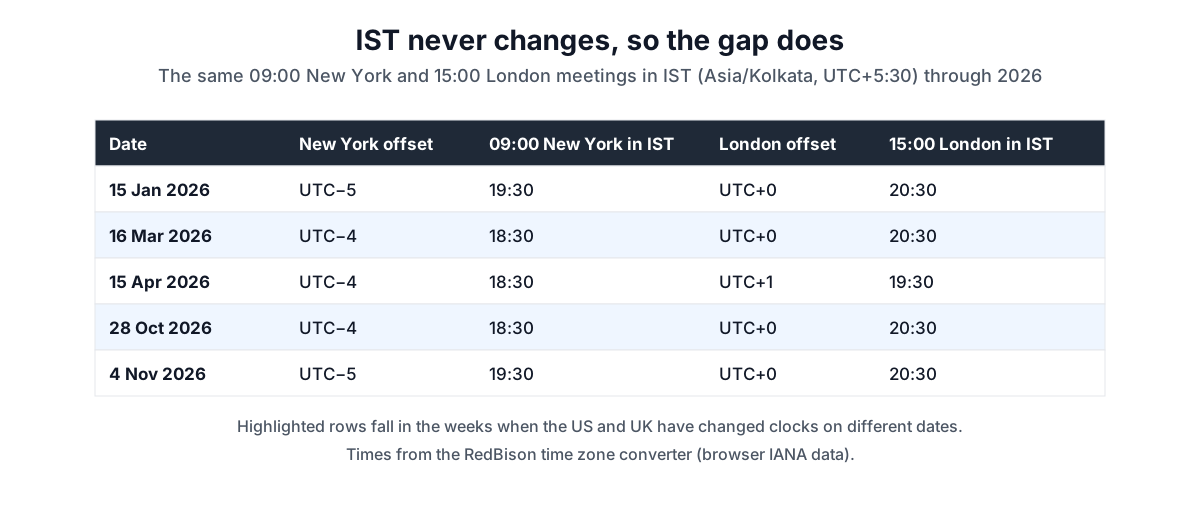
The US moves clocks on the second Sunday in March and the first Sunday in November; for 2026 that is 8 March and 1 November. The UK moves on the last Sundays in March and October: 29 March and 25 October in 2026. India stays put, so the IST time of the same meeting changes:
| Meeting | In winter | In summer |
|---|---|---|
| 09:00 New York | 19:30 IST (15 January 2026) | 18:30 IST (15 April 2026) |
| 09:00 Los Angeles | 22:30 IST (15 January 2026) | 21:30 IST (15 July 2026) |
| 15:00 London | 20:30 IST (15 January 2026) | 19:30 IST (15 April 2026) |
Two stretches catch teams out every year. From 8 March to 28 March 2026 the US has moved and the UK has not, so a 09:00 New York call on 16 March is 18:30 IST while London is still on GMT (13:00). From 25 October to 31 October 2026 the UK has moved back and the US has not, so the gap between your US and UK clients is four hours instead of five for one week.
Worked example: a deployment window for a New York client. You run a weekly release at 20:00 IST on Saturdays. On 7 March 2026 that is 09:30 in New York (UTC−5). From 8 March, after the US change, 20:00 IST is 10:30 in New York. If the client's change-freeze window is fixed in New York time, your IST slot has to move to 19:00 from Saturday 14 March, the first release after the US change, and back to 20:00 from Saturday 7 November 2026, when 20:00 IST is again 09:30 in New York. Schedule it in the client's zone and let the tooling compute IST.
Australia and the Gulf
Australian clients add a third pattern. Sydney (Australia/Sydney) is UTC+11 from the first Sunday in October to the first Sunday in April and UTC+10 otherwise, so a 10:00 IST call is 15:30 in Sydney on 20 November 2026 and 14:30 on 20 June 2026. Brisbane and Perth do not change clocks, so the Sydney office and the Brisbane office of the same client can be an hour apart. Dubai is UTC+4 in both June and November in the converter, which makes the Gulf the easiest overlap: 1 hour 30 minutes behind IST.
The IST abbreviation clash
The IANA tz notes warn that abbreviations "are ambiguous in practice". IST is a good example: it is India Standard Time (UTC+5:30), but also Irish Standard Time, Ireland's summer time (UTC+1). A calendar invite from a Dublin colleague that says "10:00 IST" means 14:30 in India in summer. Store Asia/Kolkata, and in emails write the offset too: "19:30 IST (UTC+5:30)".
Habits for Indian teams
- Log in UTC. Servers in Mumbai or Hyderabad regions should still write UTC with a
Z. Converting at display time keeps logs comparable with your clients' systems. - Store future client events in the client's zone. A 09:00
America/New_Yorkcall next year is stored as exactly that; IST is computed when shown. - Never hard-code a US or UK offset. "New York is 9.5 hours behind" is true for only about eight months of the year; the rest of the time it is 10.5.
- Add days, not 24 hours, in client zones. Across 8 March 2026, "tomorrow at the same New York time" is 23 hours away.
- Keep tz data updated. IST will not change, but your clients' rules can, and the IANA database is updated when they do (release 2026b, for British Columbia, came out in April 2026).
Tools for this job
- IST time converter: IST to US, UK, Gulf and Australian times on any date, with each country's clock changes applied.
- World clock: the current time in client cities side by side.
- Epoch converter: Unix timestamps to UTC and IST while debugging.
- Cron expression generator: check when a scheduled job actually fires.
For durations and date differences, the guide to age and time calculations covers the arithmetic.
Frequently asked questions
Does India have daylight saving time?
No. India stays on UTC+5:30 all year. Any change in the gap to the US, UK, Europe or south-eastern Australia comes from those countries changing their clocks.
What is 9 am EST in IST?
7:30 pm IST while New York is on Eastern Standard Time (UTC−5), from early November to early March. While New York is on daylight time (UTC−4), 9 am there is 6:30 pm IST.
Should I use Asia/Kolkata or Asia/Calcutta?
Asia/Kolkata. Asia/Calcutta still works because IANA keeps it as a backward-compatible link, but new code and configuration should use the current name.
How do I get accurate IST on a server?
Point NTP at a reliable source, such as NPL's time.nplindia.in, keep the system clock in UTC, and set Asia/Kolkata only where local display is needed.
Sources and further reading
- Time and Frequency Metrology, CSIR-National Physical Laboratory. IST as UTC(NPLI) plus 5:30 and NPL's public NTP servers.
- Theory and pragmatics of the tz code and data, IANA. Zone naming, the Asia/Calcutta to Asia/Kolkata rename kept as a link, and ambiguous abbreviations.
- Time Zone Database, IANA. The data behind Asia/Kolkata and every client zone.
- Daylight Saving Time Rules, NIST. The US rule and the 2026 dates, 8 March and 1 November.
- When do the clocks change?, GOV.UK. The UK rule and the 2026 dates.
- Time Zone Database release 2026b, IANA. An example of a mid-year rules update.
- Date.prototype.getTimezoneOffset(), MDN Web Docs. The sign convention of the browser offset.
More Time Tools
Every tool in the Time Tools section, free and in your browser.