
Canadian Time Zones for Developers: Newfoundland to B.C.
Six zones, a half-hour offset in Newfoundland, Saskatchewan and Yukon on one offset all year, and B.C.'s 2026 move to permanent UTC-7 that needs tzdata 2026b.
By Redbison Dev · · 6 min read
Canada edition. Written for Canadian developers: the provinces' daylight time rules from the National Research Council, B.C.'s permanent Pacific time from March 2026, the IANA 2026b update, and ISO dates. US edition
Canada is the hardest country in the Americas to get right in scheduling code. It spans six time zones, Newfoundland is half an hour off its neighbours, Saskatchewan and Yukon stay on one offset all year, and in 2026 British Columbia stopped changing its clocks, a change that only reaches your users once their browser or runtime has the new time zone data. This edition covers the rules by province, the B.C. change and what it means for code, and the habits that keep Canadian schedules right. Conversions can be repeated in the Canadian time zone converter.
The zones and who changes clocks
The National Research Council (NRC), which publishes Canada's official time, lists the time zones by province and territory. Daylight time starts at 2 a.m. local time on the second Sunday in March and ends at 2 a.m. on the first Sunday in November, with the dates set in provincial and territorial legislation. NRC itself notes that some of the page is out of date from November 1, 2026 and points to provincial sites, because of the B.C. change.
A 1 p.m. Toronto call, in the converter with America/Toronto as the source:
| IANA zone | Where | 2026-02-18 13:00 Toronto | 2026-06-17 13:00 Toronto |
|---|---|---|---|
| America/St_Johns | Newfoundland | 14:30 (UTC−3:30) | 14:30 (UTC−2:30) |
| America/Halifax | Nova Scotia, N.B., P.E.I. | 14:00 (UTC−4) | 14:00 (UTC−3) |
| America/Toronto | Ontario, most of Quebec | 13:00 (UTC−5) | 13:00 (UTC−4) |
| America/Winnipeg | Manitoba | 12:00 (UTC−6) | 12:00 (UTC−5) |
| America/Regina | most of Saskatchewan | 12:00 (UTC−6) | 11:00 (UTC−6) |
| America/Edmonton | Alberta | 11:00 (UTC−7) | 11:00 (UTC−6) |
| America/Whitehorse | Yukon | 11:00 (UTC−7) | 10:00 (UTC−7) |
| America/Vancouver | British Columbia | 10:00 (UTC−8) | 10:00 (UTC−7) |
Regina and Whitehorse are the rows to watch. Regina keeps UTC−6 all year, so it matches Winnipeg in winter and Edmonton in summer. NRC lists Yukon as "UTC-7h or Yukon Standard Time all year round", so Whitehorse matches Edmonton in winter and Vancouver in summer. There are smaller exceptions too: NRC notes that the Lloydminster area of Saskatchewan follows Alberta, parts of Quebec east of 63° West use Atlantic time, Ontario west of 90° West is on Central time, and Nunavut spans three zones, with Southampton Island on Eastern Standard Time all year.
British Columbia's last clock change
The Government of B.C. says the spring change on March 8, 2026 was "the final time change in British Columbia". Clocks did not go back on November 1, 2026. The province now stays on UTC−7 all year and calls it Pacific time, abbreviated PCT, replacing PST and PDT. Northeastern communities such as Fort St. John and Dawson Creek match the rest of B.C., and the province says southeastern communities such as Cranbrook, Fernie, Kimberley, Golden and Invermere "will remain aligned with Alberta and use mountain daylight time (UTC-6) year round".
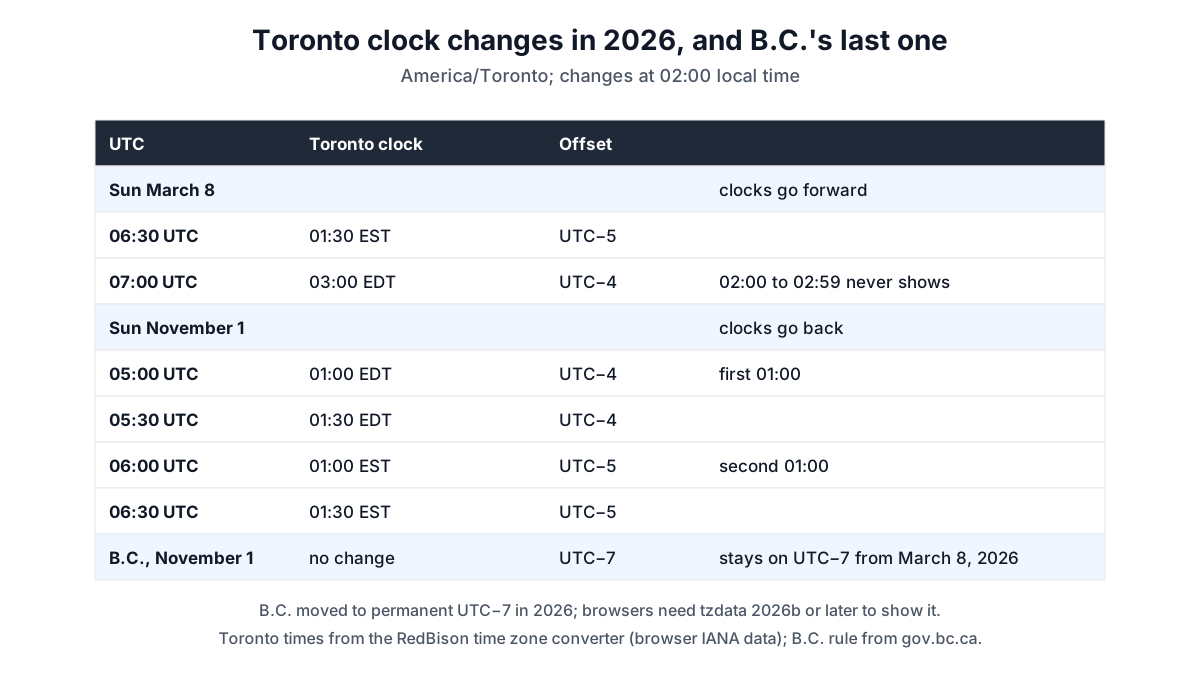
For code, the key fact is in the IANA release notes. Time Zone Database release 2026b, published April 22, 2026, models America/Vancouver as moving permanently to UTC−07 and, as a temporary workaround for limits in Unicode CLDR 48 and ICU 78, encodes the switch as happening on November 1, 2026 at 02:00. Affected timestamps carry the abbreviation "MST" in the data, not PCT. Two consequences:
- Old tz data gets Vancouver wrong from November 1, 2026. A browser, phone, server or runtime with data older than 2026b still falls back to UTC−8, so every Vancouver time it shows is an hour early. The converter uses your browser's copy of the database, so check a December date for
America/Vancouver: it should show UTC−7. - Labels may not match what people say. Your UI may print "MST" or "GMT-7" for a city whose government calls it PCT. Show the numeric offset and the city name.
If you maintain servers, update the OS tzdata package and any language runtimes that bundle their own (Java, Node.js with its own ICU, Python's tzdata package) before relying on Vancouver times after November 1, 2026.
What the change nights look like
Across most of Canada, local 02:00 to 02:59 does not exist on the second Sunday in March, and 01:00 to 01:59 happens twice on the first Sunday in November. In Toronto on March 8, 2026, a time entered as 02:30 is pushed forward to 03:30 EDT, which is 07:30 UTC. On November 1, 2026, 01:30 resolves to the first occurrence, 01:30 EDT, which is 05:30 UTC. Newfoundland changes at the same local time, so 02:30 in St. John's on March 8, 2026 becomes 03:30 NDT, 06:00 UTC.
A cron job set for 02:30 local time is skipped every March and can run twice in November. Overnight batch jobs in Canadian zones are safer at 03:00 or later, or scheduled in UTC.
Canada, the U.K. and the U.S.
Most of Canada changes on the same dates as the U.S., so Toronto to New York is always zero. The U.K. changes on different weekends, so a 9 a.m. Toronto call is 14:00 in London on October 15, 2026, 13:00 on October 28 (after the U.K. has gone back) and 14:00 again on November 4. For one week the gap is four hours.
Habits for Canadian systems
- Use the city zone, never a fixed offset.
America/ReginaandAmerica/Winnipegagree in winter and differ in summer;-06:00cannot express that. - Do not derive the zone from the province. B.C. and Ontario each contain more than one zone in practice. Ask for a city, or detect
Intl.DateTimeFormat().resolvedOptions().timeZoneand let the user change it. - Store future events as local time plus zone. A 9 a.m. Vancouver appointment next spring should be stored as 09:00
America/Vancouver. Anything converted to UTC under old rules before 2026b is an hour out after November 1, 2026. - Use ISO dates. The Canadian short date in CLDR is YYYY-MM-DD, which also sorts correctly and avoids 03/04 being read two ways.
- Log in UTC. Provinces change rules; UTC does not.
Tools for this job
- Canadian time zone converter: any date and time across Canada's zones and abroad, with the provinces that do not change clocks handled.
- World clock: live times side by side.
- Epoch converter: Unix timestamps to UTC and local time.
- Cron expression generator: check a schedule's next runs.
For counting days and durations, see the guide to date math.
Frequently asked questions
How many time zones does Canada have?
Six: Newfoundland, Atlantic, Eastern, Central, Mountain and Pacific. Newfoundland sits at UTC−3:30 in winter and UTC−2:30 in summer.
Does B.C. still change its clocks?
No. The Government of B.C. says March 8, 2026 was the final time change; the province stays on UTC−7 all year. Devices need time zone data from IANA release 2026b or later to show this correctly after November 1, 2026.
Does Saskatchewan observe daylight time?
Most of Saskatchewan stays on Central Standard Time (UTC−6) all year, according to NRC. The Lloydminster area follows Alberta and changes its clocks.
Why does my app show Vancouver an hour off in winter?
Its time zone data is older than 2026b, so it still applies the old rule and falls back to UTC−8. Update the operating system, browser or runtime that supplies the tz data.
Sources and further reading
- Time zones and daylight saving time, National Research Council Canada. Zones by province, the daylight time rule, Saskatchewan, Yukon, Quebec, Ontario and Nunavut exceptions.
- Permanent daylight saving time, Government of British Columbia. The final change on March 8, 2026, Pacific time (PCT) at UTC−7, and the northeast and southeast exceptions.
- Time Zone Database release 2026b, IANA. America/Vancouver at permanent UTC−07, the November 1, 2026 workaround and the MST abbreviation.
- Theory and pragmatics of the tz code and data, IANA. How zones are named and why future predictions can change.
- Daylight Saving Time Rules, NIST. The U.S. rule shared by most of Canada.
- When do the clocks change?, GOV.UK. The U.K. dates behind the one-week gap.
More Time Tools
Every tool in the Time Tools section, free and in your browser.