
Australian Time Zones for Developers: AEST, AEDT and IANA
Three standard zones become five in summer, Brisbane and Sydney part ways each October, and Lord Howe moves 30 minutes. How to handle Australian time in code.
By Redbison Dev · · 6 min read
Australia edition. Written for Australian developers: the state-by-state daylight saving rule from NSW, the 2026 change nights in Sydney, Queensland, WA and NT on fixed offsets, Lord Howe, Broken Hill and Eucla, and day-first dates. US edition
Australia has three standard time zones and five in summer. From the first Sunday in October to the first Sunday in April, New South Wales, Victoria, South Australia, Tasmania and the ACT move their clocks forward, while Queensland, the Northern Territory and Western Australia do not. A company with offices in Sydney and Brisbane is in one time zone for half the year and two for the other half. For developers this is a common source of Australian time bugs: treating "AEST" or a state as if it fixed the offset. This edition covers the rules, the 2026 change nights, the odd zones, and the habits that keep Australian schedules right. Conversions can be repeated in the Australian time zone converter.
The rule and who follows it
The NSW Department of Communities and Justice publishes the rule: daylight saving starts at 2am on the first Sunday in October, when clocks go forward an hour, and ends at 3am on the first Sunday in April, when they go back. NSW, Victoria, South Australia, Tasmania, the ACT and Norfolk Island observe the same period. Queensland, the Northern Territory, Western Australia, Christmas Island and the Cocos (Keeling) Islands do not. Lord Howe Island moves its clocks by 30 minutes instead of an hour.
A 9am Sydney meeting, in the converter with Australia/Sydney as the source:
| IANA zone | Where | 1 December 2026 | 1 July 2026 |
|---|---|---|---|
| Australia/Sydney | NSW, ACT (Australia/Melbourne and Australia/Hobart follow the same rule) | 09:00 (UTC+11) | 09:00 (UTC+10) |
| Australia/Brisbane | Queensland | 08:00 (UTC+10) | 09:00 (UTC+10) |
| Australia/Adelaide | South Australia | 08:30 (UTC+10:30) | 08:30 (UTC+9:30) |
| Australia/Broken_Hill | Broken Hill, NSW | 08:30 (UTC+10:30) | 08:30 (UTC+9:30) |
| Australia/Darwin | Northern Territory | 07:30 (UTC+9:30) | 08:30 (UTC+9:30) |
| Australia/Perth | Western Australia | 06:00 (UTC+8) | 07:00 (UTC+8) |
| Australia/Eucla | Eucla area, WA border | 06:45 (UTC+8:45) | 07:45 (UTC+8:45) |
| Australia/Lord_Howe | Lord Howe Island | 09:00 (UTC+11) | 09:30 (UTC+10:30) |
Three rows surprise people. Broken Hill is in New South Wales but keeps South Australian time, so it has its own IANA zone; use it rather than Australia/Sydney for an address there. The Eucla area on the Western Australian border runs at UTC+8:45 in the IANA database, as Australia/Eucla, a quarter-hour offset that breaks code assuming half hours at most. And Lord Howe's 30-minute change means it matches Sydney in summer and sits half an hour ahead in winter.
The 2026 change nights in Sydney
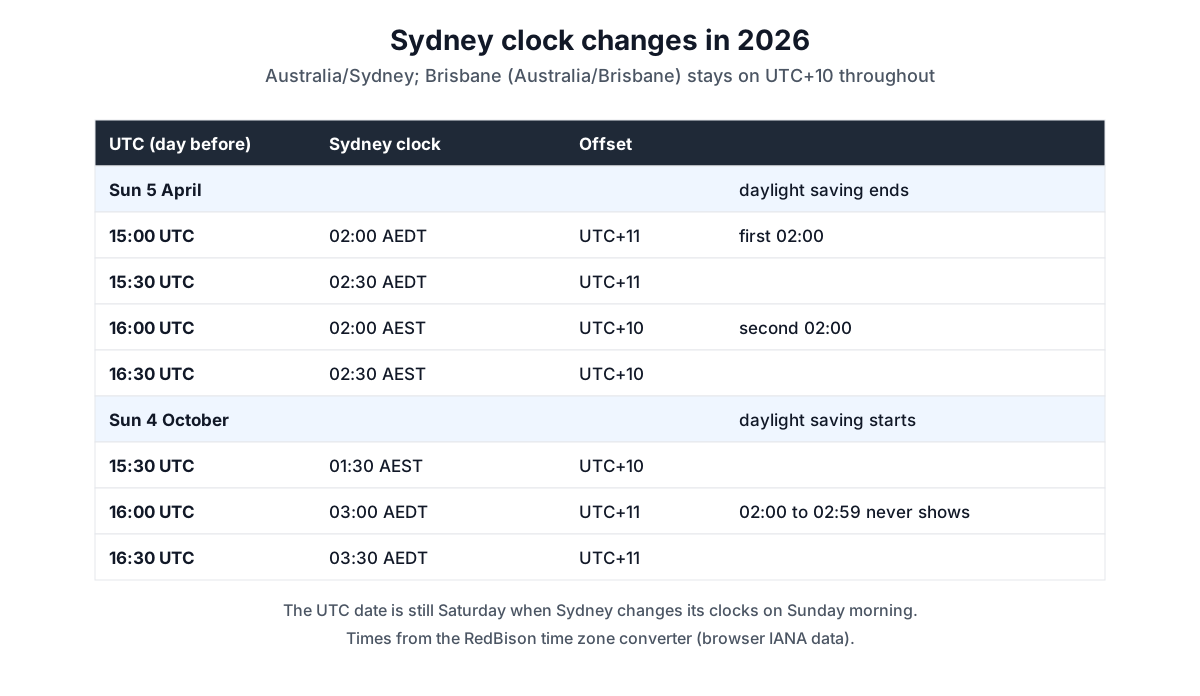
- Sunday 5 April 2026: at 3am AEDT clocks go back to 2am AEST, so local 02:00 to 02:59 happens twice. The converter resolves an ambiguous time to its first occurrence: 02:30 becomes 02:30 AEDT, which is 15:30 UTC on Saturday 4 April.
- Sunday 4 October 2026: at 2am AEST clocks go forward to 3am AEDT, so 02:00 to 02:59 never happens. A time typed in the gap is pushed forward by the gap's length: 02:30 becomes 03:30 AEDT, 16:30 UTC on Saturday 3 October.
Notice the UTC date. Sydney changes on Sunday morning, which is still Saturday in UTC. Code that looks for "the change day" by UTC date gets it wrong by a day. On Lord Howe the gap is 30 minutes: 02:15 on 4 October 2026 becomes 02:45 at UTC+11.
A nightly job set for 02:30 Australia/Sydney runs twice in April and not at all in October, depending on the scheduler. Schedule overnight work at 03:30 or later, or in UTC.
AEST, AEDT and other labels
AEST (UTC+10), AEDT (UTC+11), ACST (UTC+9:30), ACDT (UTC+10:30) and AWST (UTC+8) are display labels. The IANA project's notes warn that abbreviations "are ambiguous in practice". Their own example is CST, which means different things in China and North America, so a shortened label such as "EST" or "CST" cannot tell you which country is meant. Two habits follow:
- Never parse an abbreviation into an offset. Store the zone name, such as
Australia/Brisbane, and compute the label. - Show the numeric offset with the label. "09:00 AEST (UTC+10)" lets a reader in Perth check it.
The labels also mislead in summer: a Brisbane meeting in December is AEST, a Sydney one AEDT, and both are "eastern time".
Australia and the UK
Australia's summer is the UK's winter, so the gap between Sydney and London takes three values. A 6pm call from Sydney lands in London at 07:00 on 10 November 2026 (11 hours), 08:00 on 1 April 2026 and 20 October 2026 (10 hours, when only one country has changed), and 09:00 on 10 June 2026 (9 hours). The UK changes on the last Sundays in March and October, Sydney on the first Sundays in April and October, so the 10-hour windows are about a week from late March and about three weeks in October.
Habits for Australian systems
- Use the city zone, not the state. Sydney, Broken Hill and Lord Howe are all in New South Wales and have three different offsets in winter (UTC+10, UTC+9:30 and UTC+10:30) and two in summer.
- Never use
Australia/Brisbanefor a Sydney customer to "avoid daylight saving". It fixes the offset but shows every summer appointment an hour early. - Store future events as local time plus zone. A 9:00
Australia/Melbourneappointment next February is stored as exactly that, then converted for display. - Format with
en-AU.new Intl.DateTimeFormat('en-AU', { timeZone: 'Australia/Sydney', dateStyle: 'short', timeStyle: 'short' })gives day-first dates that Australian readers expect. - Log in UTC with an explicit
Z, and remember the UTC date can differ from the local one.
Tools for this job
- Australian time zone converter: any date and time across the states and overseas, with daylight saving only where it applies.
- World clock: current times in several cities.
- Epoch converter: Unix timestamps to UTC and local time.
- Cron expression generator: check when a schedule fires.
For durations and date differences, see the guide to date math.
Frequently asked questions
When does daylight saving start and end in 2026?
In NSW, Victoria, South Australia, Tasmania and the ACT it ended at 3am on Sunday 5 April 2026 and started at 2am on Sunday 4 October 2026: the first Sundays of those months under the NSW rule.
Why is Brisbane an hour behind Sydney in summer?
Queensland does not observe daylight saving, so Brisbane stays on UTC+10 while Sydney moves to UTC+11 from October to April. From April to October the two cities agree.
What time zone is Broken Hill in?
South Australian time, even though it is in New South Wales: UTC+9:30 in winter and UTC+10:30 in summer. The IANA zone is Australia/Broken_Hill.
How far behind Sydney is Perth?
Two hours from April to October and three hours from October to April. Perth stays on UTC+8 all year.
Sources and further reading
- Daylight saving, NSW Department of Communities and Justice. The start and end rule, which states and territories observe it, and Lord Howe Island's 30-minute change.
- Time Zone Database, IANA. The data behind Australia/Sydney, Australia/Broken_Hill, Australia/Eucla and the other zones.
- Theory and pragmatics of the tz code and data, IANA. Zone naming rules and why abbreviations are ambiguous.
- When do the clocks change?, GOV.UK. The UK dates behind the 10-hour weeks.
- Intl.DateTimeFormat, MDN Web Docs. Formatting a time in an IANA zone in JavaScript.
- RFC 3339: Date and Time on the Internet: Timestamps, IETF. Timestamps with explicit offsets.
More Time Tools
Every tool in the Time Tools section, free and in your browser.