
GMT, BST and Europe/London: Time Zones for UK Developers
Why GMT is not the same as UK time, how BST changes at 01:00 UTC, the weeks London and New York are four hours apart, and storing times safely in UK systems.
By Redbison Dev · · 6 min read

United Kingdom edition. Built around Europe/London: the Summer Time Act 1972 rule, the 2026 and 2027 clock-change dates from GOV.UK, day-first dates, and UK teams working with the US, India and Australia. US edition
"UK time" is not GMT for seven months of the year. From the last Sunday in March to the last Sunday in October the UK runs on British Summer Time, one hour ahead of GMT and of UTC. Many UK time bugs come from that one fact: a label that says GMT on a dashboard, a log written in local time, a meeting fixed in UTC that drifts by an hour every spring. This edition covers the rules behind Europe/London, the awkward weeks when the UK and US are out of step, and the habits that keep UK systems right. Every conversion here can be repeated in the UK time zone converter.
GMT, UTC, BST and Europe/London are four different things
| Name | What it is | Offset |
|---|---|---|
| UTC | The world reference time scale; never changes for summer | UTC+0 |
| GMT | Greenwich Mean Time, the UK's civil time in winter | UTC+0 |
| BST | British Summer Time, GMT plus one hour | UTC+1 |
| Europe/London | The IANA zone: the rules for which of GMT or BST applies on each date, back through history | UTC+0 or UTC+1 |
GMT and UTC show the same clock time, which is why they get used interchangeably, but "GMT" in a UI label is wrong half the year if the times shown are UK local. If you mean the reference scale, write UTC. If you mean whatever the clocks in London say, store and display Europe/London.
The legal rule is in the Summer Time Act 1972, section 1: during summer time the time in Great Britain is "one hour in advance of Greenwich mean time", and summer time runs from one o'clock GMT on the last Sunday in March to one o'clock GMT on the last Sunday in October. GOV.UK states the same rule in wall-clock terms, clocks go forward at 1am and back at 2am, and lists the dates:
| Year | Clocks go forward | Clocks go back |
|---|---|---|
| 2026 | 29 March | 25 October |
| 2027 | 28 March | 31 October |
What the change looks like to code
Because both changes happen at 01:00 UTC, the UK wall clock skips an hour in March and repeats one in October:
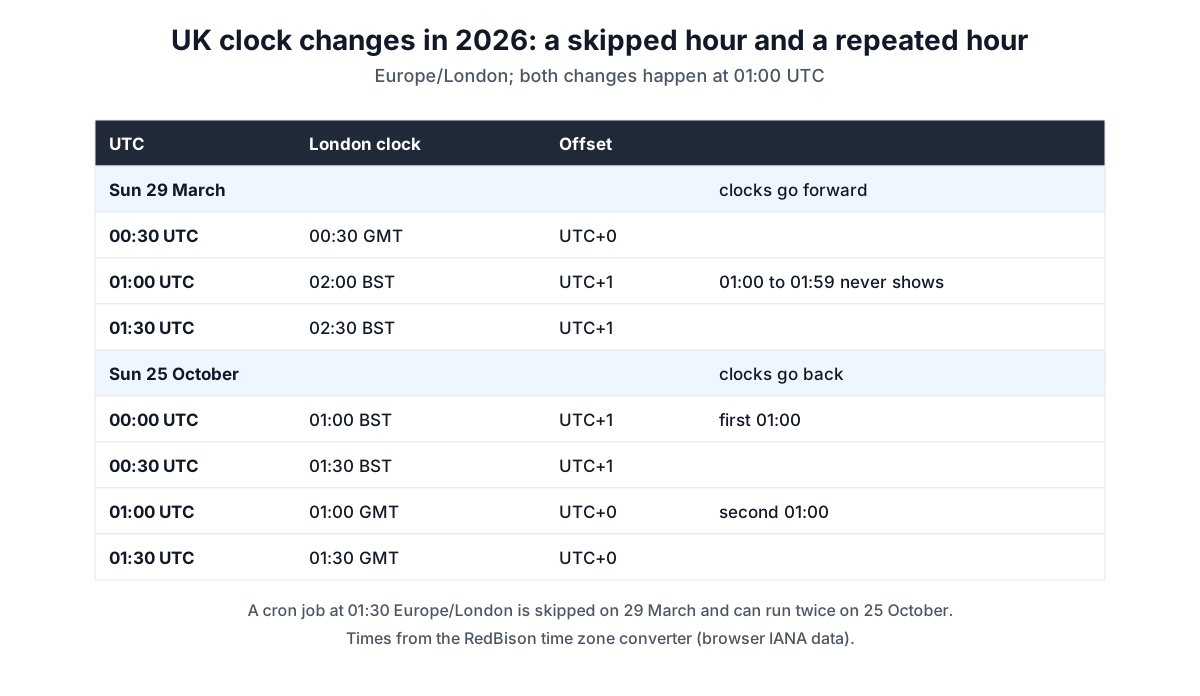
- 29 March 2026: local 01:00 to 01:59 does not exist. The converter, like many date libraries, pushes a nonexistent time forward by the gap, so 01:30 entered as London time becomes 02:30 BST, which is 01:30 UTC.
- 25 October 2026: local 01:00 to 01:59 happens twice, first on BST, then on GMT. An ambiguous time resolves to the first, so 01:30 becomes 01:30 BST, which is 00:30 UTC. If you mean the second one, give the offset:
2026-10-25T01:30+00:00.
A nightly job scheduled at 01:30 Europe/London is the classic casualty: no run on 29 March, possibly two on 25 October, depending on the scheduler. UK batch work that must run exactly once a night is safer at 02:30 or later local time, or scheduled in UTC with the local time worked out for display.
The weeks London and New York are four hours apart
The US changes clocks on the second Sunday in March and the first Sunday in November; the UK on the last Sundays of March and October. So "five hours" is wrong for about four weeks a year. A 09:00 New York stand-up, in the converter with America/New_York as the source:
| Date of the call | New York | London | Gap |
|---|---|---|---|
| Monday 16 March 2026 | 09:00 EDT (UTC−4) | 13:00 GMT | 4 hours |
| Monday 30 March 2026 | 09:00 EDT (UTC−4) | 14:00 BST | 5 hours |
| Monday 26 October 2026 | 09:00 EDT (UTC−4) | 13:00 GMT | 4 hours |
| Monday 2 November 2026 | 09:00 EST (UTC−5) | 14:00 GMT | 5 hours |
From 8 March to 28 March 2026 and from 25 October to 31 October 2026, a call booked by the US side lands an hour earlier in London. A UK-owned calendar invite set in Europe/London moves for the US side instead. Neither is a bug; it is the zone rules working as written, and the reason invites should carry a zone name rather than a fixed offset.
India and Australia from a London desk
India stays on UTC+5:30 all year, so the gap from London is 5 hours 30 minutes in winter and 4 hours 30 minutes during BST. A 09:00 London call is 14:30 in Bengaluru on 14 January 2026 and 13:30 on 15 July 2026.
Australia is harder because its daylight saving runs the opposite way to the UK's. Sydney (Australia/Sydney) is on UTC+11 from the first Sunday in October to the first Sunday in April and UTC+10 otherwise, so the London to Sydney gap takes three values:
| 09:00 in London on | Sydney | Gap |
|---|---|---|
| 14 January 2026 | 20:00 | 11 hours |
| 31 March 2026 | 19:00 | 10 hours |
| 7 April 2026 | 18:00 | 9 hours |
| 15 July 2026 | 18:00 | 9 hours |
| 6 October 2026 | 19:00 | 10 hours |
| 27 October 2026 | 20:00 | 11 hours |
The 10-hour weeks are the stretches when only one country has changed: after the UK goes forward and before Sydney goes back, and after Sydney goes forward and before the UK goes back.
Abbreviations that collide with UK ones
The IANA tz project's own notes say time zone abbreviations "are ambiguous in practice". Two that matter in the UK:
- BST is British Summer Time (UTC+1) and also Bangladesh Standard Time (UTC+6).
- IST is India Standard Time (UTC+5:30) and Irish Standard Time, Ireland's summer time (UTC+1). A London team with offices in Dublin and Bengaluru can read "10:00 IST" two ways.
Store zone names, and show a numeric offset next to any abbreviation in a UI so a reader can check it. Dublin and London agree all year on wall-clock time, but they are separate zones (Europe/Dublin, Europe/London); do not merge them in a picker.
Habits that keep UK systems right
- Log in UTC, with the
Z. Logs in UK local time look an hour behind UTC-stamped logs from other systems all summer, and the October repeat hour makes local logs ambiguous. - Store future events as local time plus
Europe/London. A 09:00 hearing, delivery slot or shift next July should be stored as 09:00 in that zone, then converted for display. Converting it to UTC today bakes in this year's rules. - Format with
en-GBand a zone.new Intl.DateTimeFormat('en-GB', { timeZone: 'Europe/London', dateStyle: 'short', timeStyle: 'short' })gives day-first dates and the 24-hour clock that UK users expect. - Add calendar days, not 24 hours. Across 29 March, "tomorrow at 09:00" is 23 hours away; across 25 October it is 25.
- Keep the tz data current. The IANA database predicts future times, and its own notes warn that those predictions become wrong when governments change the rules. Browsers, operating systems and runtimes update it on their own release cycles.
Tools for this job
- UK time zone converter: any date and time from London to other zones, with GMT and BST applied on the right dates.
- World clock: the current time in several cities at once.
- Epoch converter: Unix timestamps to UTC and local time when debugging logs.
- Cron expression generator: build a schedule and check when it fires.
For date arithmetic around the clock change, the UK guide to age and time calculations covers day counts and durations.
Frequently asked questions
Is the UK on GMT or BST now?
It depends on the date. GMT (UTC+0) runs from the last Sunday in October to the last Sunday in March and BST (UTC+1) the rest of the year. In 2026 BST began on 29 March and ended on 25 October.
Should I use GMT or UTC in logs and APIs?
UTC. It is the reference scale and never changes. GMT is the UK's winter civil time, and labelling summer UK local times "GMT" is a common error.
How many hours behind is New York from the UK?
Usually five. It is four from the second Sunday in March to the last Sunday in March, and for the week from the last Sunday in October to the first Sunday in November, because the two countries change clocks on different weekends.
What happens to 01:30 on the night the clocks go back?
It happens twice. The converter reads a time typed in that hour as the first, still on BST. To mean the second, add the offset (+00:00) or pick a time after 02:00.
Sources and further reading
- When do the clocks change?, GOV.UK. The rule and the 2026 and 2027 dates.
- Summer Time Act 1972, section 1, legislation.gov.uk. Summer time as GMT plus one hour, from 01:00 GMT on the last Sunday in March to the last Sunday in October.
- Time Zone Database, IANA. The data behind
Europe/Londonin browsers and runtimes. - Theory and pragmatics of the tz code and data, IANA. Zone naming, ambiguous abbreviations and why future predictions can change.
- Daylight Saving Time Rules, NIST. The US rule that sets the four-hour weeks.
- Time in the Republic of Ireland, Wikipedia. Irish Standard Time as Ireland's UTC+1 summer time under the Standard Time Acts 1968 and 1971.
- RFC 3339: Date and Time on the Internet: Timestamps, IETF. Timestamps with explicit offsets.
More Time Tools
Every tool in the Time Tools section, free and in your browser.