
Standard Drinks and the NZ Alcohol Limit: 250 and Zero
How NZ cans, bottles, RTDs and wine become standard drinks and a blood alcohol estimate, what 250 mcg means, the zero limit under 20, and the morning after.
By Redbison Dev · · 7 min read
New Zealand edition. Written for New Zealand drivers: 10 g standard drinks, 330 ml cans and bottles, RTDs and 150 ml wine pours, the 250 mcg breath and 50 mg blood limit for drivers 20 and over, the zero limit under 20, and Health NZ's lower-risk advice. US edition
In New Zealand a driver aged 20 or over is over the limit above 250 micrograms of alcohol per litre of breath, which the law pairs with 50 milligrams per 100 millilitres of blood. A driver under 20 has a limit of zero. A standard drink here is 10 g of pure alcohol, and most cans, bottles, RTDs and glasses of wine are more than one. The NZ version of the Blood Alcohol Calculator turns what you drank into standard drinks and an average blood alcohol estimate. This guide shows how it does that, why the same estimate means different things for a 19-year-old and a 45-year-old, and why no number on the screen tells you it is fine to drive.
Two limits, written two ways
NZ Police set out the rules plainly: 250 mcg per litre of breath or 50 mg per 100 ml of blood for drivers 20 and over, and zero for drivers under 20. If the roadside screening test reads over 250, you are asked to take an evidential breath test, usually in a booze bus or at a station. If that confirms you are over, Police say you will likely be forbidden to drive for 12 hours, so someone else has to drive you and the car home.
The breath figure and the blood figure describe the same level. 50 mg per 100 ml is 500 mg per litre of blood, and 500,000 micrograms divided by 250 is 2,000: the pairing treats a litre of blood as holding about 2,000 times the alcohol in a litre of breath. That gives a quick conversion for reading the calculator:
| Calculator shows | Blood, mg per 100 ml | Breath, mcg per litre |
|---|---|---|
| 0.020% | 20 | 100 |
| 0.050% | 50 | 250 (adult limit) |
| 0.080% | 80 | 400 |
| 0.100% | 100 | 500 |
Multiply the percentage by 1,000 for blood in mg, then by 5 for breath in mcg. The calculator estimates blood, so 0.047% means about 47 mg, or about 235 mcg on a breath device if the 2,000 ratio held for you. Real breath-to-blood ratios vary from person to person, which is one more reason the estimate is not a reading.
NZ standard drinks: read the label first
Health New Zealand | Te Whatu Ora defines a standard drink as 10 g of pure alcohol, and every can, bottle and cask sold here must say how many it contains. Its own examples of one standard drink are a 330 ml can of 4% beer or cider, a 100 ml pour of 12.5% wine and a 30 ml pour of 42% spirits. The serves people actually buy are larger or stronger:
| Serve | Grams of alcohol | NZ standard drinks |
|---|---|---|
| 330 ml can of 4% beer or cider | 10.4 | 1.0 |
| 330 ml bottle of 5% lager | 13.0 | 1.3 |
| 440 ml can of 6% craft IPA | 20.8 | 2.1 |
| 250 ml RTD at 7% | 13.8 | 1.4 |
| 150 ml glass of 13% sauvignon blanc | 15.4 | 1.5 |
| 750 ml bottle of 13% wine | 76.9 | 7.7 |
The calculator gets grams from millilitres x ABV x 0.789, the density of ethanol, and divides by 10 for NZ standard drinks. A 440 ml craft can at 6% holds as much alcohol as two standard cans, and an RTD tastes lighter than its strength. That is why the label number beats counting "drinks".
Lower-risk drinking is a health limit, not a driving limit
Health NZ recommends no more than 2 standard drinks a day and 10 a week for women, 3 a day and 15 a week for men, at least two alcohol-free days a week, and on any single occasion no more than 4 for women and 5 for men. It also says not to drink at all if you are about to drive or operate machinery. Those numbers are about long-term and injury risk. As the examples below show, someone inside them can still be over 50 mg.
The estimate, step by step
The calculator uses the Widmark formula: grams of alcohol divided by body weight times a body-water factor (0.68 for men, 0.55 for women), minus an average fall of 0.015% an hour from the first drink. Healthify, the NZ health information site, puts the liver's pace at 1 to 2 hours for each standard drink, which is the same idea in everyday terms.
Example 1, three bottles after work. An 80 kg man has three 330 ml bottles of 5% lager over two hours:
- 39.1 g of alcohol, 3.9 standard drinks
- peak if absorbed at once: 0.072% (72 mg)
- estimate after two hours: 0.042% (42 mg, about 210 mcg breath)
- about zero after 2 h 47 min more
On the average he is under the adult limit, close enough that an empty stomach or a slower liver could put him over it. If he were 19, he would be over his limit until the alcohol had gone, nearly three more hours.
Example 2, three RTDs. A 60 kg woman drinks three 250 ml RTDs at 7% over two hours:
- 41.4 g, 4.1 standard drinks, just over Health NZ's single-occasion limit of 4 for women
- estimate after two hours: 0.096% (96 mg, about 480 mcg)
- below 50 mg in about 3 h 02 min; about zero in 6 h 22 min
Almost the same grams as example 1, but a lighter body with less water per kilogram gives more than double the estimate.
Example 3, half a bottle of wine at a wedding. A 68 kg woman drinks 375 ml of 13% wine over three hours:
- 38.5 g, 3.8 standard drinks
- estimate after three hours: 0.058% (58 mg)
- below 50 mg in about 31 min; about zero in 3 h 51 min
She is inside Health NZ's single-occasion limit of 4 standard drinks and still estimated over the driving limit as the speeches finish.
Example 4, one can at 19. A 70 kg 19-year-old has one 330 ml can of 4% beer and waits an hour. The estimate is 0.007% with about 28 minutes to zero. Under 20, any alcohol is over the limit, so the only number that matters is zero.
The morning after a big night
Sleep does not speed up the liver. A long session ending at midnight can leave someone over a limit at breakfast.
Example 5, the drive home from the bach. An 80 kg 19-year-old drinks twelve 330 ml bottles of 5% lager between 4 pm and midnight, sleeps, and plans to drive home at 8 am:
- 156.2 g of alcohol, 15.6 standard drinks
- estimate at midnight: 0.167% (167 mg)
- estimate at 8 am, 16 hours after the first bottle: 0.047% (47 mg)
- about zero at 11:09 am
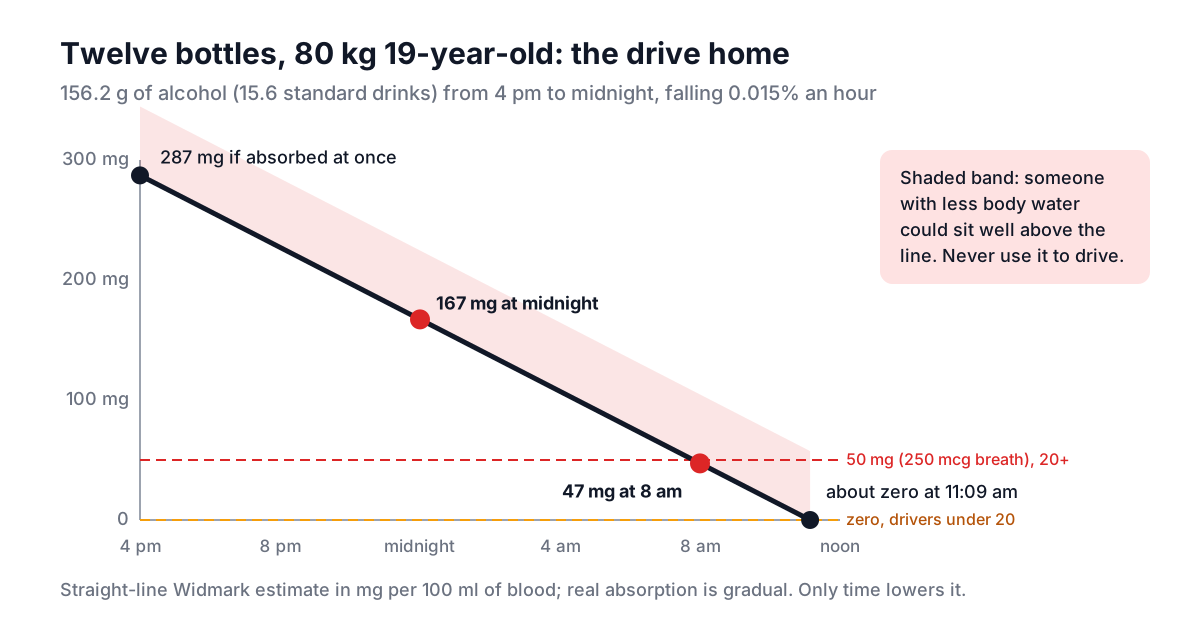
At 8 am the estimate is just under the adult line. For a driver under 20 the zero limit applies, and on the average he is over it until about 11 am. A slower clearer, a lighter build or a later last drink pushes that past lunchtime.
Why the calculator cannot clear you to drive
Every input is an average. Body water depends on build, not just weight and sex; food slows absorption; medicines, liver health and drinking history change the rate of clearance. Searle's review of the formula shows that a single estimate carries a wide margin of error in both directions. The calculator also assumes all the alcohol was absorbed at the first drink, while a real level can keep rising after the last one.
So use it to learn what your usual drinks contain and how long they take to clear, and plan the trip home before the first drink: a sober driver, a taxi or rideshare, public transport, or staying the night.
If someone has drunk a lot and cannot be woken, is breathing slowly or irregularly, or has stopped breathing, call 111 for an ambulance, put them on their side and stay with them. Healthify warns that drinking a lot at once can slow or stop breathing.
Tools for this job
- Blood Alcohol Calculator (New Zealand): NZ standard drinks, an estimate in percent, and the time to fall below 50 mg and to zero.
- Hydration Calculator: a water target for the day after.
- Sleep Calculator: plan a bedtime, remembering that sleep does not lower blood alcohol.
The US guide to blood alcohol compares standard drinks across countries if you are travelling.
Frequently asked questions
How many drinks can I have and stay under 250?
There is no number you can rely on. NZ Police say it depends on your sex, your size and how much you have eaten. In the examples above, three bottles leave an 80 kg man at an estimated 42 mg after two hours, while three RTDs put a 60 kg woman at 96 mg.
Is the limit really zero for drivers under 20?
Yes. Drivers under 20 must have no alcohol in their breath or blood. One 330 ml can of 4% beer still leaves some alcohol in a 70 kg driver an hour later, and a big night can leave a young driver over zero well into the next morning.
What does 250 mcg mean as a blood alcohol percentage?
250 micrograms per litre of breath corresponds to 50 mg per 100 ml of blood, which is 0.05% on the calculator. Multiply a percentage by 1,000 for mg and by 5 for mcg of breath.
How many standard drinks are in a bottle of wine?
A 750 ml bottle of 13% wine holds about 7.7 NZ standard drinks, and a 150 ml glass about 1.5. The label states the exact number for that bottle.
Does staying within Health NZ's lower-risk limits keep me legal to drive?
No. They are health limits. In example 3, a woman inside the single-occasion limit is still estimated over 50 mg. Health NZ's own advice is not to drink if you are about to drive.
Sources and further reading
- Being safe: road rules and reasons, New Zealand Police. 250 mcg and 50 mg for drivers 20 and over, zero under 20, the evidential breath test and the 12-hour stand-down.
- Drinking responsibly, Health New Zealand | Te Whatu Ora. The 10 g standard drink, label rule, examples and lower-risk limits.
- Alcohol, Healthify He Puna Waiora. One to two hours to break down a standard drink, effects on breathing, never drink and drive.
- Alcohol calculations and their uncertainty, Medicine, Science and the Law. Searle on the Widmark formula and its error range.
- Evidence-based survey of the elimination rates of ethanol from blood, Forensic Science International. Jones, 2010, on how fast people clear alcohol.
More Wellness Tools
Every tool in the Wellness Tools section, free and in your browser.