
Hourly Rate to Salary, Overtime and Pay Rises in NZ
Convert NZ hourly pay to an annual salary with paid holidays, check overtime and long salaried hours against the $23.95 minimum wage, and price public holiday work.
By Redbison Dev · · 8 min read
New Zealand edition. Written for New Zealand employees: the $23.95 adult minimum wage from 1 April 2026, four weeks of annual holidays and 11 national public holidays plus an anniversary day, no statutory overtime rate but time and a half for public holiday work, and pay rises tested against inflation. US edition
At New Zealand's adult minimum wage of $23.95 an hour from 1 April 2026, a 40-hour week pays $958 and a year $49,816 before tax, or $1,916 a fortnight. Annual holidays and public holidays are paid, so the yearly figure counts all 52 weeks. Overtime has fewer rules than many people think: there is no legal rate for it, only what your employment agreement says, as long as every hour is paid at least the minimum wage. The one fixed premium is public holiday work, which must be paid at least time and a half. This guide works through those numbers with the Salary and Wage Converter (NZ), the Overtime Calculator and the Pay Raise Calculator; all amounts are NZ dollars and gross. For a dispute, Employment New Zealand has free guidance.
Hourly to annual
Employment New Zealand quotes its weekly figures on a 40-hour week, and so does this guide:
| Rate from 1 April 2026 | Hour | 8-hour day | 40-hour week | 80-hour fortnight | Year (52 weeks) |
|---|---|---|---|---|---|
| Adult minimum wage | $23.95 | $191.60 | $958.00 | $1,916.00 | $49,816 |
| Starting-out and training | $19.16 | $153.28 | $766.40 | $1,532.80 | $39,852.80 |
A fortnight is the year divided by 26, not a month split in two: $49,816 ÷ 26 = $1,916. A month is $49,816 ÷ 12 = $4,151.33, not four weeks of $958.
Holidays: paid, so they do not shrink the year
All employees become entitled to 4 weeks of annual holidays after 12 months of continuous employment. There are 11 national public holidays (New Year's Day, the day after, Waitangi Day, Good Friday, Easter Monday, Anzac Day, King's Birthday, Matariki, Labour Day, Christmas Day and Boxing Day) plus your region's anniversary day, 12 days in all for most people.
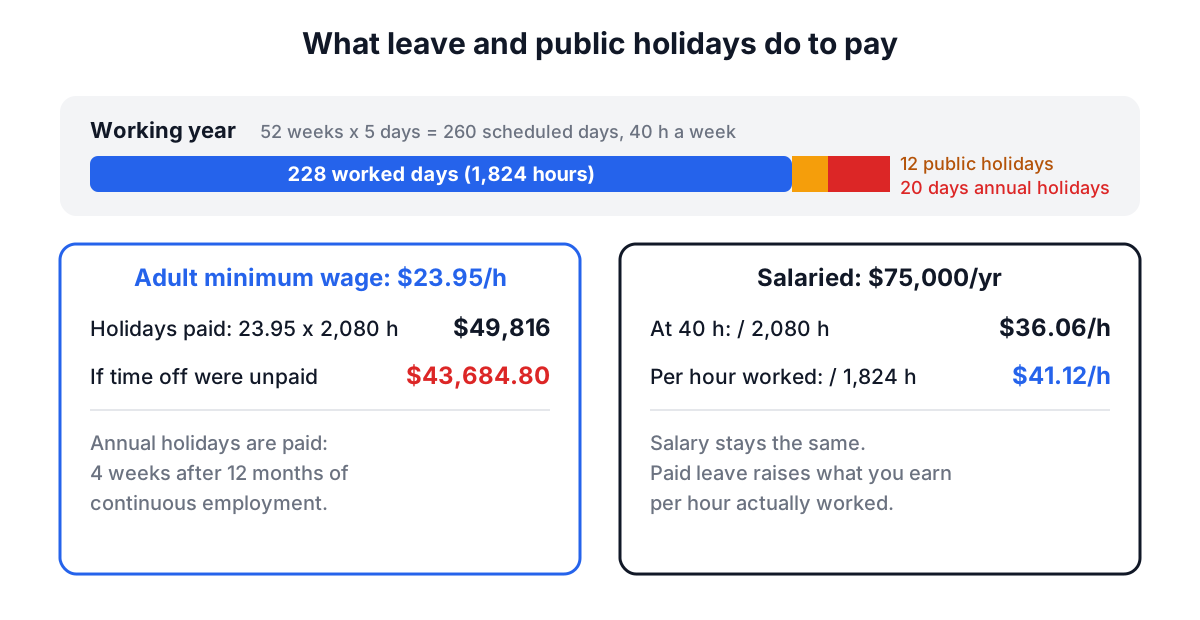
On a 40-hour, five-day week there are 260 scheduled days; take off 12 public holidays and 20 days of annual holidays and 228 remain, or 1,824 hours. Two consequences:
- A minimum wage earner's $49,816 is earned over 1,824 hours at work, which is $27.31 for each hour actually worked. If the time off were unpaid, the year would be $43,684.80, so paid holidays are worth $6,131.20.
- A $75,000 salary is $36.06 per paid hour at 40 hours, but $41.12 per hour actually worked. That is the figure to compare with contracting or casual work that pays nothing for days off.
Overtime: set by your agreement
Employment New Zealand does not set an overtime rate. Paying for overtime or extra shifts has to be agreed between employer and employee and written into the employment agreement; it can be built into a salary or paid at the normal rate, but it must be at least the minimum wage.
Salaried and working long hours
The minimum wage floor is where long salaried hours can go wrong. Take a $50,000 salary:
| Hours actually worked every week | Pay per hour ($50,000 ÷ 52 ÷ hours) | Against $23.95 |
|---|---|---|
| 40 | $24.04 | just above |
| 45 | $21.37 | below |
| 50 | $19.23 | below |
At 45 hours a week, every week, this salary works out under the minimum wage. The exact test depends on how hours are recorded and averaged in your pay period, so treat this as a prompt to check your agreement and your records, not a ruling.
Overtime at time and a half, if your agreement says so
Where an agreement does pay a premium, the calculator shows it. For someone on $28 an hour with time and a half after 40 hours, a 46-hour week is:
40 × $28.00          = $1,120.00
 6 × $42.00 (1.5×)   =   $252.00
Total                = $1,372.00   (an average of $29.83 an hour)
At the normal rate for the extra hours, the same week would be $1,288. Enter your agreement's threshold and multiplier in the Overtime Calculator.
Availability clauses
If your agreement makes you available for extra hours beyond your guaranteed hours, Employment New Zealand says that is only allowed where the agreement sets out agreed hours including guaranteed hours, the employer has genuine reasons on reasonable grounds, and you are reasonably compensated for being available. Without a valid clause, you can refuse work outside your guaranteed hours, and the employer cannot cut your shifts or give you only unpopular ones for refusing.
Working on a public holiday
This is the one statutory premium. If you work on a public holiday you must be paid at least time and a half:
| Hourly rate | 8-hour public holiday shift at 1.5× |
|---|---|
| $23.95 (adult minimum wage) | $287.40 |
| $28.00 | $336.00 |
Whether you also get an alternative day off depends on whether the day would otherwise have been a working day for you; Employment New Zealand has a separate page on alternative holidays. In the Overtime Calculator, enter the shift as all overtime (threshold 0, multiplier 1.5) to see the pay.
Pay rises against inflation
A rise is measured against the old pay, and its real value depends on inflation:
real rise = (1 + rise) ÷ (1 + inflation) − 1
Stats NZ publishes the consumers price index every quarter. Its September 2026 quarter release, published on 22 October 2026, put annual inflation at 3.7%. On a $75,000 salary:
| Rise | New salary | Extra a year | Real change at 3.7% inflation |
|---|---|---|---|
| 3% | $77,250 | $2,250 | −0.68% |
| 3.7% | $77,775 | $2,775 | 0.00% |
| 5% | $78,750 | $3,750 | +1.25% |
When a newer quarter is out, enter its annual figure in the Pay Raise Calculator instead.
A rise that only matches inflation keeps your buying power level; anything less is a cut in real terms. Minimum wage earners can compare the new rate each 1 April with the CPI change over the year before.
Frequently asked questions
Do I get time and a half for overtime in NZ?
Only if your employment agreement says so. Employment New Zealand says overtime pay must be agreed between employer and employee and can be built into a salary or paid at the normal rate, provided it is at least the minimum wage. Public holiday work is different: it must be paid at least time and a half.
What is the minimum wage as an annual salary in NZ?
$23.95 an hour from 1 April 2026 is $958 for a 40-hour week and $49,816 a year before tax, with annual holidays and public holidays paid. The starting-out and training minimum wage of $19.16 is $39,852.80 a year.
Can a salary be below the minimum wage if I work long hours?
Yes. Overtime pay must be at least the minimum wage, so a $50,000 salary for 50 hours a week, about $19.23 an hour, would be below the $23.95 adult minimum. Check your agreement and the hours recorded for your pay period.
How many public holidays are there in New Zealand?
Eleven national public holidays, including Matariki, plus a regional anniversary day, so 12 for most employees.
Sources and further reading
- Minimum wage rates and types, Employment New Zealand. Adult, starting-out and training rates from 1 April 2026.
- Annual holidays, Employment New Zealand. Four weeks after 12 months of continuous employment.
- Public holidays and anniversary dates, Employment New Zealand. The 11 national holidays and regional anniversary days.
- Public holidays rights for employees, Employment New Zealand. A maximum of 12 public holidays a year and at least time and a half for working on one.
- Working overtime or extra shifts, Employment New Zealand. Overtime pay by agreement, at least the minimum wage; availability clauses.
- Annual inflation at 3.7 percent in September 2026, Stats NZ, 22 October 2026. CPI up 3.7% in the 12 months to the September 2026 quarter.
- Consumers price index, Stats NZ. The quarterly CPI used to test a pay rise.
More Pay & Shopping
Every tool in the Pay & Shopping section, free and in your browser.