
How Much Should Your Emergency Fund Be in NZ?
Build an emergency fund in NZ dollars from Sorted's $1,000 starter to three to six months of costs, with weekly rent converted and no guaranteed redundancy pay.
By Redbison Dev · · 9 min read
New Zealand edition. Written for New Zealanders: NZD, weekly rent converted to monthly, Sorted's $1,000 starter and three-to-six-month guidance, the fact that NZ law does not require redundancy pay, 10 days of sick leave, and how a partner's income affects Jobseeker Support. US edition
Sorted, the government-backed money guidance service, recommends starting with an emergency fund of $1,000 and building it to cover three to six months of expenses, kept somewhere easy to reach but separate from everyday money. For redundancy in particular it suggests at least three months. Two New Zealand facts make that advice sharper than it looks: an employer does not have to pay redundancy compensation unless your agreement says so, and a partner's income can stop a Jobseeker Support claim altogether. This guide sizes the fund with the NZ emergency fund calculator for a renting household. It explains the arithmetic and the rules; it is not personal financial advice.
Start with weekly rent
Rents in New Zealand are quoted weekly, and the calculator works in months, so convert first: weekly rent x 52 / 12. $560 a week is $2,427 a month; $650 a week is $2,817. Dividing a weekly figure by 4 understates the month by about 8%, because a year has 52 weeks, not 48.
A renting couple's essential costs might look like this:
| Essential | Monthly |
|---|---|
| Rent ($560 a week) | $2,427 |
| Power, internet and phone | $300 |
| Groceries | $900 |
| Insurance (car, contents, health, life) | $250 |
| Petrol, bus fares and parking | $320 |
| Minimum debt repayments | $150 |
| Other must-pays | $100 |
| Total | $4,447 |
Leave out KiwiSaver contributions above what your employer deducts, extra loan repayments, takeaways and holidays.
Redundancy pay is not guaranteed
Employment New Zealand is clear that an employer does not have to provide redundancy compensation. You receive it only if it is in your employment agreement, a workplace policy, or something you agree with your employer. Your final pay must still include wages owed and holiday pay, plus any redundancy compensation you are entitled to, and you are owed the notice period in your agreement or, if none is stated, a reasonable period.
So check your agreement. If it has no redundancy clause, your notice period and holiday pay may be all that bridges the gap to the next job, and the fund should sit at the upper end of the range. The NZ version of the calculator adds a month when you tick "No redundancy pay in my employment agreement".
Sick leave covers short illnesses only
Eligible employees get 10 days of paid sick leave a year. That handles a bad flu, not a long illness or injury. ACC covers accidents, but for illness the fund is what keeps the rent paid.
Don't count on Jobseeker Support if your partner works
Jobseeker Support is income-tested on you and your partner together. Work and Income gives the weekly income limit, before tax, as $693 for a single person aged 25 or over and $957 for a sole parent, with the payment reducing as income rises and stopping once it reaches nothing. For a couple where one partner keeps working, that partner's wage can reduce the payment to zero.
The flip side is that the working partner's pay is itself income that continues. If $2,200 a month of a partner's after-tax pay would still go to these bills, enter it as "Income that would continue" and the fund only covers the gap.
How long it takes
Starting from Sorted's $1,000 and saving $400 a month at 3.5%:
| Target | Amount | Reached |
|---|---|---|
| One month of costs | $4,447 | month 9 |
| Three months, partner's $2,200 counted | $6,741 | month 14 |
| Three months, nothing counted | $13,341 | month 30 |
| Four months (children at home) | $17,788 | month 40 |
| Five months (children, no redundancy clause) | $22,235 | month 50 |
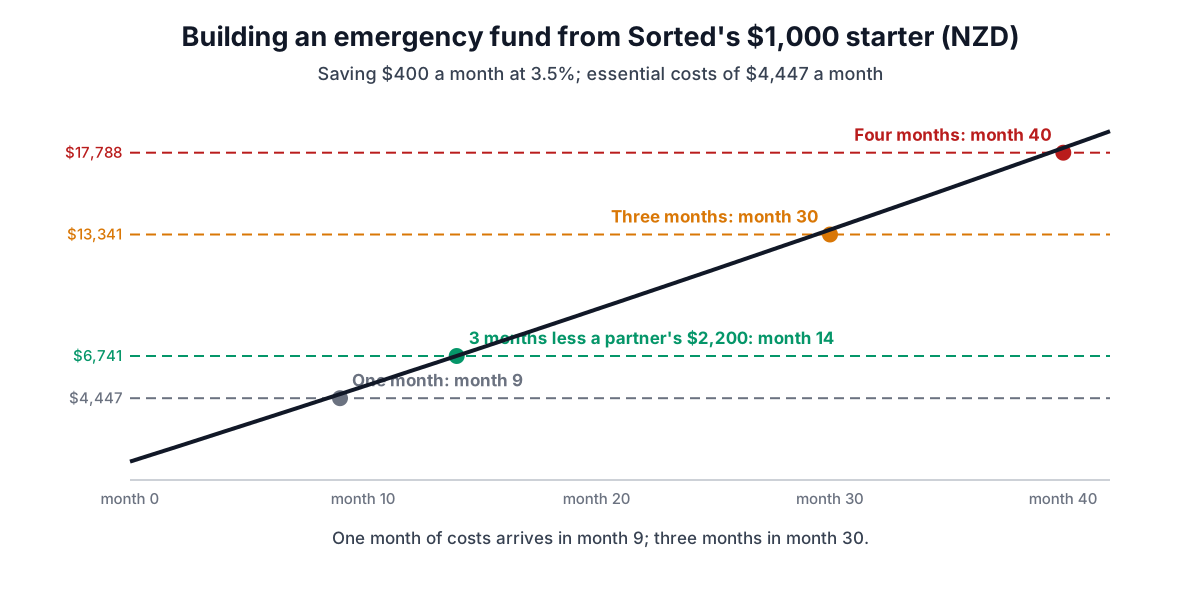
The three-month goal earns $603 of interest along the way; the deposits do the real work. The first milestone, one month of costs, is the one to celebrate: it covers most car repairs, vet bills and short gaps in pay. After that, an automatic payment on payday and any windfalls paid straight in shorten the rest.
Where to keep it
Sorted's guidance is to keep the fund somewhere easily accessible but separate from daily spending money, such as a high-interest savings account, and not in shares or other volatile investments. It suggests a separate bank so the balance is less visible day to day, and, once you are past the $1,000 starter, three-month term deposits for part of the fund.
Interest on savings is taxable, with resident withholding tax deducted by the bank at the rate you give it, so make sure your bank has your IRD number and the right rate.
KiwiSaver is not an emergency fund. It is locked in until you qualify to withdraw, and hardship withdrawals are an application to your provider, not a cash account you can draw on when the car breaks down.
Fund or debt first?
If you carry credit card debt at around 20%, a common order is Sorted's $1,000 starter, then the expensive debt, then the rest of the fund. A credit card is not an emergency fund: the balance just moves the emergency into next month.
Tools for this job
The NZ emergency fund calculator sizes the fund and the time to build it. The NZ net worth calculator shows it alongside KiwiSaver and other assets, the Savings Goal Calculator handles other targets such as a house deposit, and the Budget Planner helps find the monthly saving.
Frequently asked questions
How much emergency fund does Sorted recommend?
Start with $1,000, then build to three to six months of expenses. For redundancy, Sorted suggests at least three months; for people running their own business, up to six.
Do I get redundancy pay in New Zealand?
Only if your employment agreement, a workplace policy or an agreement with your employer provides it. Employment New Zealand says an employer does not have to provide redundancy compensation.
How do I turn weekly rent into a monthly cost?
Multiply by 52 and divide by 12. $560 a week is $2,427 a month. Dividing by 4 understates it by about 8%.
Can I get Jobseeker Support if my partner is working?
It depends on your combined income. Work and Income tests the couple's weekly income before tax, and the payment reduces to nothing as income rises, so a partner's wage can stop it.
Sources and further reading
- How to build up your emergency savings, Sorted (Te Ara Ahunga Ora Retirement Commission). The $1,000 starter, three to six months, and where to keep it.
- Redundancy, Employment New Zealand (MBIE). No legal requirement for redundancy compensation; notice and final pay.
- Sick leave, Employment New Zealand (MBIE). 10 days a year for eligible employees.
- Jobseeker Support, Work and Income. Income test for you and your partner and weekly limits.
- An essential guide to building an emergency fund, US Consumer Financial Protection Bureau. Saving habits that build the fund.
Open the Emergency Fund Calculator
More Planning Tools
Every tool in the Planning Tools section, free and in your browser.