
How Big Should Your Emergency Fund Be in Canada?
Size an emergency fund in Canadian dollars from essential costs, less the EI benefits you would receive, and decide between a TFSA and a savings account to hold it.
By Redbison Dev · · 9 min read
Canada edition. Written for Canadians: essential costs in CAD, Employment Insurance at 55% of insurable earnings up to $729 a week in 2026, the FCAC's three-to-six-month guidance, TFSA withdrawal and re-contribution rules, and CDIC coverage. US edition
The Financial Consumer Agency of Canada suggests saving three to six months of regular expenses, or of income if that is easier to track. The dollar figure behind that advice depends heavily on one Canadian program: Employment Insurance. If you lose your job, or are too sick to work, EI can replace part of your pay, and the fund only has to cover the gap. This guide sizes the fund with the Canadian emergency fund calculator for a household spending CA$3,800 a month on essentials, then looks at where to keep it, including the TFSA trap that catches people who use one as an emergency account. It explains the arithmetic and the rules; it is not personal financial advice.
Essential costs, not take-home pay
Count what you would still have to pay if your pay stopped:
| Essential | Monthly |
|---|---|
| Rent or mortgage, with property tax and condo fees | $2,000 |
| Hydro, heat, internet and phone | $300 |
| Groceries | $750 |
| Insurance (car, home or tenant, life, extended health) | $250 |
| Transportation | $350 |
| Minimum debt payments | $150 |
| Total | $3,800 |
Leave out RRSP and TFSA contributions, extra mortgage prepayments, travel and restaurants. Six months of these essentials is CA$22,800.
Subtract Employment Insurance
EI regular benefits pay 55% of your average insurable weekly earnings, up to a maximum of $729 a week in 2026, based on maximum insurable earnings of $68,900. They can be paid for 14 to 45 weeks, depending on your region's unemployment rate and your insurable hours. EI sickness benefits pay at the same rate for up to 26 weeks.
For someone earning $62,400 a year:
- $62,400 / 52 = $1,200 a week of insurable earnings
- 55% = $660 a week
- $660 x 52 / 12 = about $2,860 a month
Enter that as "Income that would continue" and the shortfall falls to $940 a month:
| Six months of cover | Shortfall a month | Target |
|---|---|---|
| No EI counted | $3,800 | $22,800 |
| EI counted ($2,860) | $940 | $5,640 |
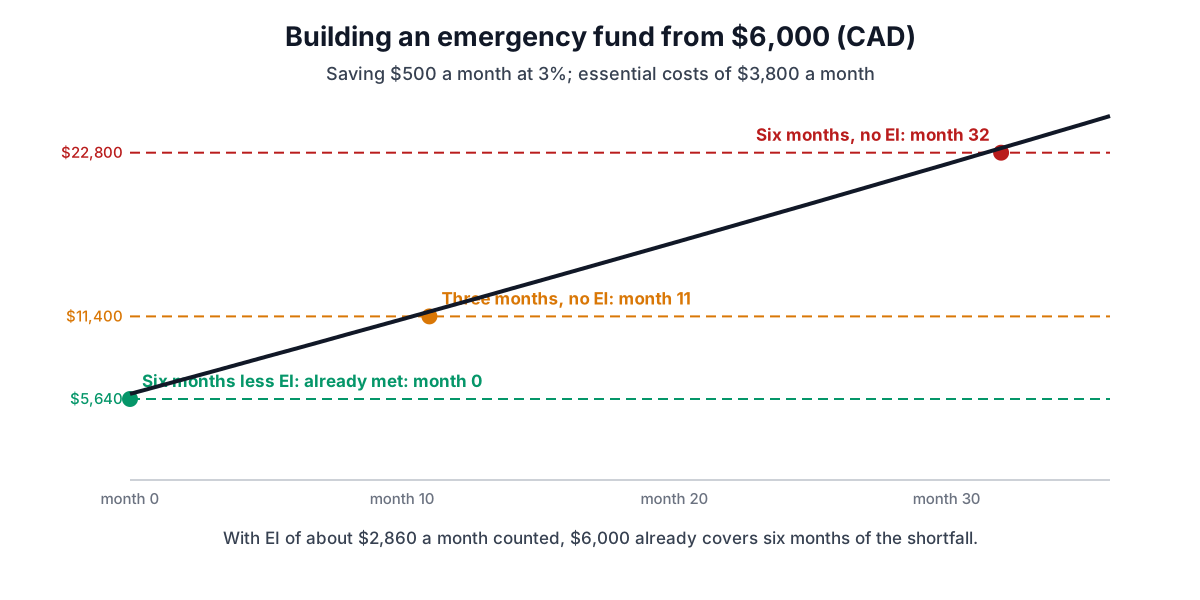
With $6,000 already saved, the EI-counted fund is already complete, covering 6.4 months of the shortfall. Without EI, saving $500 a month at 3%, the same household reaches three months ($11,400) in month 11 and six months in month 32, earning $1,119.07 of interest on the way.
Where EI stops being enough
Two limits push the fund back up:
- The maximum. Above $68,900 of insurable earnings the weekly benefit stops rising. A household with $4,500 of essentials whose earner would get the full $729 a week (about $3,159 a month) still has a $1,341 monthly gap; six months is $8,046, which $6,000 saved and $500 a month at 3% reaches in month 4.
- Eligibility. EI is paid only if you meet its conditions, including enough insurable hours. Quitting, self-employment without opting in to special benefits, or a job that is not insurable can leave you with nothing.
The sensible approach is to run the calculator twice, once with EI and once with nothing coming in, and aim somewhere between the two. For self-employed Canadians, the nothing-coming-in figure is the realistic one.
How many months?
The calculator's rule of thumb starts at three months for a two-income household with stable jobs and adds one for a single income, one for children, two for self-employed or commission income, one for owning a home, and one for a job that is slow to replace. The Canadian version swaps the US health-plan question for "No sick pay or disability coverage at work", because a long illness without either leaves you on EI sickness benefits alone.
TFSA or high-interest savings account?
A TFSA works well for an emergency fund if the money is in cash or a high-interest savings product, not in stocks. Interest earned inside it is tax-free, while interest in an ordinary savings account is taxable income. The catch is contribution room:
- A TFSA withdrawal is added back to your room only on January 1 of the following calendar year.
- If you put money back in the same year without unused room, the excess is taxed at 1% a month until it is removed.
- The TFSA dollar limit for 2026 is $7,000.
So a household that drains a TFSA emergency fund in March and wants to rebuild it by June may need an ordinary savings account for part of the rebuild. Some people keep one month of expenses in a savings account linked to chequing and the rest in a TFSA for exactly that reason.
Is the money protected?
The Canada Deposit Insurance Corporation insures eligible deposits at its member institutions up to $100,000, including principal and interest, in each of several categories: deposits in one name, joint deposits, deposits in trust, and registered plans including TFSAs, RRSPs, RRIFs, RESPs, RDSPs and FHSAs. Savings deposits and GICs qualify; mutual funds, stocks, ETFs and crypto do not. Most credit unions are covered by provincial deposit insurers instead.
Fund or debt first?
If you carry a credit card balance at around 20%, a common order is a starter buffer of about one month's essentials, then any employer pension or group RRSP match, then the expensive debt with the Canadian debt payoff calculator, then the full fund. A line of credit is not an emergency fund: lenders can reduce it.
Tools for this job
The Canadian emergency fund calculator sizes the fund and the time to reach it. The Canadian APY calculator compares savings rates, the Canadian savings goal calculator handles other targets such as an FHSA down payment, and the Canadian net worth calculator shows the fund among your other assets. The inflation and savings guide for Canada explains what rising prices do to cash.
Frequently asked questions
How much does EI pay a month?
EI regular benefits are 55% of average insurable weekly earnings, up to $729 a week in 2026. Multiply the weekly amount by 52 and divide by 12: $660 a week is about $2,860 a month, and the $729 maximum is about $3,159.
Should I count EI in my emergency fund?
You can if you are fairly sure you would qualify; the fund then only covers the gap. If your job is not insurable, you are self-employed, or you might quit, leave it at zero.
Can I use a TFSA as an emergency fund?
Yes, if the money is in cash or a high-interest savings product. Remember that withdrawals only come back as room on January 1 of the next year, and over-contributing is taxed at 1% a month.
Is my emergency fund insured?
Eligible deposits at CDIC members are insured up to $100,000 per category, with TFSAs, RRSPs, FHSAs and joint deposits each a separate category. Stocks, mutual funds and ETFs are not covered.
Sources and further reading
- Setting up an emergency fund, Financial Consumer Agency of Canada. Three to six months of expenses or income.
- EI regular benefits: how much you could receive, Government of Canada. 55%, the $68,900 maximum insurable earnings, $729 a week and 14 to 45 weeks.
- EI sickness benefits: how much you could receive, Government of Canada. Up to 26 weeks.
- Withdrawing from a TFSA, Canada Revenue Agency. Room restored on January 1 of the next year; 1% a month on excess amounts.
- Calculate your TFSA contribution room, Canada Revenue Agency. The $7,000 limit for 2026.
- Your coverage, Canada Deposit Insurance Corporation. $100,000 per category per member institution.
Open the Emergency Fund Calculator
More Planning Tools
Every tool in the Planning Tools section, free and in your browser.