
How Much Should Your Emergency Fund Be in the UK?
Size a UK rainy day fund in pounds from essential bills, less Statutory Sick Pay or New Style JSA, and see how ISAs, FSCS cover and Universal Credit rules shape it.
By Redbison Dev · · 9 min read
United Kingdom edition. Written for UK households: essential bills in pounds, what Statutory Sick Pay and New Style JSA would still pay, Universal Credit's £6,000 savings threshold, FSCS protection of £120,000, cash ISAs and the Personal Savings Allowance. US edition
The usual advice in Britain, as elsewhere, is to keep three to six months of essential outgoings in an easy-access account. What that advice leaves out is the money that would keep arriving if your pay stopped: Statutory Sick Pay if you are an employee off sick, New Style Jobseeker's Allowance if you lose your job, or a partner's wage. Count that, and the pot you need can shrink by thousands of pounds. Over-save, and Universal Credit's savings rules can work against you. This guide sizes the fund with the UK emergency fund calculator, using a household spending £1,960 a month on essentials. It explains the arithmetic and the rules; it is not personal financial advice.
Start with essential outgoings
The fund covers what you would still have to pay with no income: not your take-home pay, and not your full spending. For a renting household the calculator's UK example looks like this:
| Essential | Monthly |
|---|---|
| Rent, council tax and any service charge | £1,110 |
| Energy, water, broadband and phone | £220 |
| Food shopping | £380 |
| Insurance (contents, car, life) | £50 |
| Travel to work | £150 |
| Minimum debt repayments | £50 |
| Total | £1,960 |
Leave out pension contributions above any minimum, overpayments on debts, holidays, takeaways and subscriptions you would cancel. Keep council tax and the TV licence in: they do not stop when your pay does.
Take off what would still come in
Statutory Sick Pay. GOV.UK gives SSP as £123.25 a week, or 80% of your normal weekly earnings if that is lower, paid by your employer for up to 28 weeks. £123.25 x 52 / 12 is about £534 a month. Low earners should use the smaller 80% figure, and if your contract pays enhanced sick pay, use that for the weeks it lasts.
New Style Jobseeker's Allowance. This depends on Class 1 National Insurance paid as an employee in the previous two tax years, not on your savings. It is up to £95.55 a week if you are 25 or over (£75.65 under 25), paid for up to 182 days. £95.55 x 52 / 12 is about £414 a month.
Self-employed people get neither SSP nor, usually, New Style JSA on their own contributions, so for them the honest figure is nil unless they hold income protection insurance.
Enter the monthly amount in "Income that would continue" and the calculator sizes the pot on the shortfall:
| Six months of cover | Shortfall a month | Target |
|---|---|---|
| Nothing coming in | £1,960 | £11,760 |
| With New Style JSA (£414) | £1,546 | £9,276 |
| With Statutory Sick Pay (£534) | £1,426 | £8,556 |
How many months?
The calculator starts at three months for a two-income household with stable jobs and adds months for risk: one for a single income, one for children, two for self-employed or irregular income, one for owning your home (the boiler and the roof are your bill), one for a job that is slow to replace. A single self-employed renter lands on six months. In the UK version the last box is "Only Statutory Sick Pay if I am off sick", for employees whose contract pays nothing above the statutory minimum.
How long it takes to build
Starting from £3,000 and saving £250 a month at 4% AER:
| Target | Three months reached | Goal reached | Interest on the way |
|---|---|---|---|
| £8,556 (SSP counted) | month 5 | month 21 | £388.63 |
| £9,276 (New Style JSA counted) | month 7 | month 24 | £476.21 |
| £11,760 (nothing counted) | month 11 | month 33 | £788.78 |
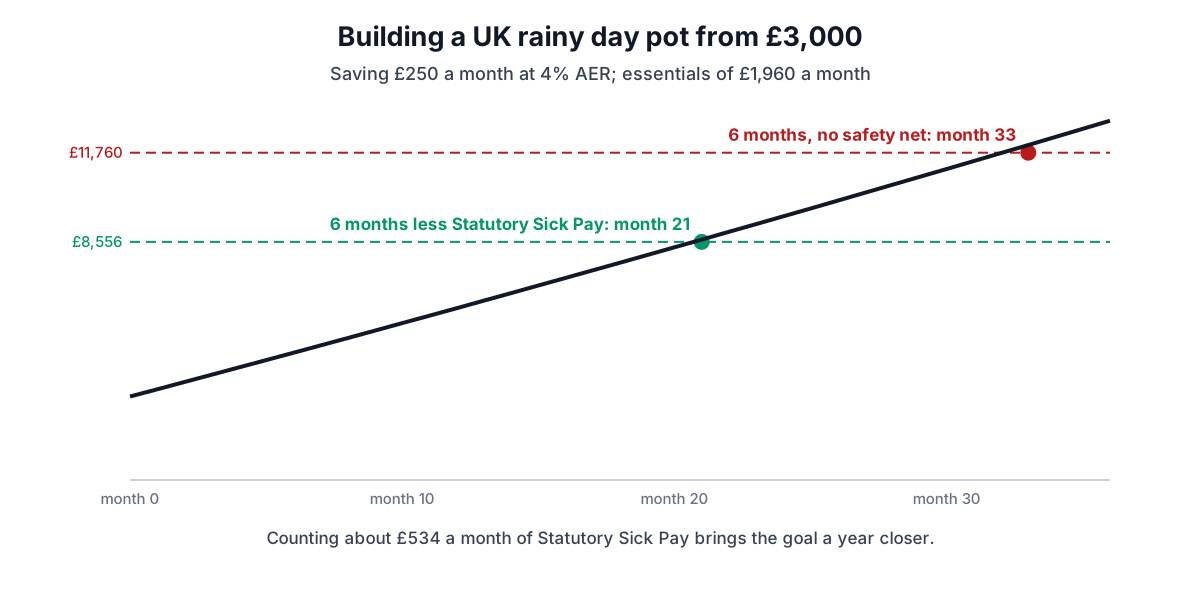
Counting sick pay brings the goal a full year closer. Raising the monthly saving matters even more: at £400 a month the £11,760 goal arrives in month 21. A standing order on payday, and any bonus or tax refund paid straight in, does most of the work.
The Universal Credit catch
If Universal Credit is a realistic fallback, savings change the picture. Under DWP's rules, savings below £6,000 do not affect it; between £6,000 and £16,000 the award is reduced by £4.35 a month for every £250 or part of £250; above £16,000 you usually cannot claim. A partner's savings count too.
So a £10,000 pot would cut a Universal Credit award by 16 x £4.35 = £69.60 a month. That is not a reason to keep no savings, since the pot is there precisely so that you do not depend on the benefit, but it is a reason not to let the emergency fund grow far beyond its target in cash when the surplus could pay down debt or go into a pension. New Style JSA, by contrast, ignores savings entirely.
Where to keep it
Easy access, separate from your current account. A savings account you can reach within a day, at a different provider if that stops you dipping into it.
FSCS protection. Deposits at UK-authorised banks, building societies and credit unions are protected up to £120,000 per person per firm, the limit since 1 December 2025. Brands that share one banking licence share one limit, which matters only for large balances.
Cash ISA or ordinary savings. You can pay up to £20,000 into ISAs in the 2026 to 2027 tax year, and GOV.UK confirms you can take money out at any time without losing the tax benefits, although a provider's terms may set notice periods. A flexible ISA lets you put withdrawn cash back in the same tax year without using more allowance. For many basic-rate taxpayers an ordinary account is fine too: the Personal Savings Allowance lets you earn £1,000 of interest tax-free (£500 for higher-rate, nothing for additional-rate), and £11,760 at 4% earns about £470 a year.
Not a Lifetime ISA. Withdrawals for anything other than a first home, reaching 60 or terminal illness lose a 25% charge, which is the opposite of what an emergency fund needs.
Not shares, and not a credit card. Markets can fall in the same downturn that costs you your job, and a credit limit can be cut when you most need it.
Fund or debt first?
If you also have credit card debt at 20% or more, a common order is: a starter buffer of about one month's essentials, then any employer pension match, then the expensive debt with the UK debt payoff calculator, then the rest of the fund. Each step stops the next emergency undoing the last.
Tools for this job
The UK emergency fund calculator sizes the pot and the time to build it. The UK savings goal calculator handles other targets such as a deposit, the UK APY and AER calculator compares account rates, and the UK net worth calculator shows the fund among your other assets. If prices are rising faster than your savings rate, the inflation and savings guide explains what that does to the pot.
Frequently asked questions
How much is Statutory Sick Pay a month?
GOV.UK gives up to £123.25 a week, or 80% of normal weekly earnings if lower, for up to 28 weeks. That is about £534 a month (£123.25 x 52 / 12).
Do my savings affect New Style JSA?
No. GOV.UK says your savings and your partner's are not taken into account. It depends on Class 1 National Insurance contributions in the previous two tax years and is paid for up to 182 days.
How much savings can I have and still get Universal Credit?
Up to £6,000 has no effect. Between £6,000 and £16,000 the award falls by £4.35 a month for every £250 or part of £250, so £10,000 cuts it by £69.60 a month. Above £16,000 you usually cannot claim.
Is my emergency fund protected if my bank fails?
Eligible deposits are protected by the FSCS up to £120,000 per person at each UK-authorised bank, building society or credit union, the limit since 1 December 2025. Joint accounts are covered up to £120,000 for each holder.
Sources and further reading
- Statutory Sick Pay: what you'll get, GOV.UK. £123.25 a week or 80% of earnings, up to 28 weeks.
- New Style Jobseeker's Allowance, Department for Work and Pensions. National Insurance conditions, 182 days, savings not counted.
- Jobseeker's Allowance: what you'll get, GOV.UK. Weekly rates by age.
- Universal Credit: money, savings and investments, Department for Work and Pensions. The £6,000 and £16,000 limits and the £4.35 per £250 reduction.
- Banks, building societies and credit unions, Financial Services Compensation Scheme. £120,000 per person per firm from 1 December 2025.
- Individual Savings Accounts, GOV.UK. The £20,000 allowance for 2026 to 2027 and withdrawals.
- How much tax-free interest you can earn, GOV.UK. The Personal Savings Allowance.
- Lifetime ISA: withdrawing money, GOV.UK. The 25% withdrawal charge.
Open the Emergency Fund Calculator
More Planning Tools
Every tool in the Planning Tools section, free and in your browser.