
How Much Emergency Fund Do You Need in Australia?
Size an emergency fund in Australian dollars from essential costs, with extra months for casual work without paid leave, and weigh an offset against savings.
By Redbison Dev · · 9 min read
Australia edition. Written for Australians: costs in AUD with council rates and strata levies, the National Employment Standards' 10 days of paid personal leave, the ABS count of 2.5 million employees without paid leave, and Financial Claims Scheme cover for savings and offset accounts. US edition
The standard advice is to keep three to six months of essential costs in cash. In Australia the most useful question for choosing between three and six is not how stable your industry is but what kind of job you have. A permanent employee has paid sick and carer's leave and annual leave to fall back on; a casual employee or contractor has neither, so a week off sick is a week without pay. This guide sizes the fund for both with the Australian emergency fund calculator, then looks at where to keep it, including the offset account question most home owners ask. It explains the arithmetic and the rules; it is not personal financial advice.
Your essential monthly costs
The fund covers what you would still have to pay if your income stopped:
| Essential | Monthly |
|---|---|
| Rent or home loan repayments, with council rates and strata levies | $2,100 |
| Electricity, gas, internet and phone | $280 |
| Groceries | $650 |
| Insurance (private health, car, home and contents, life) | $250 |
| Fuel, public transport, tolls and parking | $250 |
| Minimum debt repayments | $70 |
| Total | A$3,600 |
Leave out voluntary super contributions, extra home loan repayments, holidays and takeaway. If rent is quoted weekly or fortnightly, convert it first: weekly x 52 / 12.
Casual or permanent: why it changes the months
Under the National Employment Standards, a full-time employee gets 10 days of paid sick and carer's leave a year and 4 weeks of annual leave, with part-time employees getting leave in proportion to their hours. Casual employees and contractors get no paid sick leave or annual leave. A short illness for a permanent employee costs nothing; for a casual it costs that week's pay.
That is not a niche situation. The Australian Bureau of Statistics found that in August 2025, 2.5 million employees, 20% of all employees, were not entitled to either paid holiday leave or paid sick leave in their main job.
The calculator starts at three months for a two-income household with permanent jobs and adds months for risk. The Australian version adds one for "No paid sick leave (casual or contractor)". A single casual worker typically ticks one income (+1), irregular hours (+2) and no paid leave (+1), giving seven months.
Two households, same savings habit
Both start with A$4,000 saved and put away A$600 a month at 4.5% p.a.:
| Household | Months | Target | Three months reached | Goal reached | Interest earned |
|---|---|---|---|---|---|
| Permanent full-time couple | 3 | A$10,800 | month 11 | month 11 | A$287.31 |
| Single casual worker | 7 | A$25,200 | month 11 | month 33 | A$1,724.34 |
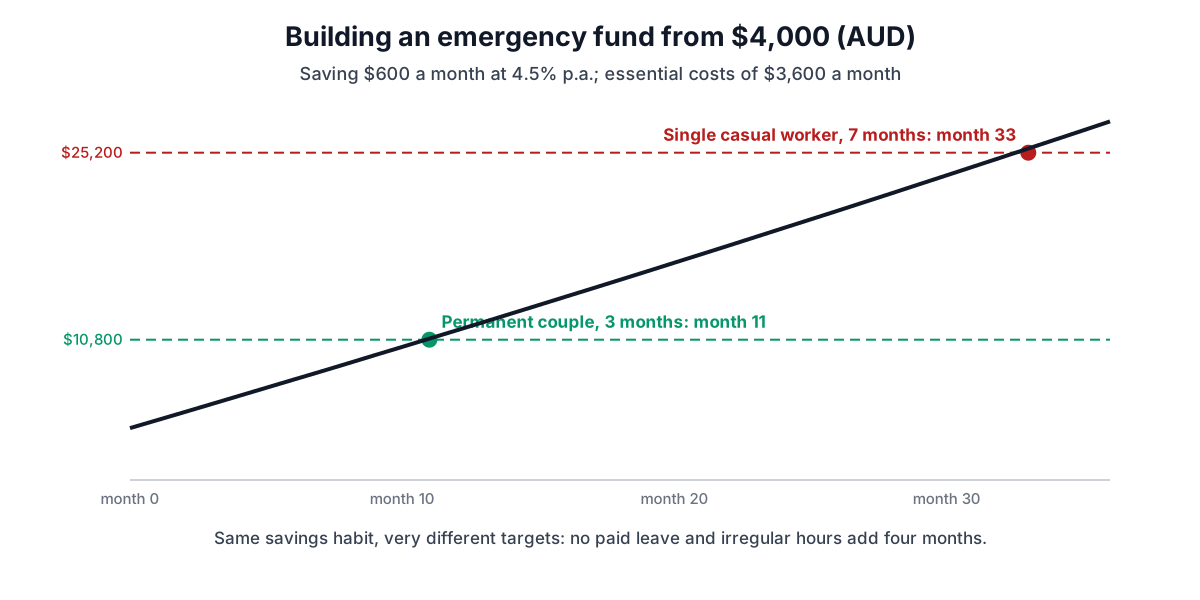
Seven months sounds like a lot until you remember that it has to cover every sick day as well as the gaps between shifts or contracts. Raising the monthly amount is the lever that matters: at A$900 a month the casual worker reaches three months in month 8 and the full A$25,200 in month 23.
If a partner's pay would keep coming in, enter the part of it that would go to these bills as "Income that would continue", and the fund only covers the gap.
Offset account or savings account?
For home owners with an offset account, money sitting there reduces the interest charged on the loan while staying available to withdraw. Since home loan rates are usually above savings rates, it is often the better-paying home for spare cash, and offset savings are not taxed as interest income the way savings account interest is.
The risk is behavioural: if the offset is also your everyday account, the emergency fund blurs into spending money. Some people set a floor in the offset that they treat as the fund and never spend below. Note that a redraw facility is different from an offset: redraw is money already repaid into the loan, and lenders can limit access to it, so treat it more cautiously than cash.
Is the money protected?
The Financial Claims Scheme, administered by APRA, protects deposits at Australian banks, building societies and credit unions up to $250,000 for each account holder at each authorised deposit-taking institution. Transaction, savings and cheque accounts, term deposits and offset accounts that are separate deposit accounts are covered; foreign currency accounts are not. Most emergency funds are far below that limit.
Where not to keep it
- Shares or ETFs. Markets can fall in the same downturn that costs you shifts or your job.
- A credit card or buy now pay later. Borrowing for an emergency turns it into debt, and limits can be cut.
- A term deposit you cannot break. Fine for part of a large fund, but check the early withdrawal terms first.
Fund or debt first?
If you carry a credit card balance at around 20%, a common order is a starter buffer of about one month's essentials, then attacking the expensive debt with the Australian debt payoff calculator, then building the full fund. Each step makes the next surprise less likely to land on the card.
Tools for this job
The Australian emergency fund calculator sizes the fund and the time to build it. The Australian savings goal calculator covers other targets such as a home deposit, the Australian APY calculator compares savings rates, and the Australian net worth calculator shows the fund among your other assets. For what inflation does to cash, see the inflation and savings guide for Australia.
Frequently asked questions
Do casual workers need a bigger emergency fund?
Usually, yes. Casual employees and contractors get no paid sick or annual leave, so any time off is unpaid. The calculator adds a month for no paid sick leave and two for irregular income, which takes many single casual workers to seven months.
How much paid sick leave do full-time employees get?
The National Employment Standards give full-time employees 10 days of paid sick and carer's leave a year, with part-time employees getting it pro rata. Awards and agreements can give more.
Should my emergency fund sit in my offset account?
It can. Money in a separate offset account reduces home loan interest, stays available and is protected by the Financial Claims Scheme. Keep a set floor that you treat as the fund so it does not get spent day to day.
How much of my savings is government-guaranteed?
The Financial Claims Scheme covers deposits up to $250,000 per account holder at each authorised deposit-taking institution, including savings accounts, term deposits and separate offset accounts.
Sources and further reading
- Employees' pay, leave and entitlements, business.gov.au, Australian Government. Paid sick and carer's leave and annual leave under the National Employment Standards; casuals and contractors.
- Working arrangements, August 2025, Australian Bureau of Statistics. 2.5 million employees without paid holiday or sick leave.
- Financial Claims Scheme: banks, building societies and credit unions, Australian Prudential Regulation Authority. The $250,000 limit and covered accounts.
- Financial Claims Scheme, Australian Prudential Regulation Authority.
- An essential guide to building an emergency fund, US Consumer Financial Protection Bureau. Habits for building the fund.
Open the Emergency Fund Calculator
More Planning Tools
Every tool in the Planning Tools section, free and in your browser.