
How Much Lawn Seed per m² in NZ, and When to Sow
Work out lawn seed in grams per m² and kilogram bags for an NZ section, when to choose kikuyu over ryegrass, autumn or spring sowing, and ready lawn instead.
By Redbison Dev · · 9 min read

New Zealand edition. New Zealand edition in square metres and kilograms, using the rates printed on NZ lawn seed packs (40 g/m² for ryegrass and fescue blends, 20 g/m² for kikuyu), the NZ sowing seasons and ready lawn laid on 100 mm of worked soil. US edition
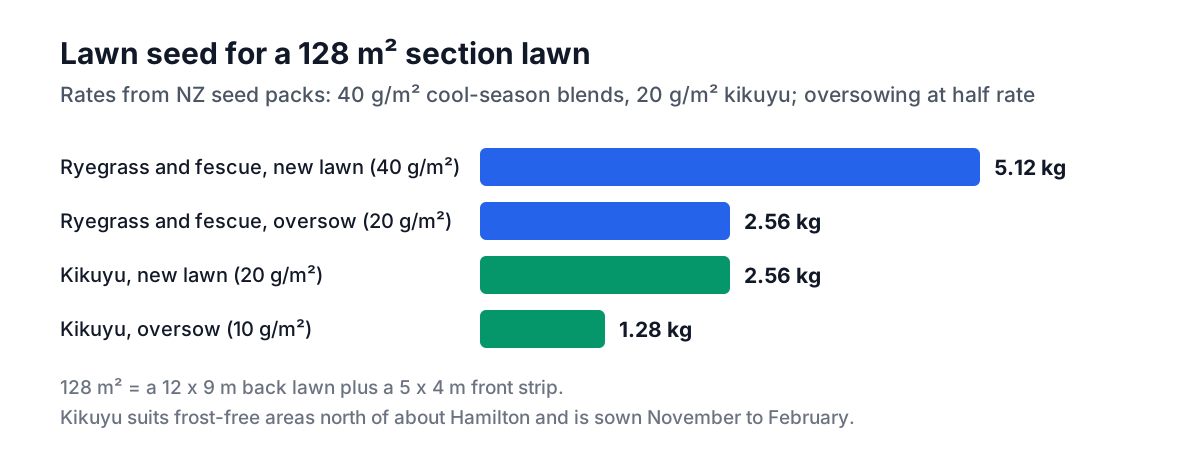
New Zealand lawn seed packs give the rate in grams per square metre, and for the common ryegrass and fescue blends it is 40 g/m² for a new lawn and 20 g/m² for oversowing. A back lawn of 12 by 9 metres plus a 5 by 4 metre strip out the front is 128 m², so it needs 5.12 kg of seed from scratch: two 4 kg bags, or six 1 kg packs. Oversowing the same lawn to thicken it takes 2.56 kg. A kikuyu lawn in Northland or Auckland needs half the weight, because kikuyu packs are sown at 20 g/m².
This edition works through those numbers with the Lawn Seed Calculator, and covers the choices that decide them in New Zealand: which grass suits your region, when to sow, and when ready lawn makes more sense.
Measure the section in square metres
Measure each lawn area as rectangles, in metres, and add them. Leave out garden beds, paths, the deck and the clothesline pad. For the example:
- back lawn: 12 x 9 = 108 m²
- front strip: 5 x 4 = 20 m²
- total: 128 m²
An odd-shaped lawn is easier as a rectangle with a triangle or two taken off. Do not round up the area as a safety margin; the bag sizes already leave you some spare.
Pick the grass before you pick the rate
The rate depends on the seed, so the grass type comes first. Yates' guide on choosing the right grass splits NZ lawns into two groups:
| Group | Typical seed | Where it suits | Notes |
|---|---|---|---|
| Cool-season blends | perennial ryegrass with chewings fescue | Temperate and cool areas, most of the country | Look best in autumn and spring; may need summer watering |
| Tall fescue blends | tall fescue with ryegrass | Drier sites | Best drought tolerance of the cool-season grasses |
| Shade blends | ryegrass with chewings and creeping red fescue | Under trees, south-facing strips | Highly shade tolerant |
| Warm-season | kikuyu | North of about Hamilton, frost-free coasts | Highly drought tolerant, frost-sensitive, dormant in winter |
Rates from the NZ packs:
| Seed | New lawn | Oversowing | When the pack says to sow |
|---|---|---|---|
| Sow Anytime (ryegrass and chewings fescue) | 40 g/m² | 20 g/m² | Year-round once soil allows; germinates from 3°C |
| Tall Fescue (57% tall fescue, 43% ryegrass) | 40 g/m² | 20 g/m² | September to November or April to May |
| Sun and Shade (ryegrass and two fescues) | 40 g/m² | 20 g/m² | September to November or April to May |
| Kikuyu | 20 g/m² | 10 g/m² | November to February, central and upper North Island |
Kikuyu seed goes further per kilogram, but it is the slowest to come up: the pack gives 7 to 21 days to germinate against about 7 days for ryegrass. The Tall Fescue and Sun and Shade packs warn that germination slows when the soil is below 12°C.
Worked example: the 128 m² lawn
In the calculator, enter the area, choose the job and type the rate from your pack:
| Job | Rate | Seed | Packs |
|---|---|---|---|
| New lawn, ryegrass and fescue | 40 g/m² | 5.12 kg | 2 x 4 kg, or 6 x 1 kg |
| Oversowing a thin lawn | 20 g/m² | 2.56 kg | 3 x 1 kg |
| New kikuyu lawn | 20 g/m² | 2.56 kg | 3 x 1 kg |
| Oversowing kikuyu | 10 g/m² | 1.28 kg | 2 x 1 kg |
Two 4 kg bags give 8 kg for a job that needs 5.12 kg, so compare against one 4 kg bag plus two 1 kg packs (6 kg). The calculator counts whole bags of one size; if you mix sizes, use the kilogram figure.
A mixed lawn is common on a section with a big tree. If the 20 m² front strip sits in shade, sow it with a shade blend at 40 g/m² (0.8 kg, one 1 kg pack) and the 108 m² back lawn with a standard blend (4.32 kg, two 4 kg bags). Enter each area separately.
When to sow in New Zealand
Yates' guide to sowing a lawn from seed gives early to mid spring or early to mid autumn for cool-season seed. Autumn is usually the better of the two: the soil is still warm after summer, so the grass establishes before winter, while a spring sowing has to be watered through its first summer. Kikuyu is the exception. It needs warm soil and is sown from November to February.
Preparing the ground, with the numbers
The same guide gives a sequence worth following in order:
- Spray existing weeds and grass with a non-selective herbicide, then leave the area for 2 weeks.
- Loosen compacted soil with a rake. On heavy clay or very sandy soil, topdress at 1 m³ per 10 m². For the 128 m² lawn that is 12.8 m³ of lawn mix, about 100 mm deep, which is a truck delivery rather than bags from the garden centre.
- Level hollows with topdressing in layers of 1 to 2 cm at a time.
- Rake shallow furrows in one direction, spread the seed mixed with starter fertiliser, then rake across to cover it.
- Water gently several times a day so the surface stays moist through germination, then keep the top 1 cm moist for 2 to 3 weeks.
Mow for the first time as late as you can, on the highest setting, and never take more than a third of the leaf. Once established, ryegrass and fescue lawns are mown at 3 to 5 cm and kikuyu at 2.5 cm. Wait about 12 weeks after sowing before using a lawn weedkiller, and feed again at about 3 months, when the starter fertiliser runs out.
Ready lawn instead of seed
Ready lawn (roll-out turf) gives a finished lawn on the day, at a much higher cost per square metre. Order the area plus an allowance for cutting around edges. With rolls of 1 m², a common size but one to confirm with your supplier, the 128 m² lawn needs:
- 5% extra for a simple rectangle: 134.4 m², so 135 rolls;
- 10% extra for curved beds: 140.8 m², so 141 rolls.
Readylawn's installation advice is to work the soil to a depth of 100 mm and roughly level it, have the turf delivered when the ground is ready so it can be laid straight away, and not leave it rolled up, because it deteriorates. Soak it after laying, keep it well watered for about three weeks, and mow once it is twice as long as when laid; in summer that can be only 7 to 10 days later.
Seed or ready lawn?
Seed is the cheaper option and lets you pick a blend for each part of the section, but the lawn needs weeks of watering and should be kept free of feet and pets until it is well established. Ready lawn suits a new build where the section needs to be usable quickly, a sloping site where rain would wash seed away, or a summer job when seed would struggle. The calculator compares the two on your own bag and turf prices.
Tools for this job
- Lawn Seed Calculator: kilograms and bags of seed at your pack rate, or rolls of ready lawn with a cutting allowance.
- Square Footage Calculator: areas of irregular lawns, which you can switch to square metres.
- Gravel and Mulch Calculator: cubic metres of topsoil or lawn mix to topdress before sowing.
- The US grass seed rates and sod ordering guide covers warm-season grasses grown in the southern United States.
Frequently asked questions
How much lawn seed do I need for 100 m² in NZ?
At the 40 g/m² rate on NZ ryegrass and fescue packs, 4 kg for a new lawn, which is one 4 kg bag. Oversowing 100 m² takes 2 kg. For kikuyu at 20 g/m², a new 100 m² lawn needs 2 kg.
Should I sow a lawn in spring or autumn?
For ryegrass and fescue, early to mid autumn is usually better, because the soil is still warm and the grass establishes before winter. Spring sowing works but needs more watering through the first summer. Kikuyu is sown in warm weather, from November to February.
Is kikuyu a good lawn for Auckland?
It suits frost-free areas north of about Hamilton and is highly drought tolerant. It is highly drought tolerant but frost-sensitive and goes dormant in winter, so weigh that against a ryegrass blend that stays green.
Is the kikuyu sowing rate different?
The kikuyu pack gives 20 g/m² for a new lawn against 40 g/m² for ryegrass and fescue blends, so use the rate on the pack you buy rather than a general figure. Kikuyu also germinates more slowly, in 7 to 21 days.
How long until I can walk on a new lawn?
Keep traffic to a minimum until the grass is well established and has been mown a few times. Ready lawn usually takes about three weeks of watering to root; a lawn sown from seed takes longer, especially in cool weather.
Sources and further reading
- Guide on how to establish a lawn by seed, Yates New Zealand. Sowing seasons, the 2-week herbicide wait, topdressing at 1 m³ per 10 m², watering, mowing heights and the 12-week wait before weedkiller.
- How do I choose the right grass?, Yates New Zealand. Cool-season and warm-season grasses, shade and drought tolerance, kikuyu north of about Hamilton.
- Yates Sow Anytime Lawn Seed, Yates New Zealand. 40 g/m² new lawn, 20 g/m² oversowing, germination from 3°C.
- Yates Tall Fescue Lawn Seed and Sun and Shade Lawn Seed, Yates New Zealand. Blends, rates and sowing months.
- Yates Kikuyu Lawn Seed, Yates New Zealand. 20 g/m² new lawn, 10 g/m² oversowing, November to February, 7 to 21 days to germinate.
- Installing natural turf, Readylawn. Soil worked to 100 mm, laying on delivery, three weeks of watering and the first mow.
Open the Grass Seed and Sod Calculator
More Construction & Home
Every tool in the Construction & Home section, free and in your browser.