
How Much Grass Seed Do I Need? Rates and Sod in Canada
Seeding rates in kg per 100 m² for Kentucky bluegrass, fescue and ryegrass, Ontario's mid-August window, overseeding without herbicides, and sod by the roll.
By Redbison Dev · · 9 min read

Canada edition. Canadian edition in metric with square feet alongside, built on OMAFRA's turf guide (seeding rates, mixtures, timing), CFIA's Canada No. 1 Lawn Grass Mixture grade and Ontario's cosmetic pesticide rules. US edition
For a new Canadian lawn, seed Kentucky bluegrass at 1.0 to 1.5 kg per 100 m², fine fescues at about 2.0 kg, perennial ryegrass at 2.5 kg and tall fescue at 3.0 to 4.0 kg, the rates in Ontario's turf management guide. A 280 m² lawn, about 3,000 square feet, needs 3.5 kg of bluegrass seed at 1.25 kg per 100 m². Overseeding a thin lawn takes about half the new-lawn rate. In most of Ontario the best time to do either is mid-August to mid-September.
This edition uses the Grass Seed and Sod Calculator for Canada, which works in metres and kilograms and shows square feet alongside, because Canadian seed bags are in kilograms while many of us still measure the yard in feet.
Measure the lawn, in whichever units you have
Measure the lawn as rectangles, add them, and leave out the house, driveway, deck and garden beds. Real estate listings in Canada give floor area in square feet, so you may start there: 3,000 ft² is 278.7 m², and the calculator converts either way. The Square Footage Calculator handles irregular shapes.
Rates come in three forms on Canadian bags and websites:
| Form | Where you see it | Converting |
|---|---|---|
| kg per 100 m² | OMAFRA and Canadian seed suppliers | 1 kg per 100 m² = 10 g/m² |
| g/m² | the calculator's rate box | multiply kg per 100 m² by 10 |
| lb per 1,000 ft² | US-made bags and US guides | 1 lb per 1,000 ft² = 4.88 g/m², so 1 kg per 100 m² is about 2.05 lb |
The 4.88 figure comes from the exact pound and square foot definitions in NIST's conversion factors.
Seeding rates for Canadian grasses
Canadian lawns are cool-season grass. OMAFRA's Integrated Pest Management for Turf, Publication 845, Table 7-2, lists the rates and how quickly each species establishes. OMAFRA gives days for bluegrass and ryegrass and a rating for the others:
| Species | Seeding rate, kg per 100 m² | Establishment rate (days or OMAFRA rating) | Cold tolerance |
|---|---|---|---|
| Kentucky bluegrass | 1.0 to 1.5 | 21 days | very good |
| Perennial ryegrass | 2.5 | 4 to 6 days | poor |
| Red fescue | 2.0 | medium | good |
| Chewings fescue | 2.0 | excellent | good |
| Hard fescue | 2.0 to 2.5 | slow to medium | good |
| Tall fescue | 3.0 to 4.0 | quite good | fair |
The pattern is the same everywhere: big seeds, high rates. UMass Extension's seed quality table puts Kentucky bluegrass at about 2,177,000 seeds per pound and perennial ryegrass and tall fescue at about 227,000, nearly ten times fewer. A low weight of bluegrass still lands a dense stand of seed, and because bluegrass spreads by rhizomes it fills gaps over time.
OMAFRA notes that turf is rarely seeded as a monoculture. Its Table 7-1 suggests, as a share of the seed mixture:
- Sunny lawn, medium to high maintenance: Kentucky bluegrass 80 to 100%, turf-type perennial ryegrass 0 to 20%.
- Medium maintenance: bluegrass 50 to 60%, fine fescue 20 to 30%, ryegrass 20%.
- Dry, shady, low maintenance: a fine fescue blend, or fine fescue 30%, ryegrass 20% and shade-tolerant bluegrass 50%.
The ryegrass in those mixes is a nurse grass: it is up in under a week while bluegrass takes three. Its poor cold tolerance is the reason the mixes cap it, and the reason a ryegrass-heavy lawn can thin out after a hard Prairie or northern Ontario winter.
A worked example: 280 m² of new lawn
In the Grass Seed and Sod Calculator for Canada, enter an area of 280 m², pick Kentucky bluegrass, type 12.5 g/m² (1.25 kg per 100 m²) and a 2 kg bag.
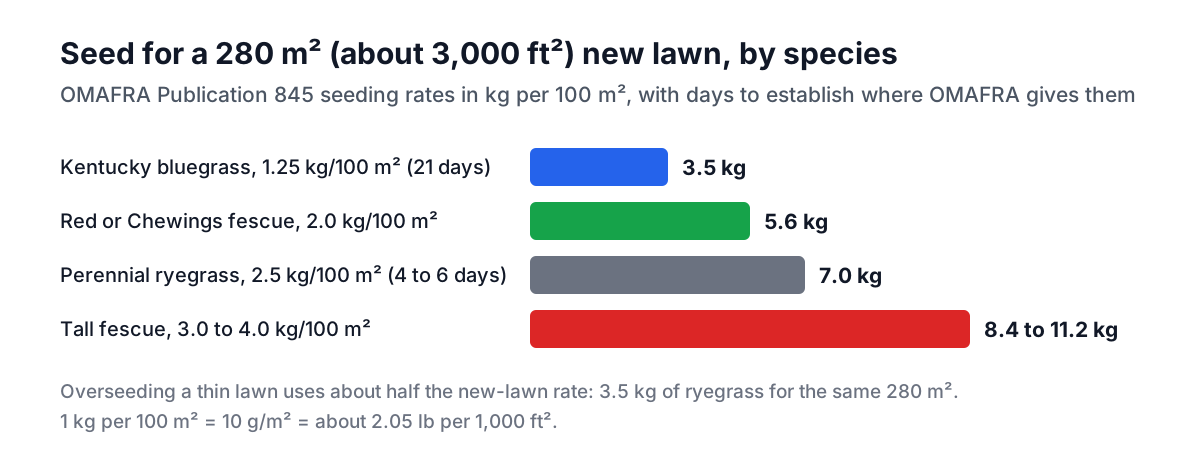
| Job | Rate | Seed | 2 kg bags |
|---|---|---|---|
| New bluegrass lawn | 12.5 g/m² | 3.5 kg | 2 |
| Fine fescue for a shady lawn | 20 g/m² | 5.6 kg | 3 |
| Perennial ryegrass, new lawn | 25 g/m² | 7.0 kg | 4 |
| Overseeding with ryegrass (half rate) | 12.5 g/m² | 3.5 kg | 2 |
For a mixture, use a weighted rate. An 80/20 bluegrass and ryegrass mix by weight works out to 0.8 x 1.25 + 0.2 x 2.5 = 1.5 kg per 100 m², so 4.2 kg for the same lawn. If the bag gives its own rate, use that instead; it allows for that lot's purity and germination.
What the grade on the bag means
Lawn seed sold in Canada is graded under the federal Seeds Act. The Canadian Food Inspection Agency notes that a Canada No. 1 Lawn Grass Mixture must contain at least 85% pure seed by weight, with the rest of the standard in Table XIV of the Seeds Regulations. Mixtures with added foreign material, such as coatings, are specialty seed and must be labelled with the approximate percentage or quantity of seed. A 2 kg bag that is half coating is 1 kg of seed, so check the label before comparing prices per kilogram.
When to seed and when to overseed
OMAFRA puts the best time to seed most cool-season grasses in Ontario at mid-August to mid-September. Seed sown in summer, it warns, is usually overrun with annual and perennial broadleaf weeds and annual grassy weeds. Spring seeding is possible, but seedlings then have to establish through the summer weed pressure OMAFRA describes. The window is Ontario's; outside Ontario, check your provincial agriculture ministry's turf advice for local dates.
Overseeding matters more where cosmetic pesticides are restricted, as in Ontario. Ontario's rules ban certain pesticides on lawns, naming ingredients such as 2,4-D, glyphosate and diazinon. OMAFRA's guide says overseeding helps keep turf thick and reduces weed invasion, and that aeration prepares the surface for it. So the usual sequence on a thin lawn is: core-aerate in late summer, overseed at half rate, keep the seed moist for the first weeks, and mow high.
Ordering sod
Kentucky bluegrass is the grass OMAFRA lists for sod farms. Roll and pallet sizes vary by farm, so ask before ordering. If your farm cuts 2 by 5 ft rolls (10 ft²) and stacks 500 ft² on a pallet:
- 280 m² plus 5% for a simple shape is 294 m², so 317 rolls, or 6.34 pallets.
- With 10% for curves and trees it is 308 m², 332 rolls and 6.64 pallets.
- Either way that is seven pallets; ask whether loose rolls are sold so you do not pay for a full extra pallet.
Lay sod the day it arrives on soil that is already graded, raked and moist, with joints staggered like brickwork and pieces butted tight, then water until the soil underneath is wet.
Tools for this job
- Grass Seed and Sod Calculator for Canada: seed in kilograms and bags at the OMAFRA or bag rate, or sod rolls and pallets.
- Square Footage Calculator: the lawn area in square feet or square metres, including odd shapes.
- Gravel and Mulch Calculator: topsoil to level the yard before seeding, or mulch for the beds.
- Related reading: the US grass seed rates and sod ordering guide covers warm-season grasses that do not survive Canadian winters.
Frequently asked questions
How much grass seed do I need for 1,000 square feet in Canada?
About 93 m². At OMAFRA's 1.0 to 1.5 kg per 100 m² for Kentucky bluegrass that is roughly 0.9 to 1.4 kg, and at 2.5 kg per 100 m² for perennial ryegrass about 2.3 kg. Overseeding takes about half. Use the bag rate if it gives one.
When is the best time to seed a lawn in Ontario?
Mid-August to mid-September, according to OMAFRA's turf guide. It warns that seed sown in summer is usually overrun by broadleaf and grassy weeds.
Why does my bluegrass seed take so long to come up?
Kentucky bluegrass takes about 21 days to establish, against 4 to 6 days for perennial ryegrass, in OMAFRA's Table 7-2. OMAFRA's sunny-lawn mixture allows up to 20% ryegrass, which comes up quickly while the bluegrass establishes. Keep the seedbed moist for the full three weeks.
Is perennial ryegrass a good choice for a Canadian lawn?
As part of a mix, yes: it establishes quickly and is OMAFRA's choice for overseeding sports fields. On its own it is risky in cold regions, because OMAFRA rates its cold tolerance as poor, against very good for Kentucky bluegrass.
Sources and further reading
- Integrated Pest Management for Turf, Publication 845, Ontario Ministry of Agriculture, Food and Rural Affairs. Table 7-1 mixtures, Table 7-2 seeding rates and establishment rates, and the mid-August to mid-September seeding window.
- Lawn and turf grass mixtures that have had foreign plant material added, Canadian Food Inspection Agency. The 85% pure seed minimum for Canada No. 1 Lawn Grass Mixture and specialty seed labelling.
- Pesticides: home lawns and gardens, Government of Ontario. Pesticides you cannot use on lawns.
- Seeding rate considerations, UMass Amherst. Seeds per pound and minimum purity and germination by species.
- NIST Guide to the SI, Appendix B.8, US National Institute of Standards and Technology. Pound and square foot conversion factors.
Open the Grass Seed and Sod Calculator
More Construction & Home
Every tool in the Construction & Home section, free and in your browser.