
How Much Grass Seed per m², and How Many Rolls of Turf?
Work out lawn seed in grams per square metre and kilogram boxes, when to add 50%, overseeding and patch rates, and how many 1 m² turf rolls to order.
By Redbison Dev · · 9 min read

United Kingdom edition. UK edition in metres and kilograms, built on RHS advice: packet rates in g/m², UK seed mixes, autumn and spring sowing, 15 to 25 g/m² for patches and turf laid in 1 m² rolls between mid-autumn and early spring. US edition
In the UK, grass seed is sown at the rate on the box, in grams per square metre, and that rate depends on the mix. For a hard-wearing family lawn sown at 35 g/m², a 10 by 6 metre garden needs 2.1 kg of seed, or 3.15 kg if you leave the seed uncovered and add the extra 50% the RHS suggests to make up for birds. Overseeding a thin lawn takes half the new-lawn rate. Turf is simpler still: count square metres, add 5 to 10% for cutting, and order that many 1 m² rolls.
This edition works through those numbers with the Grass Seed and Turf Calculator, and covers what UK lawns need that US guides leave out: our seed mixes, our sowing calendar and the RHS's preferred turf season.
Measure in square metres
Measure the lawn as rectangles in metres and add them, leaving out borders, paths, the patio and the shed base. Two common shortcuts:
- An L-shaped lawn is two rectangles. A 10 by 6 m main lawn plus a 3 by 2 m strip by the side return is 60 + 6 = 66 m².
- A curved edge is easier to estimate as a rectangle minus a triangle, or with the Square Footage Calculator, which works in square metres in its UK version.
Some advice gives rates in ounces per square yard. The RHS quotes both: 15 to 25 g/m² is ½ to ¾ oz per square yard. If a box gives pounds per 1,000 square feet, as US-made seed sometimes does, multiply by 4.88 to get g/m².
Which mix, and why the rates differ
The RHS guide to lawns from seed describes three types of mix:
| Mix | Typical grasses | Use |
|---|---|---|
| General-purpose, hard-wearing | perennial ryegrass, tall fescue, red fescues, browntop | Family lawns, play and pets; grows fast, needs regular mowing |
| Luxury or fine | Chewings fescue, strong and slender creeping red fescue, browntop | Ornamental lawns mown low; slow-growing, does not take hard wear |
| Shady | hard fescue, creeping red fescues, browntop | Light to medium shade; not very hard-wearing |
The RHS adds that any perennial ryegrass in a lawn mix should be labelled "turf" or "fine", not the coarse agricultural kind.
Why does a fine mix often sow at a lower weight? Seed size. UMass Extension's seed quality table gives about 227,000 seeds per pound for perennial ryegrass and tall fescue, 546,000 for red fescue and 8,723,000 for colonial bentgrass. Per gram that is roughly 500 seeds of ryegrass, 1,200 of red fescue and 19,000 of bent. So 35 g/m² of ryegrass puts about 17,500 seeds on each square metre, while 25 g/m² of red fescue puts down about 30,000. A lighter-looking rate is often the denser sowing.
The same table explains why no bag is 100% live seed: each species has a minimum purity and germination, and the rate on the box allows for it. That is the reason to use the packet rate over any generic figure, including the calculator's default. Type the box's rate over it.
A worked example: a 10 by 6 m lawn
In the Grass Seed and Turf Calculator, enter 10 m by 6 m, choose perennial ryegrass, type the packet rate of 35 g/m² and a 1 kg box size.
| Job | Rate used | Seed | 1 kg boxes |
|---|---|---|---|
| New lawn, seed covered with fleece or netting | 35 g/m² | 2.1 kg | 3 |
| New lawn, seed left uncovered (+50%) | 52.5 g/m² | 3.15 kg | 4 |
| Overseeding a thin lawn (half rate) | 17.5 g/m² | 1.05 kg | 2 |
| Fine mix, if its packet says 25 g/m² | 25 g/m² | 1.5 kg | 2 |
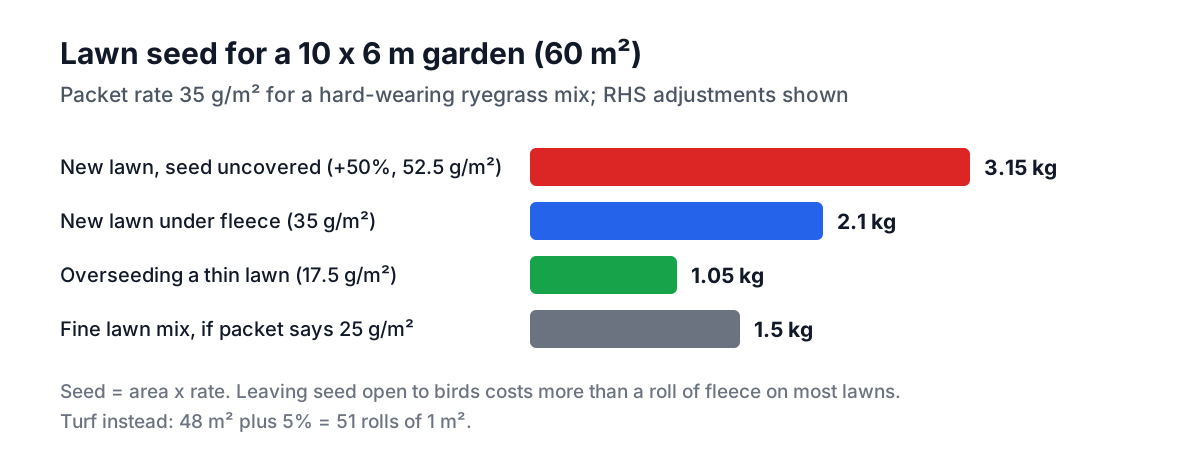
The 50% extra for uncovered seed is RHS advice, and on a 60 m² lawn it costs more than a kilogram of seed. A length of horticultural fleece weighted at the edges, or bird tape on a larger lawn, often costs less than the extra box.
The overseeding rate of 17.5 g/m² falls inside the 15 to 25 g/m² the RHS gives for repairing lawns. For a few bald patches rather than the whole lawn, measure only the patches: 6 m² of worn goalmouth at 15 to 25 g/m² needs just 90 to 150 g, and a full-rate sowing on those bare patches is fine.
While you are measuring, the RHS also suggests raking in a general-purpose fertiliser at 70 g/m² before sowing a new lawn. On 60 m² that is 4.2 kg.
When to sow in the UK
The RHS gives two windows: autumn, September to November, and mid-spring, March to April. Early autumn is preferred, because the soil is still warm, rain is more reliable and seedlings have time to establish before the first hard frosts. Seed appears in about seven to ten days.
Spring sowing works but needs watering through any dry spell, and the lawn should see little use until late autumn. An autumn-sown lawn should be kept off until June. The RHS's first cut comes when the seedlings are 5 to 7.5 cm tall, taking off about a third with a sharp mower.
Ground preparation takes longer than sowing. The RHS suggests starting several weeks ahead: dig or rotovate compacted soil to about 20 cm, let it settle, ideally for five to six weeks, firm it by treading in several directions and rake it to a fine, level tilth.
Turf: rolls, pallets and the right season
Turf is often sold in the UK in rolls of about 1 m², stacked on pallets; roll size and pallet coverage vary by supplier, so check both. With 1 m² rolls the arithmetic is easy:
- An 8 by 6 m lawn is 48 m². With 5% extra for a simple shape that is 50.4 m², so 51 rolls.
- With 10% extra for curved borders it is 52.8 m², so 53 rolls.
- If a pallet covers 50 m², 51 rolls are 1.02 pallets. Ask whether the supplier sells loose rolls before paying for a second full pallet.
The RHS turf guide has a timing message that differs from US advice. It recommends laying turf in mid-autumn, or any time up to early spring when the soil is not wet or frosty, and avoiding mid-spring to early autumn, when turf struggles to establish. Lay it within 24 hours of delivery if possible; if laying is delayed by more than a few days, unroll it flat in the light and water it if dry, because rolled turf soon discolours and weakens. Stagger the joints like brickwork, push the pieces tightly together, stand on boards rather than the new turf, and give it a first high cut once it has rooted, usually after about three weeks.
Seed or turf?
Seed costs far less per square metre and gives you the widest choice of mix. It needs the right season, weeks of preparation and patience: an autumn-sown lawn is not ready for football until the following summer. Turf gives a finished lawn on the day and suits gardens where children or dogs cannot be kept off, at several times the cost. The calculator takes your local prices for boxes and pallets and compares the two for the same area.
Tools for this job
- Grass Seed and Turf Calculator: seed in kilograms and boxes at the packet rate, or turf rolls and pallets with a cutting allowance.
- Square Footage Calculator: the area of awkward lawn shapes in square metres.
- Gravel and Mulch Calculator: topsoil to level the plot before seeding, or bark for the borders.
- Related reading: the US grass seed rates and sod ordering guide covers warm-season grasses that UK lawns do not use.
Frequently asked questions
How much grass seed do I need for 50 square metres?
At a packet rate of 35 g/m², 1.75 kg for a new lawn, or about 2.6 kg if the seed will be left uncovered and you add the RHS's 50%. Overseeding the same area at half rate takes about 0.9 kg. Always check the rate on your box, as fine and shade mixes differ.
Should I cover grass seed with fleece?
It helps. The RHS suggests covering new seed with horticultural fleece weighted at the edges, or bird tape on larger lawns, and sowing 50% more seed if you do not cover it. On a 60 m² lawn that extra is over a kilogram of seed.
Can I lay turf in summer?
The RHS advises against it. Its preferred window is mid-autumn to early spring, when the soil is not wet or frosty, because turf laid between mid-spring and early autumn struggles to establish. Turf laid in early spring may need extra watering through the summer.
Why does my fine lawn seed have a lower rate than the family mix?
Fine mixes are mostly fescues and browntop, which have much smaller seeds than ryegrass. A gram of red fescue holds about 1,200 seeds against about 500 for ryegrass, so 25 g/m² of fescue puts down more seeds than 35 g/m² of ryegrass.
Sources and further reading
- Starting a lawn from seed, Royal Horticultural Society. Sowing times, seed mixes, the 50% extra for uncovered seed, fertiliser at 70 g/m², germination and first mowing.
- Repairing lawns, Royal Horticultural Society. Reseeding at about 15 to 25 g/m² in spring or autumn.
- How to lay turf, Royal Horticultural Society. When to lay turf, laying within 24 hours if possible and unrolling turf when laying is delayed by more than a few days, staggering joints and first mowing.
- Seeding rate considerations, UMass Amherst. Seeds per pound, seeding rates and minimum purity and germination by species.
- NIST Guide to the SI, Appendix B.8, US National Institute of Standards and Technology. Pound and square foot conversion factors behind the 4.88 g/m² figure.
Open the Grass Seed and Sod Calculator
More Construction & Home
Every tool in the Construction & Home section, free and in your browser.