
What Size Generator for My House in Pakistan? kVA Guide
Size a generator in kVA for load shedding in Pakistan: the water motor, fridge and split AC starting surge, power factor, current at 230 V and a changeover switch.
By Redbison Dev · · 10 min read
Pakistan edition. Written for Pakistani homes: generator sizes in kVA at the rated power factor, a load list with a deep freezer, a 1/2 hp water motor and 1 ton split ACs, current at NEPRA's 230 V nominal supply, and how load shedding priorities work. US edition
For a typical house in Pakistan the answer runs from about 3.3 kVA to 9.3 kVA, and the split AC is what moves you along that range. A refrigerator, lights, TV, router and chargers need about 3.3 kVA, because the refrigerator compressor's start sets the size. Add a deep freezer and a 1/2 hp water motor and it is about 5.2 kVA. Switch on a 1 ton split AC and the minimum rises to about 7.8 kVA, and a second AC takes it past 9 kVA. This edition works through those cases with the Pakistan Generator Size Calculator, explains kVA and power factor, and covers safe connection through a changeover switch.
What the grid gives you, and what it takes away
NEPRA's Performance Standards (Distribution) Rules set the nominal low-voltage supply at 400/230 V, require a distribution company to keep at least 95% of its consumers within ±5% of nominal voltage, and set the frequency at 50 Hz (±1%). A house on a single-phase connection is on 230 V, so that is the voltage the calculator uses for current. It matches the 230 V value in the international IEC 60038 standard voltages.
The same rules define load shedding as the deliberate, rotating removal of load "on a rotating and proportionate basis" and set an order of priority. The rules set the order in which distribution companies shed load when NTDC instructs them:
- consumers in rural areas, and residential consumers in urban areas where separate feeders exist;
- consumers other than industrial in urban areas;
- agricultural consumers with a dedicated supply;
- industrial consumers;
- schools and hospitals;
- defence and strategic installations.
Distribution companies must rotate disconnections within each group in a non-discriminatory way. Houses are in the first two groups, so planning for regular outages is sensible, and a generator sized for the loads that really must run is cheaper to buy and to fuel than one sized for the whole house.
Why generators are rated in kVA
The alternator is limited by current, so plates usually show kVA, and kW at a rated power factor. A set marked 6.5 kVA and 5.2 kW has a power factor of 5.2 ÷ 6.5 = 0.8. The method works in watts and converts at the end:
minimum kVA = minimum watts ÷ rated power factor, and kW = kVA × power factor.
So a 5 kVA set at 0.8 gives 4 kW. Enter the plate's ratio in the calculator's power factor field so different sets are compared on the same basis.
Starting surge: the refrigerator, water motor and AC
Resistive loads such as an iron, a geyser element or a heater draw the same power from switch-on. Motors and compressors draw several times their running current for a moment while they get up to speed. At home in Pakistan those are the refrigerator, the deep freezer, the water motor that fills the overhead tank, and the AC compressor.
The calculator's Pakistan list starts from these typical figures. Use your appliance's plate or data sheet where you have it.
| Load | Running W | Starting W |
|---|---|---|
| Refrigerator | 700 | 2,200 |
| Deep freezer | 500 | 1,500 |
| Lights (10 LED bulbs) | 100 | 100 |
| TV and router | 250 | 250 |
| Laptop and phone chargers | 100 | 100 |
| Water motor, 1/2 hp | 1,000 | 2,100 |
| 1 ton split AC (typical figures) | 1,200 | 3,600 |
The AC row uses typical figures, not a measurement of any model. Inverter ACs start their compressors differently, so for an inverter unit replace both figures with the running and starting watts from its data sheet.
The largest-start method
- Add the running watts of everything on together.
- Add the single largest extra surge (starting minus running) once.
- Check running plus 20% headroom; the larger figure is the minimum rating.
- Divide by the power factor for kVA.
Worked examples
All at 20% headroom, a 0.8 power factor and 230 V, with no surge allowance.
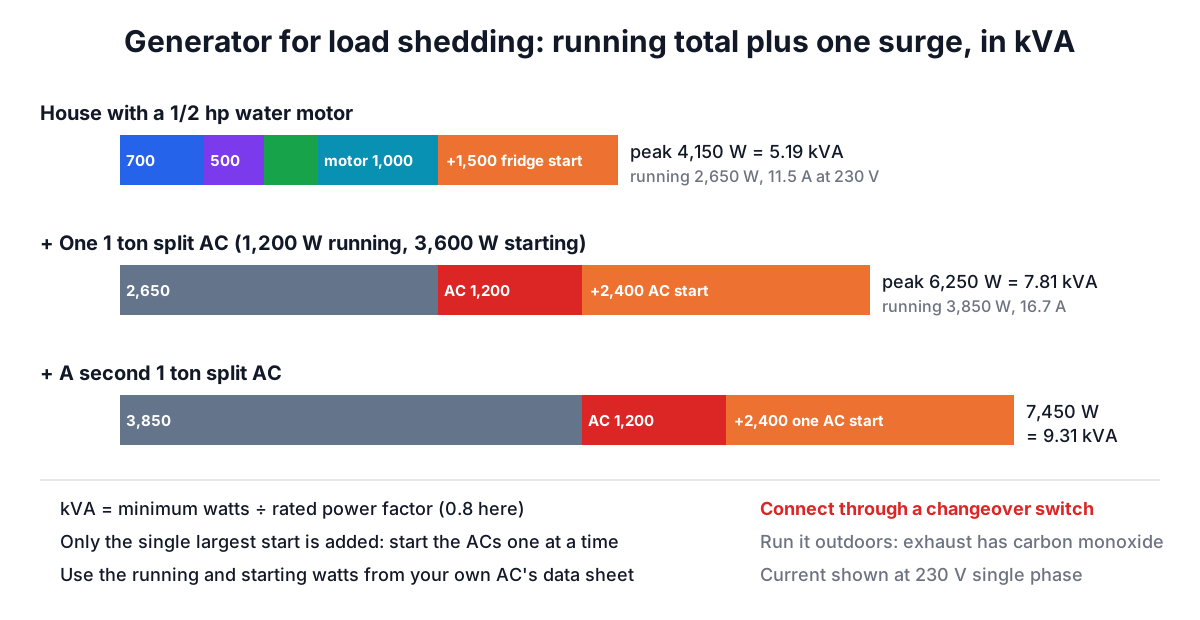
1. Essentials. Refrigerator, lights, TV and router, chargers. Running 1,150 W (5.0 A); the refrigerator's start makes the peak 2,650 W: 3.31 kVA.
2. The default house. Add the deep freezer and the 1/2 hp water motor. Running 2,650 W (11.5 A). The refrigerator's extra 1,500 W is larger than the motor's 1,100 W, so the peak is 4,150 W: 5.19 kVA.
3. One 1 ton split AC. Running 3,850 W (16.7 A). The AC's extra 2,400 W is now the largest surge, and the peak is 6,250 W: 7.81 kVA.
4. Two 1 ton split ACs. Running 5,050 W (22.0 A). Only one AC start is added, as long as they do not start together, so the peak is 7,450 W: 9.31 kVA.
5. One AC with fewer loads. AC, refrigerator, lights, TV and chargers only: running 2,350 W, peak 4,750 W, 5.94 kVA. The AC alone needs 3,600 W at start, 4.5 kVA.
The step from example 3 to example 4 is why switching the second AC on a minute after the first matters. If both compressors start in the same second, both surges land on the generator together.
A short surge allowance
Some data sheets allow a few seconds above rated output. With a 20% surge allowance, example 3 falls from 6,250 W to 5,208 W, 6.51 kVA. Use the "+20%" option only when the maker states it.
Generator, UPS or solar?
If you already run fans, lights and the router on a UPS and batteries during load shedding, the generator only has to cover what the UPS cannot: usually the refrigerator, the water motor and the AC. Check the UPS's rated watts before adding any compressor to it. For the battery side, the Battery Runtime Calculator and the battery runtime guide explain how long a bank lasts. For solar, NEPRA's Prosumer Regulations, 2026 cover grid-connected solar, wind or biogas up to 1 MW and say a facility's capacity shall not exceed the premises' sanctioned load; the Pakistan solar panel guide and the Pakistan Solar Panel Calculator size a system.
Connecting safely
Never feed the house through a socket with a double-ended lead. Power can flow back through the meter into the distribution lines, where linemen working on a feeder they believe is off can be electrocuted. A changeover switch, installed by a qualified electrician, keeps the generator and the distribution company's supply apart.
Carbon monoxide is the bigger daily risk. The US CDC says to run a generator outdoors, more than 20 feet (about 6 m) from windows, doors and vents, and never inside a home or garage, even with doors and windows open. The US EPA adds that deadly levels can build up quickly in enclosed spaces and linger for hours. In practice that means not in the porch, the car garage or a closed stairwell, and with a CO alarm indoors.
Mistakes to avoid
- Sizing from the AC's tonnage alone. The starting surge, not the running watts, sets the generator.
- Starting two ACs together. Stagger them by a minute.
- Comparing kVA and kW directly. Convert with the plate's power factor.
- Putting an iron, geyser or heater on a small set. Heating elements draw their full plate rating while they run; check it before you add one.
- Running the generator in the garage. The CDC warns that people who are asleep can die from carbon monoxide before they have symptoms.
Frequently asked questions
Will a 5 kVA generator run a 1 ton AC?
A 1 ton split AC entered at 1,200 W running and 3,600 W starting needs 4.5 kVA on its own at a 0.8 power factor, so yes. With a refrigerator, deep freezer and water motor also running, the AC's start pushes the peak to 6,250 W, about 7.8 kVA.
What size generator do I need for a refrigerator and water motor?
With a refrigerator, deep freezer, LED lights, TV and router, chargers and a 1/2 hp water motor, the running load is 2,650 W and the refrigerator's start makes the peak 4,150 W. At a 0.8 power factor that needs about 5.2 kVA.
How do I convert kVA to kW?
Multiply kVA by the generator's rated power factor. At 0.8, a 6.5 kVA set gives 5.2 kW. To go from the watts you need to a kVA rating, divide by the power factor.
What voltage is household supply in Pakistan?
NEPRA's Performance Standards (Distribution) Rules list 400/230 V as the nominal low-voltage supply, with at least 95% of consumers to be kept within ±5% of nominal, at 50 Hz (±1%). A single-phase house supply is 230 V.
Sources and further reading
- NEPRA Performance Standards (Distribution) Rules, 2005, with amendments, NEPRA. Nominal voltages, ±5%, 50 Hz, the definition and priorities of load shedding.
- NEPRA (Prosumer) Regulations, 2026, NEPRA. Distributed generation up to 1 MW and the sanctioned load limit.
- IEC 60038 IEC standard voltages, International Electrotechnical Commission. Standard values including 230 V at 50 Hz.
- Carbon monoxide poisoning basics, US CDC. Generators outdoors, more than 20 feet from openings.
- Carbon monoxide's impact on indoor air quality, US Environmental Protection Agency. Why portable generators must never run in enclosed spaces.
Open the Generator Size Calculator
More Electrical
Every tool in the Electrical section, free and in your browser.