
What Size Generator for Load Shedding? kVA Explained
Size a petrol or diesel generator in kVA for load shedding: running watts, the borehole pump surge, power factor, 230 V current and the changeover switch.
By Redbison Dev · · 10 min read
South Africa edition. Written for South African homes: generators rated in kVA at a power factor, a load list with a fridge-freezer, chest freezer and borehole pump, current at 230 V, Eskom's load shedding blocks, and generator wiring to SANS 10142-1 with a Certificate of Compliance and a changeover switch. US edition
The answer for most South African houses is between about 3.3 kVA and 9 kVA, and one item decides which end you are at: the borehole pump. A fridge-freezer, LED lights, the TV, router and chargers need a set of about 3.3 kVA, because the fridge compressor's start sets the size. Add a chest freezer and a 1 hp borehole pump and the minimum rises to about 7.1 kVA, not because the pump runs at a high wattage but because of the surge when it starts. This edition works through those cases with the South African Generator Size Calculator, explains why sets are sold in kVA, and covers the part that keeps electricians and Eskom technicians safe: the changeover switch.
Why generators here are sold in kVA
A generator's alternator is limited by current, so its plate often gives two figures: kVA, and kW at a rated power factor. A set marked 8 kVA and 6.4 kW has a power factor of 6.4 ÷ 8 = 0.8. Your appliances need watts, so the method runs in watts and converts at the end:
minimum kVA = minimum watts ÷ rated power factor
At 0.8, a 5 650 W requirement is 5 650 ÷ 0.8 = 7.06 kVA. Read the plate on the sets you are comparing and enter that ratio in the calculator's power factor field, so a "7.5 kVA" and a "6 kW" set are compared on the same basis. If a set is rated in watts only, enter 1.
Current matters for the cable and the changeover switch. Single-phase low-voltage supply is 230 V: Eskom's connection charges procedure describes low-voltage networks "normally supplying at 400/230 volts three-phase or 230 volts single-phase", and the national standard voltages are set by SANS 1019, based on IEC 60038. Current is running watts ÷ 230.
Running watts, starting watts and the borehole pump
Kettles, geysers, stoves and heaters are resistive: they draw the same from the moment they switch on. Motors are different. A stationary motor draws several times its running current until it gets up to speed, and that is where starting (surge) watts come from. In a South African house the motors are the fridge-freezer, the chest freezer, the borehole or pressure pump, and sometimes a pool pump or gate motor.
The calculator's South African list uses these typical figures. They are starting points; the rating plate on your own appliance always wins.
| Load | Running W | Starting W |
|---|---|---|
| Fridge-freezer | 700 | 2 200 |
| Chest freezer | 500 | 1 500 |
| Lights (10 LED bulbs) | 100 | 100 |
| TV and router | 250 | 250 |
| Laptop and phone chargers | 100 | 100 |
| Borehole pump, 1 hp | 2 000 | 4 000 |
| Microwave, 1 000 W | 1 500 | 1 500 |
The largest-start method
Motors rarely start at the same moment, so you do not add every surge:
- Add the running watts of everything on at once.
- Find the single largest extra surge (starting minus running) and add it once.
- Check the running total plus 20% headroom; the larger of the two figures is the minimum rating.
- Divide by the power factor for kVA.
Worked examples for a load shedding slot
All at 20% headroom, a 0.8 power factor and 230 V, with no surge allowance from the generator.
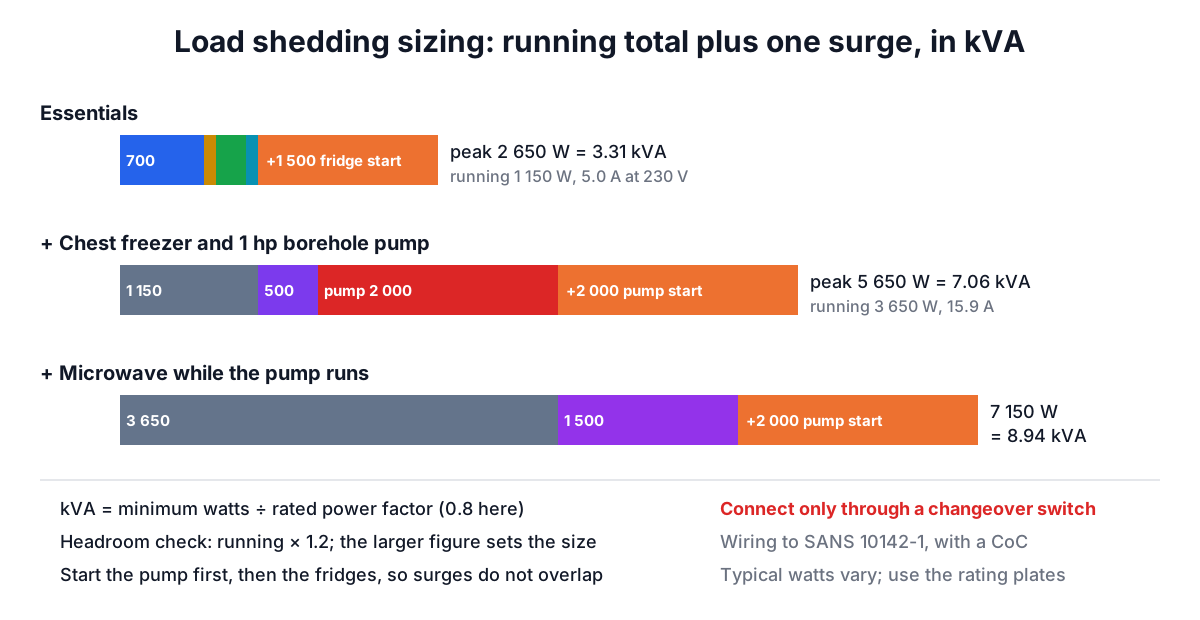
1. Essentials only. Fridge-freezer, lights, TV and router, chargers. Running 1 150 W (5.0 A). The fridge's start adds 1 500 W, so the peak is 2 650 W. Running plus headroom is only 1 380 W, so the peak sets the size: 3.31 kVA.
2. Add the chest freezer. Running 1 650 W (7.2 A). The fridge-freezer still has the biggest surge, so the peak is 3 150 W: 3.94 kVA. A second fridge adds running load, not a second surge.
3. Add the 1 hp borehole pump. Running 3 650 W (15.9 A). The pump's start (2 000 W above running) is now the largest, and the peak is 5 650 W: 7.06 kVA. Running plus headroom is 4 380 W, well below the peak, which is typical when one big motor is on the list.
4. The microwave while the pump runs. Running 5 150 W (22.4 A), peak 7 150 W: 8.94 kVA.
5. The microwave with the pump off. Running 3 150 W, the fridge-freezer's surge is the largest again, and the peak is 4 650 W: 5.81 kVA.
Examples 4 and 5 are the cheapest lesson in generator sizing: not running the microwave and the borehole pump together saves about 3 kVA of generator. Fill the storage tank before the slot, or switch the pump off while you cook.
If the set allows a short surge
Some data sheets allow a few seconds above the rated output. With a 20% surge allowance, example 3 drops from 5 650 W to 4 708 W, or 5.89 kVA. Choose the "+20%" option only when the maker's data sheet states it; the conservative default assumes no allowance.
How long you need to run it
Eskom's guide to interpreting load shedding schedules says stages 1 to 4 use 2-hour blocks, except Eskom-supplied Johannesburg areas, which use 4-hour blocks. From stage 5 the 2-hour blocks are progressively replaced by 4-hour ones: three of the twelve slots in four days at stage 5, all twelve at stage 8. Each block includes 30 minutes for switching, so a 2-hour block can mean up to 2.5 hours without power, and a 4-hour block up to 4.5 hours. Stage 1 means up to three slots in four days; stage 4 up to twelve.
That sets fuel and noise, not size. A set sized for the peak still needs enough fuel for a 4.5-hour slot, and running it lightly loaded for hours is where a slightly smaller set, or a battery system for the overnight loads, pays off. For a battery comparison, see the South African battery runtime guide and the Battery Runtime Calculator. For running costs per litre against the grid, the Fuel Cost Calculator helps.
Altitude and heat
Engines lose power in thin air and in heat, and much of Gauteng sits on the Highveld. Most generator manuals give a derating table or a percentage per altitude step above a reference height. Check that table for your set before you buy it for a Johannesburg or Pretoria house; a set that is just big enough at the coast can be short at altitude.
Connecting safely: the changeover switch
A generator plugged into a plug point, or wired into the DB board without isolation, can push power back into the network, where technicians working on a "dead" line can be electrocuted. A changeover switch that isolates the house from the supply is how an electrician stops back-feed.
Wiring a generator into the house is electrical installation work: it must comply with SANS 10142-1 and be covered by a Certificate of Compliance. Eskom's procedure for managing certificates of compliance says that off-grid or islanded systems need no Eskom registration but must comply with the OHS Act and SANS 10142-1, and that Eskom requires a customer declaration letter for any off-grid generator from its direct customers. A system connected to the grid is different: Eskom's small-scale embedded generation page says households with systems below 100 kVA must register even if they do not export. If you buy from a municipality, ask it what it requires.
Carbon monoxide is the other danger. The US CDC carbon monoxide advice is to run a generator outdoors, more than 20 feet (about 6 m) from windows, doors and vents, and never inside a home or garage, even with doors and windows open. In a South African house that also means away from air bricks and out of an enclosed carport.
Mistakes to avoid
- Sizing for the running total only. The borehole pump will stall the set at start.
- Adding every surge together. Motors rarely start at the same instant, so it oversizes the set you pay for.
- Comparing kVA with kW. Convert with the plate's power factor first.
- Putting the geyser or kettle on a small set. Heating elements draw their full plate rating for as long as they run; check it before you add one.
- Skipping the changeover switch. The wiring must comply with SANS 10142-1, and the switch protects people working on the network.
Frequently asked questions
What size generator do I need for a house with a borehole pump?
With a fridge-freezer, chest freezer, LED lights, TV and router, chargers and a 1 hp borehole pump, the running load is 3 650 W, but the pump's start pushes the peak to 5 650 W. At a 0.8 power factor that needs about 7.1 kVA, or about 5.9 kVA if the set's data sheet allows a 20% short surge.
How do I convert kW to kVA for a generator?
Divide kW by the generator's rated power factor, which is the kW figure on the plate divided by the kVA figure. At 0.8, a 5.65 kW requirement is 5.65 ÷ 0.8 = 7.06 kVA. Use the same power factor for every set you compare.
How long does load shedding last at each stage?
Stages 1 to 4 use 2-hour blocks (4-hour blocks in Eskom-supplied Johannesburg areas); from stage 5 more of the slots become 4-hour blocks, until stage 8 uses 4-hour blocks only. Each block includes 30 minutes for switching, so a 2-hour block can mean up to 2.5 hours without power.
Do I need to register a generator with Eskom?
Eskom's certificate of compliance procedure says an off-grid or islanded generator needs no Eskom registration, but must comply with the OHS Act and SANS 10142-1, and Eskom direct customers must give a declaration letter. A system connected to the grid falls under the SSEG registration rules instead.
Can I run the microwave on a 5 kVA generator during load shedding?
Not with both fridges running and no surge allowance. Adding a 1 500 W microwave to the essentials and a chest freezer gives a peak of 4 650 W, which is 5.81 kVA at a 0.8 power factor. With the borehole pump also running, the peak becomes 7 150 W, about 8.9 kVA.
Sources and further reading
- Interpreting load shedding schedules, Eskom. Stage sizes, 2-hour and 4-hour blocks and the 30 minutes for switching.
- Management of certificates of compliance for electrical installations (240-170000465, rev. 3), Eskom Distribution. Off-grid generators, SANS 10142-1 and the customer declaration.
- Small-scale embedded generation, Eskom Distribution. Registration for grid-connected systems and the off-grid exemption.
- Connection charges for customers connected to Eskom's distribution network, Eskom Distribution. Low-voltage supply at 400/230 V three-phase or 230 V single-phase.
- SANS 1019:2021 Standard voltages, currents and insulation levels, South African Bureau of Standards. Scope and basis in IEC 60038.
- Carbon monoxide poisoning basics, US CDC. Running generators outdoors, away from windows, doors and vents.
Open the Generator Size Calculator
More Electrical
Every tool in the Electrical section, free and in your browser.