
Founder Dilution and the ESOP Pool for a Singapore Pte Ltd
How a Singapore Pte Ltd cap table moves through a seed and Series A in S$, what the ESOP top-up costs founders, ACRA allotment steps and IRAS tax on option gains.
By Redbison Dev · · 10 min read
Singapore edition. Written for Singapore founders: Singapore dollars, ordinary and preference share rounds for a private limited company, the ESOP pool shuffle, ACRA's allotment and EROM steps, and how IRAS taxes employees' option gains. US edition
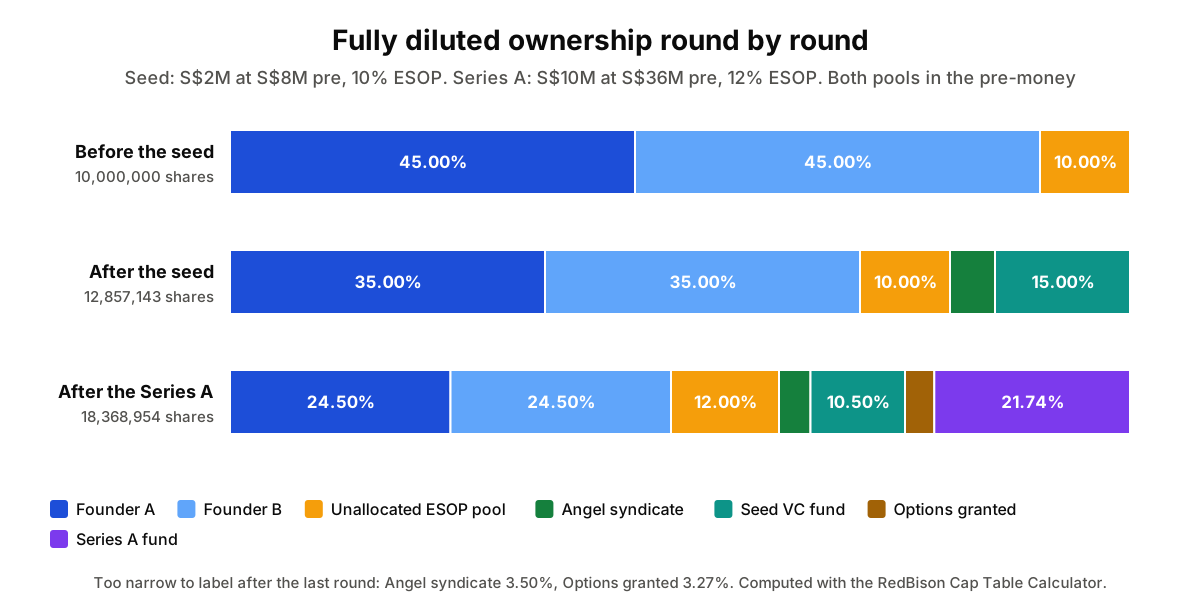
Two Singapore founders who start at 45% each, raise a S$2 million seed at S$8 million pre-money and a S$10 million Series A at S$36 million pre, each with an ESOP top-up in the pre-money, end with 24.50% each. S$3,802,817 of the Series A headline pays for new ESOP shares nobody holds yet, so the effective pre-money is S$32,197,183. The Singapore version of the Cap Table Calculator opens on this path, and the Singapore Option Pool Shuffle Calculator prices the pool on its own. This guide works through both rounds with the tools' numbers, then covers what is particular to a Singapore Pte Ltd: share classes, ACRA's allotment steps and the IRAS rules for ESOP gains.
The starting cap table
The founders hold 4,500,000 ordinary shares each and reserve 1,000,000 for an ESOP pool. Investors price on a fully diluted basis: ordinary shares, preference shares as converted, options granted and the unallocated pool.
| Holder | Shares | Fully diluted |
|---|---|---|
| Founder A | 4,500,000 | 45.00% |
| Founder B | 4,500,000 | 45.00% |
| Unallocated ESOP pool | 1,000,000 | 10.00% |
| Total | 10,000,000 | 100.00% |
Share classes in a Singapore round
ACRA lists five kinds of shares a company can have: ordinary, preference, redeemable preference, convertible preference and treasury shares, each with its own rights. Founders and employees usually hold ordinary shares. A seed can be ordinary shares or a class of convertible preference shares with its own rights; the rights come from the constitution and the investment agreement, not from the cap table. The calculator counts shares and works the same either way.
The seed
An angel syndicate invests S$500,000 and a seed fund S$1,500,000 at a S$8,000,000 pre-money, with an ESOP of 10% after the round in the pre-money. The existing pool would be 7.78% after the round, so 285,714 new ESOP shares are created first, and the price is S$8,000,000 ÷ 10,285,714 = S$0.7778.
| Holder | Shares | Fully diluted |
|---|---|---|
| Founder A | 4,500,000 | 35.00% |
| Founder B | 4,500,000 | 35.00% |
| Unallocated ESOP pool | 1,285,714 | 10.00% |
| Angel syndicate | 642,857 | 5.00% |
| Seed VC fund | 1,928,571 | 15.00% |
| Total | 12,857,143 | 100.00% |
The investors own exactly their S$2 million of a S$10 million post-money. The S$222,222 of new ESOP shares came out of the founders, so the effective pre-money is S$7,777,778.
The Series A and the ESOP shuffle
After 600,000 options are granted, 685,714 remain unallocated. The Series A fund offers S$10,000,000 at S$36,000,000 pre with a 12% unallocated ESOP after the round. The calculator adds 1,518,560 pool shares and prices the round at S$2.5042; the fund receives 3,993,251 shares.
| Holder | Shares | Fully diluted |
|---|---|---|
| Founder A | 4,500,000 | 24.50% |
| Founder B | 4,500,000 | 24.50% |
| Unallocated ESOP pool | 2,204,274 | 12.00% |
| Options granted | 600,000 | 3.27% |
| Angel syndicate | 642,857 | 3.50% |
| Seed VC fund | 1,928,571 | 10.50% |
| Series A fund | 3,993,251 | 21.74% |
| Total | 18,368,954 | 100.00% |
Put the same Series A into the Option Pool Shuffle Calculator (12,857,143 shares before the round, 685,714 unallocated, 12% target):
- Effective pre-money: S$36,000,000 less S$3,802,817 of new ESOP shares = S$32,197,183.
- Pre-money excluding the whole pool: S$30,480,000. The full 12% pool is worth S$5,520,000, 12% of the S$46 million post-money.
- Shuffle cost: existing holders keep 66.26% with the pool in the pre-money and would keep 68.04% if it were added after the round, a gap of 1.78 points.
- Counter-offer: a headline of S$40,090,909 with the same 12% pool would leave the existing shares priced at a real S$36 million.
Each founder gives up 45.56% of the starting stake, while each founder's 4,500,000 shares are worth S$3,500,000 at the seed price and S$11,269,014 at the Series A price.
The Singapore steps around each round
Shareholder approval and the EROM
ACRA's allotment guidance says you need approval at a general meeting before directors allot shares, even if the constitution lets the directors decide on allotments; the directors then set the number, terms and price under section 161 of the Companies Act. ACRA's page deals with issuing shares. The unallocated ESOP pool on the cap table is a reservation for shares that are issued later, when options are exercised, so ask your corporate secretary how the general meeting approval and the ESOP plan cover those issues. For a private company the allotment takes effect when the Electronic Register of Members (EROM) is updated through the return of allotment, which ACRA lists as free to file. Check that your cap table and the EROM agree on that date.
How IRAS taxes the pool when staff exercise
IRAS generally taxes gains from employee stock options when they are exercised: the open market price on the exercise date less the exercise price, times the number of shares, taxed as employment income. Share awards with a vesting period are taxed at vesting, and where the plan restricts selling the shares, when the restriction lifts.
Example. An early hire holds 40,000 options with an exercise price equal to the seed price, S$0.7778, and exercises when the company is valued at the Series A price, S$2.5042. If the Series A price were the open market value of an ordinary share, the gain would be about S$69,058 (40,000 x S$1.7264). In practice the Series A shares may be preference shares with extra rights, so the open market value of an ordinary share can be lower. Agree the valuation with your adviser before reporting it.
Two more IRAS points to plan around: the Equity Remuneration Incentive Scheme for start-ups no longer applies after YA 2024, and foreign employees who leave Singapore with unexercised or unvested options are treated as having made the gain at tax clearance. The Qualified Employee Equity-based Remuneration scheme can still defer the tax for up to five years, with interest.
This is planning arithmetic, not legal or tax advice. Have a corporate secretary and a tax adviser check the closing cap table, the filings and the ESOP plan.
Tools for this job
- Cap Table Calculator (Singapore): every holder through each round, with the dilution table.
- Option Pool Shuffle Calculator (Singapore): one round's ESOP top-up, effective pre-money and counter-offer.
- Co-founder Equity Split (Singapore): the founders' split and the ESOP reserve before the first round.
- Percentage Calculator: check a holder's stake by hand.
The Singapore guide to splitting co-founder equity covers the split and vesting, and the US edition of this guide covers post-money SAFEs.
Frequently asked questions
What does the ESOP top-up cost at a Series A?
In this example, 1,518,560 new ESOP shares worth S$3,802,817 sit inside the S$36 million pre-money. Existing holders keep 66.26% instead of 68.04% with the pool added after the round.
Do shareholders have to approve a funding round in Singapore?
Yes. ACRA says approval at a general meeting is needed before directors allot shares, even if the constitution lets the directors decide. The allotment then takes effect for a private company when the EROM is updated.
When are ESOP gains taxed in Singapore?
Generally when the options are exercised, on the open market price at exercise less the exercise price. Share awards with vesting are taxed at vesting, and restricted shares when the restriction lifts.
Does dilution make my shares worth less?
Not if the price per share rises. Each founder's stake falls from 35.00% to 24.50% at the Series A, but the shares rise in value from S$3,500,000 to S$11,269,014. A down round is what lowers value per share.
Sources and further reading
- Share types and shareholding, ACRA. Ordinary, preference, redeemable preference, convertible preference and treasury shares; members in the EROM.
- Allotment of shares, ACRA. General meeting approval, section 161 and when a private company's allotment takes effect.
- Gains from the exercise of stock options, IRAS. When ESOP gains are taxed, the gain computation, deemed exercise for foreign employees, the end of ERIS and QEEBR.
- The Option Pool Shuffle, Venture Hacks. The article that named the shuffle.
- NVCA 2020 Term Sheet, National Venture Capital Association. The US model Series A term sheet, with the pool in the pre-money.
- Post-Money SAFE User Guide, Y Combinator. A worked Series A with the pool in the pre-money.
Open the Cap Table and Dilution Calculator
More Fundraising & Equity
Every tool in the Fundraising & Equity section, free and in your browser.