
Blood Alcohol in Canada: Standard Drinks, 0.08 and 0.05
How Canadian standard drinks, tall cans and coolers become a BAC estimate, how the 0.08 criminal limit and provincial 0.05 sanctions work, and why novices get zero.
By Redbison Dev · · 7 min read
Canada edition. Written for Canadian drivers: 13.45 g standard drinks, 341 ml bottles and 473 ml tall cans, weight in pounds, the Criminal Code 0.08 limit, Ontario and Alberta sanctions at 0.05, zero tolerance and Canada's Guidance on Alcohol and Health. US edition
In Canada, a standard drink is 13.45 g of pure alcohol, the amount in a 341 ml bottle of 5% beer, and two sets of rules apply to drivers: the Criminal Code makes 80 mg of alcohol per 100 ml of blood (0.08) a crime, and the provinces suspend licences at lower levels, usually from 0.05. A BAC calculator can turn your drinks into an estimate and show how long it takes to fall, but it cannot tell you that you are fit to drive. This guide works through Canadian drinks with the Canadian version of the BAC Calculator and shows where the estimate goes wrong.
Canadian standard drinks, and the serves that are not one
Health Canada defines a standard drink as 17.05 ml or 13.45 g of pure alcohol: a 341 ml (12 oz) bottle of 5% beer, a 142 ml (5 oz) glass of 12% wine or a 43 ml (1.5 oz) shot of 40% spirits. That is close to the US 14 g drink, but more than the UK unit (8 g) or the Australian standard drink (10 g), so drink counts from foreign websites do not carry over.
Plenty of what Canadians actually pour is more than one:
| Serve | Grams of ethanol | Canadian standard drinks |
|---|---|---|
| 341 ml bottle of 5% beer | 13.5 | 1.0 |
| 473 ml tall can of 5% beer | 18.7 | 1.4 |
| 568 ml (20 oz) bar pint of 5% beer | 22.4 | 1.7 |
| 473 ml can of 7% cooler or seltzer | 26.1 | 1.9 |
| 142 ml glass of 12% wine | 13.4 | 1.0 |
| 43 ml shot of 40% spirits | 13.6 | 1.0 |
The calculator works out grams as volume x ABV x 0.789 (the density of ethanol) and divides by 13.45 to count drinks. A 7% tall-can cooler is nearly two drinks, which is easy to miss when it tastes like soda.
What the national guidance says
Canada's Guidance on Alcohol and Health, published in 2023 by the Canadian Centre on Substance Use and Addiction, replaced the old low-risk drinking guidelines with a continuum of weekly risk: two standard drinks or fewer a week and you are likely to avoid alcohol-related consequences; three to six raise the risk of several cancers, including breast and colon cancer; seven or more raise the risk of heart disease and stroke significantly. It is health guidance about long-term harm. It sets no driving threshold, and nothing in it suggests a number of drinks that is safe before getting behind the wheel.
From drinks to an estimated BAC
The calculator uses the Widmark formula: grams of alcohol divided by body weight times a body-water factor (0.68 for men, 0.55 for women), minus 0.015% for every hour since the first drink. Enter weight in pounds; the result is in percent, so 0.067% is 67 mg per 100 ml, the unit police and the Criminal Code use.
Example 1, four beers after work. A 180 lb man has four 341 ml bottles of 5% beer over two hours:
- 53.8 g of alcohol, 4 standard drinks
- peak if absorbed at once: 0.097%
- estimate now: 0.067%
- below 0.05 in about 1 h 08 min; about zero in 4 h 28 min
The estimate is under the criminal limit and inside the provincial range. In Ontario a reading of 0.05 to 0.079 brings an immediate 7-day licence suspension, an education course and a $250 penalty the first time. In Alberta the same range brings a 3-day suspension, a 3-day vehicle seizure and a $300 fine plus a 20% victim surcharge. And the estimate might be well off in either direction.
Example 2, two coolers at a cottage. A 145 lb woman drinks two 473 ml cans of 7% cooler over an hour and a half:
- 52.2 g of alcohol, 3.9 standard drinks, although she had "two cans"
- estimate now: 0.122%
- below 0.08 in about 2 h 48 min, below 0.05 in about 4 h 48 min, about zero in 8 h 08 min
Two cans of a strong cooler put a lighter person well past 0.08 in the estimate. If a test showed a level like that, Alberta's immediate roadside sanctions for 0.08 or more start with 90 days in which she could not drive at all, then a further 12-month suspension, during which she could drive only in the Ignition Interlock Program, plus a 30-day vehicle seizure and a $1,000 fine, before any criminal case. Under the Criminal Code a first conviction at 120 to 159 mg carries a minimum fine of $1,500.
The next morning
Elimination is slow. The formula assumes a steady fall of 0.015% an hour that nothing you do after drinking changes, so only time lowers the estimate. For a 165 lb man that fall is about 7.6 g of alcohol an hour, little more than half a Canadian standard drink, so a late night carries into the drive to work.
Example 3, a wedding reception. A 165 lb man has six 341 ml beers and two 43 ml shots between 7 p.m. and midnight:
- 107.9 g of alcohol, 8 standard drinks
- estimate at midnight: 0.137%
- below 0.08 at about 3:48 a.m., below 0.05 at about 5:48 a.m.
- estimate at 7 a.m.: 0.032%; about zero at about 9:08 a.m.
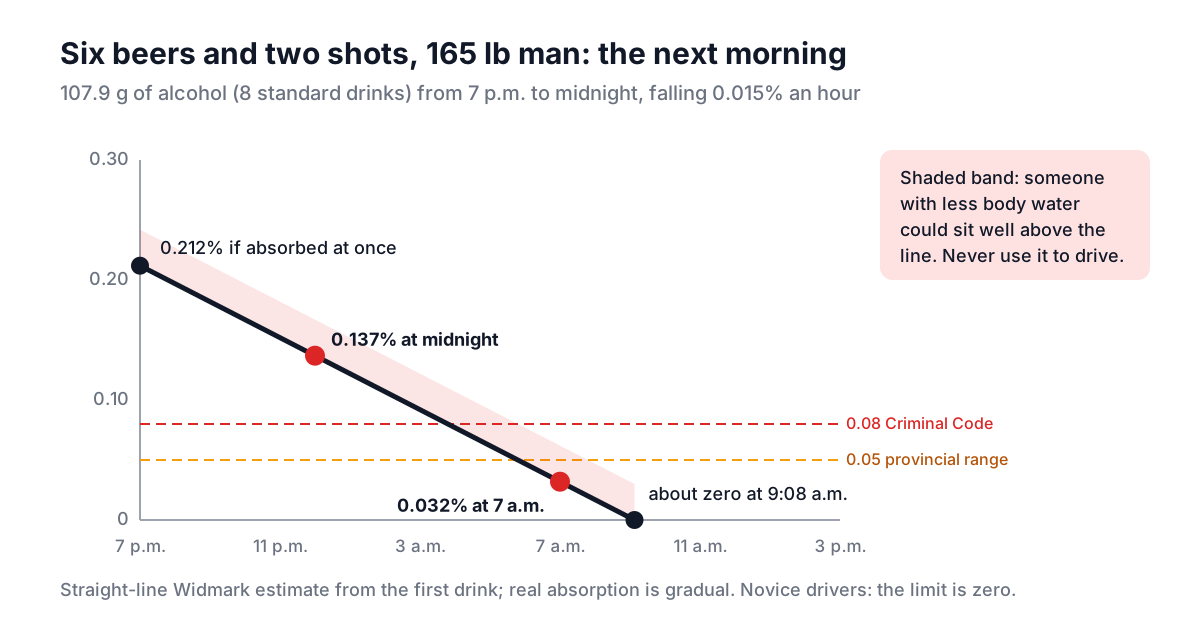
At 7 a.m. the estimate is below both lines, but it is still above zero, which is the only limit that matters for a G2 driver in Ontario or anyone 21 or under. And a straight line is generous: Queensland's road-safety page notes that blood alcohol can peak 30 to 60 minutes after the last drink, while the formula assumes everything was absorbed at the first.
Two layers of law
| Level | What applies |
|---|---|
| Any alcohol | Ontario zero tolerance: drivers 21 or under, G1, G2, M1 and M2 licence holders at any age, drivers needing an A to F licence or a CVOR, and road-building machines. Alberta zero tolerance for novice (GDL) drivers: 30-day suspension, 7-day vehicle seizure and a $200 fine plus surcharge. |
| 0.05 to 0.079 | Provincial sanctions, not a crime. Ontario: 7, 14 or 30-day suspensions with $250, $350 or $450 penalties. Alberta: 3, 15 or 30 days with $300, $600 or $1,200 fines plus surcharge. |
| 0.08 or more within two hours of driving | Criminal Code offence. First-offence minimum fines of $1,000 (80 to 119 mg), $1,500 (120 to 159 mg) and $2,000 (160 mg or more); up to 10 years in prison. Ontario adds a 90-day suspension and 7-day impoundment. |
Two more federal rules surprise people. Under mandatory alcohol screening, police can demand a roadside breath sample from any driver they have lawfully stopped, without suspecting that you have been drinking. And refusing a demand is itself an offence, with a first-offence minimum fine of $2,000. Other provinces and territories set their own novice programs and sanction amounts, so check your own province's ministry page.
Why the estimate is only a guide
Each input to the formula is an average. Two people of the same weight can carry quite different shares of body water. Food slows absorption and lowers the peak. Genetics, liver health, medication and drinking history change the rate the liver clears alcohol. Impairment also starts below 0.05, which is why provinces act at that level and why novices are held to zero.
So use the number to understand your drinks: how many standard drinks are in a tall can, how long a wedding's worth of beer takes to clear. Do not use it to decide to drive. Plan the ride before the first drink: a designated driver, a taxi or rideshare, transit or a bed for the night.
HealthLink BC lists the signs of alcohol poisoning: vomiting, confusion, passing out or being impossible to wake, seizures, slow or irregular breathing, and a low body temperature with bluish or pale skin. If you see them, call 911 straight away; HealthLink BC says immediate medical treatment is always needed.
Tools for this job
- BAC Calculator (Canadian standard drinks): standard drinks, an estimate in percent, and the time to fall below 0.08, 0.05 and zero, with weight in pounds.
- Hydration Calculator: a water target for the day after.
- Sleep Calculator: bedtimes and wake times, remembering that only time lowers the estimate.
Frequently asked questions
Is 0.05 illegal in Canada?
Not under the Criminal Code, whose limit is 0.08. But every province can sanction drivers below that. Ontario suspends your licence for 7 days at 0.05 to 0.079 the first time, and Alberta for 3 days with a vehicle seizure. Young and novice drivers face a zero limit.
How many beers to reach 0.08?
There is no fixed number. In the first example, four bottles leave a 180 lb man at an estimated 0.067% after two hours; in the second, two strong coolers take a 145 lb woman to 0.122%. Weight, sex, food, serve size and your own metabolism all shift the answer, and the estimate can be wrong by a wide margin.
How long after drinking can I drive?
The calculator shows when the estimate falls below 0.08, 0.05 and zero, using an average fall of 0.015% an hour, which for an average-sized adult is only about half to two thirds of a Canadian standard drink an hour (about 8 g of alcohol for a 180 lb man, about 5.4 g for a 145 lb woman). Do not count on clearing one drink an hour. Treat those times as the earliest possible, not a green light, and remember that novice drivers must be at zero.
Is a tall can one drink?
No. A 473 ml tall can of 5% beer is about 1.4 Canadian standard drinks, a 20 oz bar pint about 1.7, and a 473 ml can of 7% cooler about 1.9.
Can police test me if I have not been drinking?
Yes. Mandatory alcohol screening lets police demand a breath sample from any driver they lawfully stop, with no suspicion needed. Refusing is a criminal offence with a minimum $2,000 fine for a first offence.
Sources and further reading
- Impaired driving laws, Department of Justice Canada. The 80 mg offence within two hours, minimum fines by level, mandatory alcohol screening and refusal.
- Criminal Code, section 320.19, Justice Laws Website. Penalties for impaired driving offences.
- Impaired driving, Government of Ontario. Warn range penalties, 0.08 sanctions and zero tolerance.
- Impaired driving penalties, Government of Alberta. Immediate roadside sanctions for 0.05 to 0.079, 0.08 or more and novice drivers.
- Standard drink definition, Health Canada. 17.05 ml or 13.45 g; 341 ml beer, 142 ml wine, 43 ml spirits.
- Alcohol poisoning, HealthLink BC (Province of British Columbia). Signs of alcohol poisoning and the need to call 911.
- Canada's Guidance on Alcohol and Health, Canadian Centre on Substance Use and Addiction. The 2023 continuum of weekly risk.
- Alcohol limits, Queensland Government. Blood alcohol can peak 30 to 60 minutes after the last drink.
More Wellness Tools
Every tool in the Wellness Tools section, free and in your browser.