
Drink Driving Limits in Ireland: Pints, 50mg and 20mg
How pints, pub measures and wine become Irish standard drinks and a blood alcohol estimate, the 50 mg and 20 mg limits, penalty bands and the morning after.
By Redbison Dev · · 7 min read
Ireland edition. Written for drivers in Ireland: 10 g standard drinks, pints of stout and lager, 35.5 ml pub measures and 187 ml wine bottles, the 50 mg general limit and 20 mg for learner, novice and professional drivers, and the fixed penalty bands in the Road Traffic Act 2010. US edition
In Ireland most drivers are over the limit at 50 mg of alcohol per 100 ml of blood, and learner, novice and professional drivers at 20 mg. The HSE says most people reach 20 mg to 50 mg after a single standard drink, and a pint of 4.5% beer is two standard drinks. The Irish version of the Blood Alcohol Calculator turns pints, measures and glasses into Irish standard drinks and an average blood alcohol estimate. This guide walks through realistic nights out with it, shows where the penalty bands sit, and explains why the estimate can never tell you that you are fine to drive.
The two limits and who has the lower one
Section 4 of the Road Traffic Act 2010 sets the limits in blood, urine and breath:
| Limit | Blood (mg per 100 ml) | Breath (µg per 100 ml) | Urine (mg per 100 ml) |
|---|---|---|---|
| Most drivers | 50 | 22 | 67 |
| Specified person | 20 | 9 | 27 |
A "specified person" under section 3 is anyone on a learner permit, anyone in the first two years of their first full licence, holders of categories C, C1, D, D1, EB, EC, EC1, ED, ED1 or W while driving a vehicle of that category, taxi, hackney and limousine drivers at work, and anyone driving without a licence for that vehicle. The HSE's summary is shorter: the limit is 20 mg if you are a learner, novice or HGV driver.
The calculator estimates blood, so read its percentage as mg per 100 ml by multiplying by 1,000: 0.044% is 44 mg. Gardaí test your breath at the roadside or at a checkpoint.
Penalty bands
Section 29 of the same Act lets an offence in the lower bands be dealt with by a fixed charge and an automatic disqualification instead of a court hearing:
| Reading (blood) | Driver | Fixed charge | Disqualification |
|---|---|---|---|
| over 50 mg, up to 80 mg | most drivers | €200 | 3 months |
| over 80 mg, up to 100 mg | most drivers | €400 | 6 months |
| over 20 mg, up to 80 mg | specified person | €200 | 3 months |
Above those bands the fixed charge route does not apply and the case goes to court. Since the Road Traffic (Amendment) Act 2018, paying the fixed charge in the 50 to 80 mg band brings a three-month disqualification instead of penalty points (section 29(8)(a)(i)).
A fixed penalty notice is not available if you hold no driving licence in force or are disqualified at the time, or if you paid one and less than three years have passed since the disqualification that followed it began (section 29(4) and (5)); those cases go to court.
Irish standard drinks
The HSE defines a standard drink as 10 g of pure alcohol. Its examples are a half pint of 4.5% beer, stout or cider, a 35.5 ml single measure of 40% spirits and a 100 ml glass of 12.5% wine, with just over 7 standard drinks in a bottle of 12.5% wine. The calculator's arithmetic (millilitres x ABV x 0.789, divided by 10) gives the same answers and fills in the serves people order:
| Serve | Grams of alcohol | Standard drinks |
|---|---|---|
| Pint (568 ml) of 4.3% stout | 19.3 | 1.9 |
| Pint of 4.5% lager or cider | 20.2 | 2.0 |
| Pint of 5.5% craft IPA | 24.6 | 2.5 |
| 500 ml can of 4.5% cider | 17.8 | 1.8 |
| 187 ml bottle of 12.5% wine | 18.4 | 1.8 |
| 35.5 ml pub measure of 40% spirits | 11.2 | 1.1 |
| 750 ml bottle of 12.5% wine | 74.0 | 7.4 |
The little 187 ml bottles of wine sold in pubs and at events hold almost two standard drinks each. A home pour of spirits is often bigger than a 35.5 ml pub measure; a double (71 ml) is two standard drinks. UK units are 8 g, not 10 g, so a pint that is 2 Irish standard drinks is about 2.5 UK units: do not mix up guidance from the two countries.
The HSE's low-risk weekly guidelines are up to 11 standard drinks for women and 17 for men, spread over the week, with 2 to 3 alcohol-free days and no more than 6 on any one occasion. Those are health guidelines. They say nothing about driving.
Worked examples
The calculator uses the Widmark formula: grams of alcohol divided by body weight times a body-water factor (0.68 for men, 0.55 for women), minus an average fall of 0.015% an hour from the first drink. You can enter weight in stones and pounds.
Example 1, three pints after the match. A 13 st 5 lb (84.8 kg) man has three pints of 4.3% stout over three hours:
- 57.8 g of alcohol, 5.8 standard drinks
- peak if absorbed at once: 0.100% (100 mg)
- estimate now: 0.055% (55 mg)
- below 50 mg in about 21 min; below 20 mg in about 2 h 21 min; about zero in 3 h 41 min
On the average he is in the first penalty band: €200 and a three-month ban if he drove now. A slower clearer would be further over.
Example 2, one can for a learner. A 68 kg man on a learner permit drinks one 500 ml can of 4.5% cider and waits an hour:
- 17.8 g, 1.8 standard drinks
- estimate now: 0.023% (23 mg), over the 20 mg limit
- below 20 mg in about 14 min; about zero in 1 h 34 min
One can is enough to put a learner over their limit on the average estimate, exactly as the HSE warns.
Example 3, two small bottles of wine at a wedding. A 60 kg woman drinks two 187 ml bottles of 12.5% wine over an hour and a half:
- 36.9 g, 3.7 standard drinks
- estimate now: 0.089% (89 mg), in the second band
- below 50 mg in about 2 h 37 min; below 20 mg in about 4 h 37 min; about zero in 5 h 57 min
Two "small" bottles put a lighter driver well past 80 mg, where the fixed charge doubles to €400 and the ban to six months.
The morning after
The HSE says one standard drink usually takes 1 to 2 hours to leave your system, that levels can keep rising for up to 3 hours after you stop, and that nothing, including food, water or coffee, speeds it up. Sleep does not either.
Example 4, the school run. A 75 kg man drinks seven pints of 4.3% stout from 8 pm to around midnight and has to drive the children to school at 8 am:
- 134.9 g of alcohol, 13.5 standard drinks
- estimate at midnight: 0.204% (204 mg)
- estimate at 8 am, 12 hours after the first pint: 0.084% (84 mg)
- below 50 mg at about 10:18 am; below 20 mg at about 12:18 pm; about zero at 1:38 pm
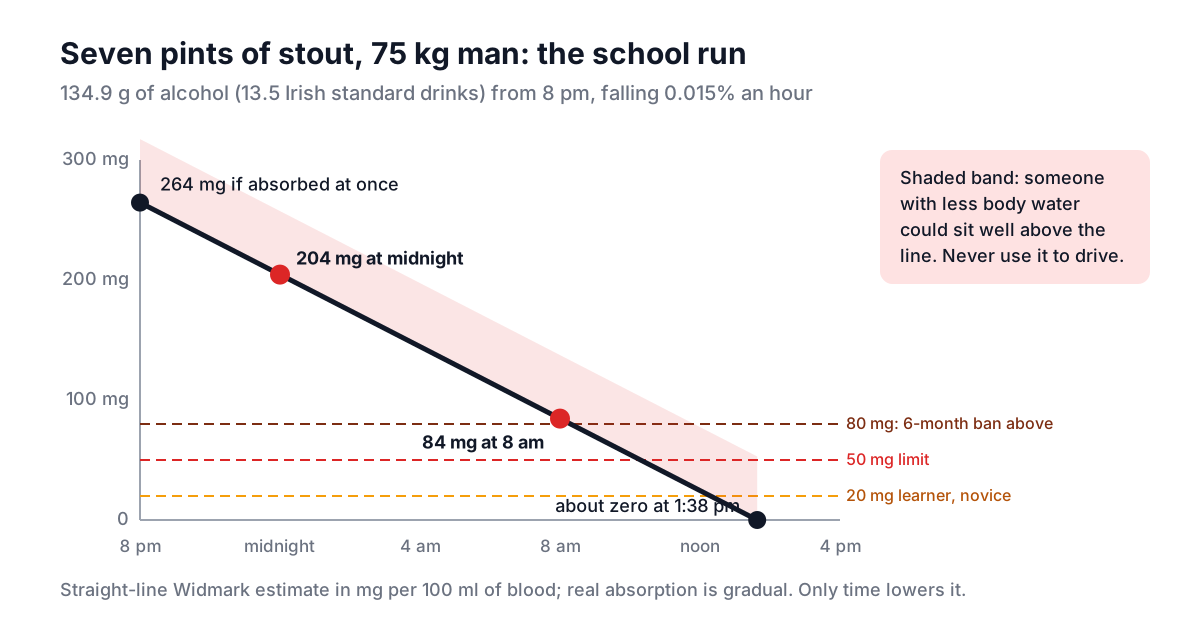
After a full night's sleep the estimate is still above 80 mg, the second penalty band. A novice driver who drank the same would be over 20 mg until after lunch.
Why the estimate is never permission
Every input is an average. Body water varies with build, not just weight and sex; food slows absorption and lowers the peak; genetics, medicines and liver health change the rate of clearance. Searle's review of the Widmark formula shows that a single estimate carries a wide margin of error in both directions. The straight line also assumes all the alcohol was absorbed at the first drink, which is not how bodies work.
Use the calculator to see what is in your usual drinks and how long they take to clear. If you are driving, the HSE's advice is the only plan that works: do not drink. Arrange a designated driver, a taxi, public transport or somewhere to stay before you go out.
If someone who has been drinking cannot be woken, is breathing slowly or irregularly, or has a seizure, call 112 or 999 for an ambulance, put them on their side and stay with them.
Tools for this job
- Blood Alcohol Calculator (Ireland): Irish standard drinks, an estimate in percent, and the time to fall below 50 mg and 20 mg.
- Hydration Calculator: a water target for the day after.
- Sleep Calculator: plan a bedtime, remembering that sleep does not lower blood alcohol.
The US guide to blood alcohol compares standard drinks across countries if you are driving abroad.
Frequently asked questions
How many pints can I drink and still drive in Ireland?
None that you can count on. Three pints of stout leave a 13 st 5 lb man at an estimated 55 mg after three hours, over the 50 mg limit. The HSE says most people reach 20 mg to 50 mg after one standard drink, and a pint is two.
Am I on the 20 mg limit?
You are if you hold a learner permit, are in the first two years of your first full licence, are driving a truck or bus on that licence category, are a taxi, hackney or limousine driver at work, or are driving without a licence for the vehicle.
What happens if I am caught between 50 mg and 80 mg?
Where the fixed charge procedure applies, section 29 of the Road Traffic Act 2010 sets €200 and a three-month disqualification. Between 80 mg and 100 mg it is €400 and six months. Above that the case goes to court.
How long does a pint take to leave your system?
The HSE says one standard drink usually takes 1 to 2 hours, so a pint of 4.5% beer, two standard drinks, can take 2 to 4 hours, and the level can still be rising for up to 3 hours after your last drink.
Can I be over the limit the next morning?
Yes. In example 4, seven pints from 8 pm still leave an estimated 84 mg at 8 am. Count the whole night from the first drink, and if the answer is close, do not drive.
Sources and further reading
- Road Traffic Act 2010, section 4, Law Reform Commission (Revised Acts). The 50 mg and 20 mg limits in blood, breath and urine.
- Road Traffic Act 2010, section 3, Law Reform Commission (Revised Acts). Who is a specified person.
- Road Traffic Act 2010, section 29, Law Reform Commission (Revised Acts). Fixed charges of €200 and €400, disqualifications of 3 and 6 months (subsection (8), as amended in 2018), and who cannot get a fixed penalty notice (subsections (4) and (5)).
- How alcohol affects your driving, HSE. Most people reach 20 mg to 50 mg after one standard drink; 1 to 2 hours per standard drink; levels can rise for up to 3 hours.
- Weekly low-risk alcohol guidelines, HSE. The 10 g standard drink, serve examples and the 11 and 17 weekly guidelines.
- Alcohol poisoning, HSE. Call 112 or 999; the recovery position while you wait.
- Alcohol calculations and their uncertainty, Medicine, Science and the Law. Searle on the Widmark formula and its error range.
- Evidence-based survey of the elimination rates of ethanol from blood, Forensic Science International. Jones, 2010.
More Wellness Tools
Every tool in the Wellness Tools section, free and in your browser.