
Diminishing Value vs Prime Cost: Depreciation in Australia
The two decline-in-value formulas in the tax law, days held in the first income year, the $20,000 instant asset write-off and the small business pool at 15% and 30%.
By Redbison Dev · · 7 min read

Australia edition. Uses Australian dollars, the July to June income year and the decline-in-value rules in Division 40 and Subdivision 328-D of the Income Tax Assessment Act 1997, beside AASB 116 depreciation for financial statements. US edition
Australian tax law calls depreciation "decline in value" and gives two formulas for it. Diminishing value takes a fixed share of what is left each year; prime cost takes the same share of the original cost every year. Both are pro-rated by the days you held the asset in the first income year, and small businesses can skip both with the instant asset write-off and the small business pool. This guide sets out the formulas as the Income Tax Assessment Act 1997 states them and works through them with the Australian depreciation calculator.
It explains the mechanics. Cars, buildings (capital works), rental property and assets used partly for private purposes have extra rules; confirm a return with a registered tax agent or the ATO.
The two formulas in Division 40
Section 40-72 (diminishing value, for assets you started to hold on or after 10 May 2006):
decline in value = base value x (days held / 365) x (200% / effective life)
Section 40-75 (prime cost):
decline in value = cost x (days held / 365) x (100% / effective life)
For assets held before 10 May 2006 the diminishing value rate is 150% instead of 200%. Diminishing value cannot be used for in-house software, most intellectual property, spectrum licences or telecommunications site access rights, and its decline in a year can never exceed the asset's base value.
The effective life comes either from the Commissioner's determination (section 40-100) or from your own reasonable estimate (section 40-105). The rate follows from it: a 5-year life gives 40% diminishing value or 20% prime cost; an 8-year life gives 25% or 12.5%.
Worked example: an $80,000 machine with a 5-year effective life
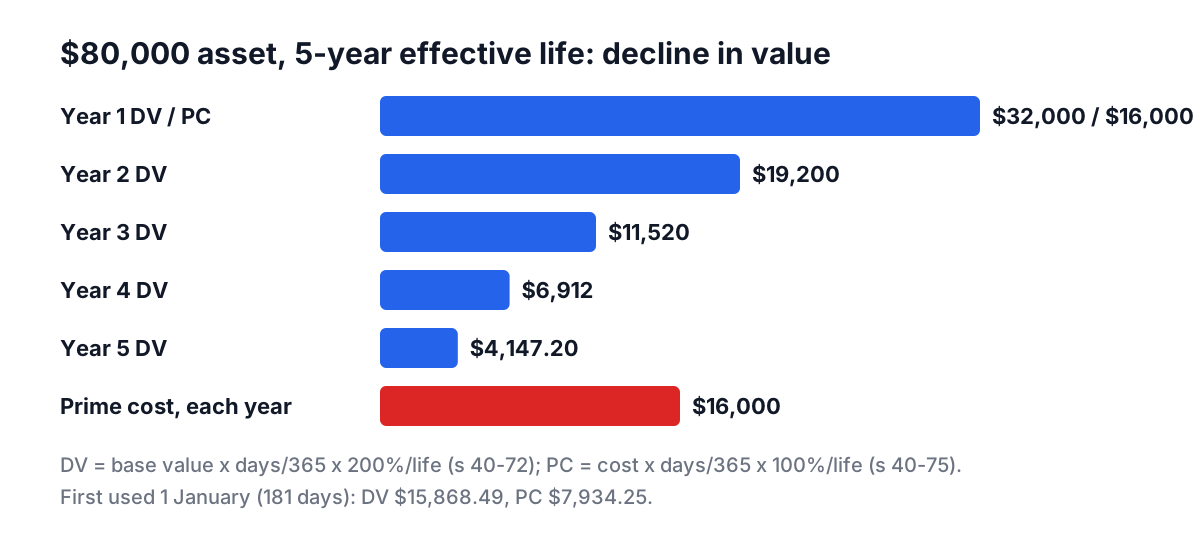
Held for the whole income year:
| Year | Diminishing value (40%) | Prime cost (20%) |
|---|---|---|
| 1 | $32,000.00 | $16,000 |
| 2 | $19,200.00 | $16,000 |
| 3 | $11,520.00 | $16,000 |
| 4 | $6,912.00 | $16,000 |
| 5 | $4,147.20 | $16,000 |
| Adjustable value after 5 years | $6,220.80 | $0 |
Diminishing value claims twice as much in the first year and keeps a tail after the effective life ends; prime cost writes the asset off exactly over its life. Both stop at the asset's cost; what changes is the timing.
First year: days held, not months
The income year runs from 1 July to 30 June. A machine first used on 1 January is held for 181 days to 30 June in a non-leap year, so:
- Diminishing value: $80,000 x 181/365 x 40% = $15,868.49
- Prime cost: $80,000 x 181/365 x 20% = $7,934.25
The calculator's "pro-rated by months held" option with 6 months gives $16,000 for diminishing value, a close approximation. For the figure on a return, use the days. Under section 40-60 the clock starts at the asset's start time, when you first use it or have it installed ready for use, not on the invoice date.
Small business: write it off or pool it
Subdivision 328-D gives small business entities that choose simplified depreciation two shortcuts:
- Instant asset write-off. Section 328-180 lets you deduct the taxable-purpose share of an asset whose cost is less than $20,000 in the income year you start to use it or have it installed ready for use.
- General small business pool. Assets costing $20,000 or more go into one pool. Section 328-190 deducts 15% of an asset's taxable-purpose value in the year it is added, and 30% of the opening pool balance each later year, regardless of when in the year you bought it.
A third rule mops up the tail. Under section 328-210, if the pool's value for a year (its opening balance plus assets added that year, less the termination value of assets disposed of) is less than $20,000 but more than zero, you deduct all of it instead of the 15% and 30% amounts, and the pool closes at zero.
Worked example: a $30,000 machine in the pool
| Year | Rule | Deduction | Pool balance after |
|---|---|---|---|
| 1 | 15% of $30,000 | $4,500 | $25,500 |
| 2 | 30% of $25,500 | $7,650 | $17,850 |
| 3 | Low pool value: $17,850 is under $20,000 | $17,850 | $0 |
Run the calculator's tax-pool method at 30% with "half rate in year 1" and 2 years shown. The third line is where the pool and the calculator part company: the calculator would take another 30% ($5,355), but the opening balance of $17,850 is already under $20,000, so if nothing is added to or sold from the pool that year, section 328-210 deducts the whole $17,850 and the pool closes. The whole $30,000 is deducted over three income years.
The Act's own example under section 328-210, Cassidy's Gardens, shows the same rule with a sale: an opening pool of $28,500, plus a $21,000 mower used 80% for business ($16,800), less a $29,600 car sale, leaves $15,700, which is deducted in full.
A $19,000 trailer, by contrast, never enters the pool. Under the $20,000 threshold it is written off in the year it is first used.
Your financial statements follow AASB 116
For the accounts, AASB 116 Property, Plant and Equipment requires the depreciation method to reflect the pattern in which the asset's future economic benefits are expected to be used up, and lists straight-line, diminishing balance and units of production as methods. Residual value and useful life are reviewed at least at each financial year-end. The accounting life does not have to match the tax effective life, so many businesses keep a book schedule and a tax schedule, and the difference becomes a deferred tax balance.
The calculator's straight-line, declining balance and units-of-production methods cover the accounts side. For the $80,000 machine with a $10,000 expected resale value after five years, straight-line gives $14,000 a year in the accounts while the tax schedule above gives $32,000 in year one.
Tools for this job
- Depreciation calculator (Australia): diminishing value, prime cost, the small business pool, and book schedules, in A$ with a July start.
- Break-even calculator (Australia) and NPV and IRR calculator (Australia) for testing whether the purchase pays.
- Auto loan calculator (Australia) for financing a work vehicle.
Frequently asked questions
What is the diminishing value formula?
Base value x (days held / 365) x (200% / effective life), from section 40-72 of the Income Tax Assessment Act 1997, for assets you started to hold on or after 10 May 2006. In the first year the base value is the cost; after that it is the opening adjustable value.
Should I use diminishing value or prime cost?
Diminishing value gives bigger deductions in the first years; prime cost gives the same deduction every year until the asset is written off. A 5-year asset costing $80,000 gives $32,000 against $16,000 in year one. Neither can claim more than the asset's cost; only the timing differs.
What is the instant asset write-off threshold?
Under section 328-180, a small business entity using simplified depreciation can immediately deduct the taxable-purpose share of an asset costing less than $20,000, in the income year it is first used or installed ready for use.
What happens when the small business pool falls below $20,000?
Under section 328-210, if the pool's value for the year is less than $20,000 but more than zero, you deduct the whole amount and the pool closes at zero.
Sources and further reading
- Income Tax Assessment Act 1997, Federal Register of Legislation. Current compilation (1 October 2026).
- Income Tax Assessment Act 1997, Volume 2 (Division 40), Federal Register of Legislation. Sections 40-72 and 40-75 and effective life.
- Income Tax Assessment Act 1997, Volume 7 (Subdivision 328-D), Federal Register of Legislation. Sections 328-180, 328-190 and 328-210.
- AASB 116 Property, Plant and Equipment (compiled), Australian Accounting Standards Board. Paragraphs 50 to 62 on depreciation methods, useful life and residual value.
- 11.3 Explain and Apply Depreciation Methods to Allocate Capitalized Costs, OpenStax, Rice University. Straight-line, declining balance and units of production explained.
Open the Depreciation Calculator
More Business Calculators
Every tool in the Business Calculators section, free and in your browser.