
Wear and Tear Allowance Explained: SARS Methods and Rates
How the section 11(e) wear-and-tear allowance works in rand: SARS write-off periods, part years, second-hand assets, small items, recoupment and book depreciation.
By Redbison Dev · · 7 min read
South Africa edition. Written for South African taxpayers: the section 11(e) allowance and SARS Interpretation Note 47, apportionment to a March year of assessment, the R7 000 small-item rule, recoupment on sale, the 27% company rate and how tax values differ from IAS 16 book depreciation. US edition
In South Africa the word depreciation means two different things. In the financial statements it is the IAS 16 (or IFRS for SMEs) charge that spreads an asset's cost over its useful life down to a residual value. On the tax return it is the wear-and-tear allowance under section 11(e) of the Income Tax Act, which follows its own rules set out by SARS in Interpretation Note 47. The two rarely agree, and the gap between them matters for cash, for deferred tax and for the bill when the asset is sold. This guide works through both with the wear-and-tear allowance calculator, using a delivery vehicle bought partway through a March year of assessment.
What section 11(e) allows
Interpretation Note 47 (Issue 5, 9 February 2021) explains the allowance. The parts that drive a calculation are:
- Method. You may use the straight-line method, writing the cost off in equal amounts over the asset's useful life, or the diminishing-value method, applying a rate to the income tax value that is left. The allowance is based on cost, with no residual value deducted.
- Write-off periods. The Note's Annexure lists periods SARS accepts on the straight-line method, for example 4 years for delivery vehicles and fork-lift trucks, 5 years for passenger cars, 3 years for personal computers and heavy-duty trucks, 2 years for tablets and cellphones, and 6 years for furniture and fittings. Assets not in the list need a reasonable period you can support with documents.
- Part years. The allowance must be apportioned when an asset is not used for trade for the whole year of assessment, for instance when it is bought partway through or sold. This applies under both methods.
- Private use. If an asset is used partly for private purposes, only the business share is allowed.
- Exclusions. Assets that qualify for certain other allowances, such as section 12C or section 12E(1), do not get section 11(e) as well. A small business corporation can choose between section 11(e) and the 50:30:20 allowance in section 12E(1A) for the assets that section covers.
A delivery vehicle bought in September
A company with a year of assessment running from 1 March buys a delivery vehicle for R480 000 and brings it into use in September. The Annexure gives 4 years, so the full-year allowance is R480 000 / 4 = R120 000. September to February is 6 months, so the first year gets 6/12 of that.
| Year of assessment | Allowance | Tax value at year end | Tax saved at 27% |
|---|---|---|---|
| Year 1 (6 months) | R60 000 | R420 000 | R16 200 |
| Year 2 | R120 000 | R300 000 | R32 400 |
| Year 3 | R120 000 | R180 000 | R32 400 |
| Year 4 | R120 000 | R60 000 | R32 400 |
| Year 5 (6 months) | R60 000 | R0 | R16 200 |
The last half year spills into a fifth year of assessment, so a 4-year asset bought mid-year is claimed over five returns. The company income tax rate is 27% for years of assessment ending on or after 31 March 2023, which turns each R120 000 allowance into R32 400 less tax. For a small business corporation taxed on the SBC table the saving depends on the band its income falls in.
In the calculator, choose straight-line, enter the cost, 0 as the residual value, 4 years, March as the start of the year and 6 months in use in year 1.
Second-hand assets
A used asset is written off over its expected remaining useful life, taking its condition into account, not over the Annexure period and not all at once. Interpretation Note 47's Example 2 is a four-year-old delivery vehicle in good condition, expected to last another three years: it is written off over three years even though the Annexure says four.
Apply that to a second-hand bakkie bought for R320 000 and brought into use in June, with an expected remaining life of 3 years. June to February is 9 months:
| Year | Allowance | Tax value |
|---|---|---|
| Year 1 (9 months) | R80 000 | R240 000 |
| Year 2 | R106 666,67 | R133 333,33 |
| Year 3 | R106 666,67 | R26 666,67 |
| Year 4 (3 months) | R26 666,67 | R0 |
The Note's Example 4 covers the opposite case: a car bought for private use and later used in the business is written off from the lower of cost and market value when it is first used in the trade, over its remaining life at that point.
Small items under R7 000
Items that normally work on their own, are not part of a set and cost less than R7 000 each can be written off in full in the year they are bought and brought into use. A R6 500 power tool qualifies; a table and six chairs bought as a set for R12 000 do not, because a set cannot be split into cheap pieces. The rule does not apply to lessors letting items such as gas cylinders or pallets, who must write them off over their useful lives.
A R18 500 laptop for a sole proprietor is over the limit, so it goes over 3 years. Bought in June with a March year, it gives R4 625 in year 1, R6 166,67 in years 2 and 3 and R1 541,67 in year 4. If the laptop is also used privately for, say, 30% of the time, each amount is reduced to the 70% business share.
Diminishing value instead
The diminishing-value method applies a fixed rate to the income tax value that remains. Interpretation Note 47's Example 1 takes an asset of R5 400 at 20%: R1 080 in the first year and R864 in the second, leaving R3 456. The calculator's diminishing-value setting reproduces those figures. The Note then shows a switch to straight-line, writing the R3 456 off evenly over the remaining three years at R1 152 a year.
Diminishing value gives more in the early years and leaves a tail; straight-line clears the asset within the write-off period. Straight-line with the Annexure periods is the simpler of the two to support if SARS asks.
Selling the asset: recoupment
Wear and tear is a deduction against income, so when an asset is sold for more than its tax value, the excess up to the allowances already claimed comes back into income as a recoupment under section 8(4)(a). SARS asks you to keep asset records until the asset is disposed of, not just until it is written off, for exactly this reason.
Suppose the delivery vehicle is sold at the end of year 3 for R260 000. Its tax value is R180 000, so R80 000 is recouped and taxed: at 27% that is R21 600. Proceeds above the original cost would be a capital gain rather than a recoupment.
Book depreciation is a different number
The financial statements follow IAS 16 or IFRS for SMEs, not the Annexure. Say the company expects to keep the vehicle for 6 years and sell it for R120 000. Its book depreciation is (R480 000 - R120 000) / 6 = R60 000 a year, R30 000 in the first six months.
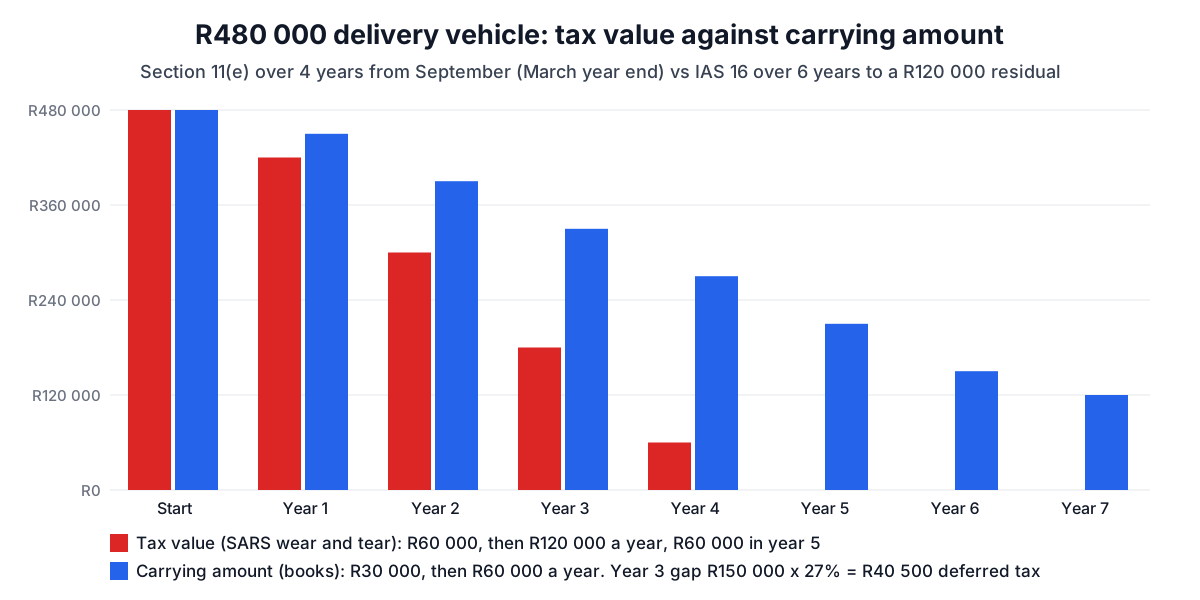
At the end of year 3 the carrying amount in the books is R330 000 and the tax value is R180 000. The R150 000 difference is a temporary difference; at 27% it gives a deferred tax liability of R40 500. The same sale for R260 000 shows a book loss of R70 000 while SARS taxes a R80 000 recoupment, which surprises owners who only read the income statement.
Records and limits
Keep invoices, the date each asset was brought into use, the business-use percentage and the allowances claimed. The Tax Administration Act requires records to be kept for five years from the date the return is submitted, and SARS expects asset records to be kept until disposal. This guide covers the section 11(e) allowance; manufacturing assets, renewable energy, buildings and farming have their own sections, and a registered tax practitioner can advise on which applies.
Tools for this job
The wear-and-tear allowance calculator builds the schedule with part-year apportionment. The Break-Even Calculator shows how depreciation shifts the volume a business needs, and the ROI Calculator compares an asset's return with its cost. For a petrol-driven delivery vehicle, the South African petrol cost calculator prices the running costs.
Frequently asked questions
What is the SARS write-off period for a delivery vehicle or bakkie?
The Interpretation Note 47 Annexure lists 4 years for delivery vehicles and 5 years for passenger cars on the straight-line method. A second-hand vehicle is written off over its expected remaining useful life, which can be shorter.
Do I apportion wear and tear for an asset bought mid-year?
Yes. The allowance must be apportioned for an asset not used for trade throughout the year of assessment, under either method. A vehicle brought into use in September by a business with a March year gets 6/12 of the annual allowance in the first year.
What happens to wear and tear when I sell the asset?
If the selling price is above the tax value, the difference up to the allowances already claimed is recouped and taxed as income under section 8(4)(a). Selling a vehicle with a R180 000 tax value for R260 000 recoups R80 000.
Is wear and tear the same as depreciation in my financial statements?
No. Book depreciation follows IAS 16 or IFRS for SMEs with a residual value and the business's own estimate of useful life. The tax allowance uses cost, no residual value and SARS's periods. The difference is a temporary difference for deferred tax.
Sources and further reading
- Interpretation Note 47 (Issue 5): Wear-and-tear or depreciation allowance, South African Revenue Service. Methods, apportionment, used assets, small items, record keeping and the Annexure of write-off periods.
- Rates of tax for companies, trusts and small business corporations, South African Revenue Service. The 27% company rate and the SBC table.
- Interpretation Notes register, South African Revenue Service. Check for a newer issue of Note 47.
- IAS 16 Property, Plant and Equipment, IFRS Foundation. Depreciable amount, residual value and useful life for the financial statements.
- IAS 12 Income Taxes, IFRS Foundation. Temporary differences and deferred tax.
Open the Depreciation Calculator
More Business Calculators
Every tool in the Business Calculators section, free and in your browser.