
Depreciation vs Capital Allowances: How the UK Treats Assets
Why UK accounts depreciation is not a tax deduction, how AIA, the 40% first-year allowance and 14% or 6% writing-down allowances work, with worked figures.
By Redbison Dev · · 7 min read
United Kingdom edition. Uses pounds sterling and HMRC capital allowances (AIA, the 40% first-year allowance from 1 January 2026, main pool at 14% from April 2026 and special rate pool at 6%) alongside straight-line and reducing balance depreciation for UK accounts. US edition
A UK business that buys a £34,000 van can deduct the whole £34,000 from its taxable profit in the year of purchase under the annual investment allowance, while its accounts charge perhaps £5,600 a year in depreciation for five years. Both figures are right. In the UK the depreciation in your accounts is not what you deduct for tax: HMRC's Business Income Manual says no deduction is allowed for items of a capital nature, and the relief for plant and machinery comes through capital allowances instead. This guide shows how the two schedules are built, with figures from the UK capital allowances and depreciation calculator.
It explains the mechanics for the 2026 to 2027 tax year. Capital allowances have many conditions; a business with large purchases, leased assets or a straddling accounting period should get advice from an accountant or tax adviser.
Two schedules for one asset
| Accounts depreciation | Capital allowances | |
|---|---|---|
| Purpose | Spread the cost over the asset's useful life in the accounts | Tax relief on capital spending |
| Who sets the rate | Your accounting policy: life, residual value, method | Legislation: AIA, first-year allowances, pool rates |
| Typical methods | Straight-line, reducing balance | 100% AIA, 40% first-year allowance, 14% or 6% writing-down allowance on a pool |
| Residual value | Yes | No: the pool runs on cost less allowances and sale proceeds |
The tax computation adds back the depreciation charged in the accounts and deducts the capital allowances, so accounting profit and taxable profit differ until the assets are sold.
The capital allowances available now
GOV.UK lists the allowances for plant and machinery:
- Annual investment allowance (AIA). Up to £1 million a year on most plant and machinery, deducted in full. Business cars cannot take the AIA; vans, lorries and trucks are not cars and can.
- 40% first-year allowance. For main-rate expenditure incurred from 1 January 2026. HMRC's policy paper says it is open to all businesses, not just companies, and excludes second-hand assets, cars and assets leased overseas. The other 60% joins the main pool.
- Full expensing and the 50% first-year allowance for companies, for qualifying investment from 1 April 2023.
- 100% first-year allowance for new, unused zero-emission cars.
- Writing-down allowances (WDA) on whatever is left: the main pool at 14% a year from 1 April 2026 for Corporation Tax and 6 April 2026 for Income Tax (18% before), and the special rate pool at 6%.
The special rate pool takes integral features such as electrical, heating and cooling systems and lifts, long-life assets, solar panels, thermal insulation added to a building and higher-emission cars. A chargeable period that straddles the April 2026 change uses a hybrid rate weighted by the days either side.
One more rule catches sole traders: on the cash basis, you can only claim capital allowances on business cars. Other equipment is deducted as an expense when you pay for it.
Worked example 1: a van under the AIA
A plumber buys a new van for £34,000 and expects to sell it for £6,000 after five years.
| Year | Tax: AIA | Accounts: straight-line |
|---|---|---|
| 1 | £34,000 | £5,600 |
| 2 | £0 | £5,600 |
| 3 | £0 | £5,600 |
| 4 | £0 | £5,600 |
| 5 | £0 | £5,600 |
| Total | £34,000 | £28,000, leaving £6,000 residual |
The van is fully relieved for tax in year one. The accounts spread £28,000 (cost less residual) evenly. When the van is sold, the sale has to be brought back into the capital allowances computation for that year, so keep the AIA claim and the sale price on file.
Worked example 2: a car in the main pool or the special rate pool
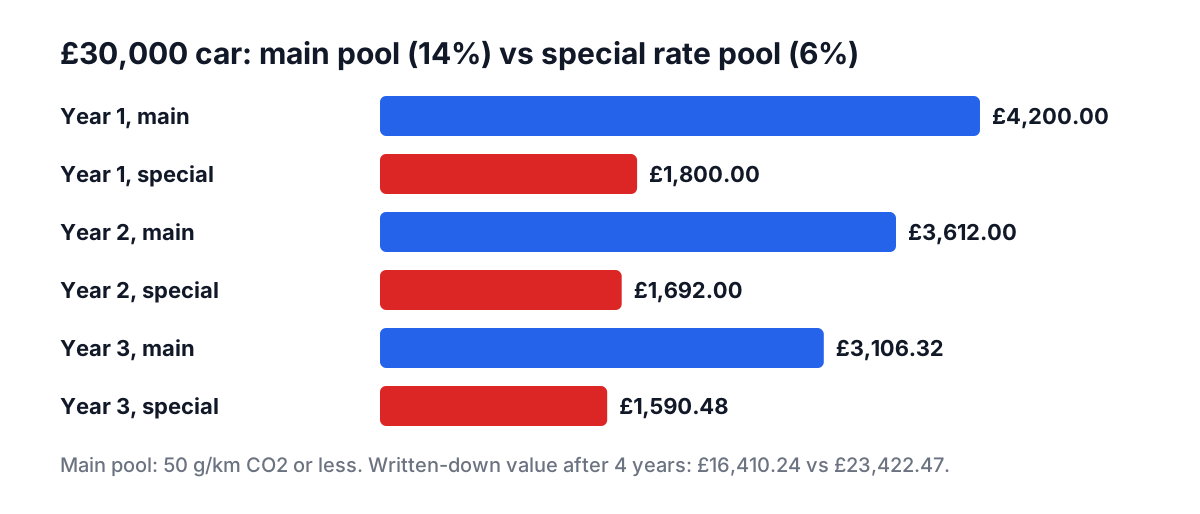
Cars cannot take the AIA. Which pool a car joins depends on its CO2 emissions: for cars bought from April 2021, 50 g/km or less goes in the main pool, over 50 g/km in the special rate pool. On a £30,000 car:
| Year | Main pool, 14% | Special rate pool, 6% |
|---|---|---|
| 1 | £4,200.00 | £1,800.00 |
| 2 | £3,612.00 | £1,692.00 |
| 3 | £3,106.32 | £1,590.48 |
| 4 | £2,671.44 | £1,495.05 |
| Written-down value after 4 years | £16,410.24 | £23,422.47 |
The tool's "tax pool" method applies the rate to the reducing balance each year, which is how a writing-down allowance works. After four years the low-emission car has had £13,590 of relief and the high-emission one £6,578. The pool never reaches zero on its own; the balance keeps attracting allowances until the assets are sold or the trade ends.
Worked example 3: a large purchase above the AIA
A partnership that has used its £1 million AIA buys £500,000 of new plant. As a partnership it cannot claim full expensing, which is for companies. Comparing the 40% first-year allowance with plain writing-down allowances:
| Year | 40% FYA, then 14% on the rest | 14% WDA only |
|---|---|---|
| 1 | £200,000 | £70,000 |
| 2 | £42,000 | £60,200 |
| 3 | £36,120 | £51,772 |
| Left in the pool | £221,880 | £318,028 |
The calculator handles this with the "first-year allowance" option: it takes 40% in year one, puts the remaining £300,000 into the pool and applies 14% from the next period. A company buying the same new plant for its own use would normally claim full expensing instead, which GOV.UK lists separately. HMRC's policy paper says the 40% allowance, unlike full expensing, is available to unincorporated businesses and for assets used for leasing (except overseas leasing), and is aimed at cases where the AIA or full expensing is unavailable or not preferred.
Accounts depreciation: straight-line or reducing balance
For the accounts, the choice is between charging the same amount every year (straight-line) and a fixed percentage of the falling balance (reducing balance). The van in example 1 uses straight-line: (£34,000 - £6,000) / 5 = £5,600 a year. The calculator also does declining balance with a switch to straight-line, sum-of-the-years' digits and units of production, which suit assets whose usefulness falls quickly or follows output.
Neither method changes the tax bill directly; only the capital allowances do. What depreciation changes is the reported profit, which matters for lenders, investors and the timing difference recorded as deferred tax.
Tools for this job
- Capital allowances and depreciation calculator (UK): tax pool with AIA, first-year allowances and WDA, or a depreciation schedule for your accounts.
- VAT calculator (UK): split a supplier's invoice into net price and VAT before you record the asset.
- Break-even calculator (UK) and NPV and IRR calculator (UK) for judging whether the purchase pays for itself.
Frequently asked questions
Can I deduct depreciation from my taxable profit in the UK?
No. HMRC's Business Income Manual says no deduction is allowed for items of a capital nature. The depreciation in your accounts is added back, and you claim capital allowances such as the AIA or writing-down allowances instead.
What is the main pool writing-down allowance rate?
14% a year on the main pool from 1 April 2026 for Corporation Tax and 6 April 2026 for Income Tax, down from 18%. The special rate pool stays at 6%. A period that straddles the change uses a hybrid rate.
Can I claim the annual investment allowance on a car?
No. Business cars are excluded from the AIA and go into the main pool (50 g/km of CO2 or less) or the special rate pool (over 50 g/km). Vans, lorries and trucks are not cars and can take the AIA.
Who can claim the 40% first-year allowance?
HMRC's policy paper says all businesses, including sole traders and partnerships, for main-rate expenditure incurred from 1 January 2026. Second-hand assets, cars and assets for overseas leasing are excluded.
Sources and further reading
- Work out your writing down allowances: rates and pools, GOV.UK. Main pool 14% from April 2026, special rate pool 6%, what goes in each.
- Capital allowances, GOV.UK. The allowance types and the cash basis rule for cars.
- Capital allowances: annual investment allowance, GOV.UK. The £1 million AIA and the exclusion of cars.
- Capital allowances: business cars, GOV.UK. Pools by CO2 emissions and the zero-emission first-year allowance.
- Capital allowances: new first-year allowance and reducing main rate writing down allowances, HM Revenue and Customs, 2025. The 40% FYA, its exclusions and the hybrid rate.
- BIM35002: capital/revenue divide: exclusion of capital items, HMRC Business Income Manual. No deduction for items of a capital nature.
Open the Depreciation Calculator
More Business Calculators
Every tool in the Business Calculators section, free and in your browser.