
Depreciation vs Capital Cost Allowance (CCA) in Canada
How CCA classes, the half-year rule and the Accelerated Investment Incentive change the first-year write-off, with figures for furniture, vehicles and computers.
By Redbison Dev · · 7 min read
Canada edition. Uses Canadian dollars and CRA capital cost allowance (classes 8, 10, 10.1 and 50, the half-year rule, the Accelerated Investment Incentive) with the changes in Bill C-15, beside book depreciation for financial statements. US edition
Canadian businesses keep two schedules for the same asset. The depreciation in your financial statements spreads the cost over the asset's useful life, using whatever method best matches how it wears out. For tax, the CRA does not use that figure; you claim capital cost allowance (CCA) at the rate set for the asset's class, on the declining balance of the class. The first year is where most of the difference lies, and it changed again in 2026. This guide works through the rules with the Canadian CCA calculator, in Canadian dollars.
It explains the mechanics. CCA has many special rules (short taxation years, rental property, passenger vehicles, transfers between related people); confirm a return with an accountant or the CRA.
How CCA works
Every depreciable property belongs to a class with a prescribed rate. A few common ones from the CRA's list:
| Class | Typical property | Rate |
|---|---|---|
| 1 | most buildings acquired after 1987 | 4% |
| 8 | property not in another class: furniture, appliances, tools costing $500 or more, machinery and other equipment | 20% |
| 10 | motor vehicles, and passenger vehicles that do not meet the Class 10.1 conditions | 30% |
| 10.1 | passenger vehicles costing more than the prescribed limit | 30% |
| 12 | tools, kitchen utensils and similar costing less than $500 | 100% |
| 50 | general-purpose computer hardware acquired after March 18, 2007 | 55% |
| 54 | zero-emission vehicles | 30% |
Each year you may claim up to the rate times the undepreciated capital cost (UCC) of the class. The CRA says you do not have to claim the maximum in any year; you can claim anything from zero up to it, and what you leave stays in the class for later. When you dispose of property you may have to add back a recapture of CCA, or deduct a terminal loss.
The first year: three possible rules
The half-year rule
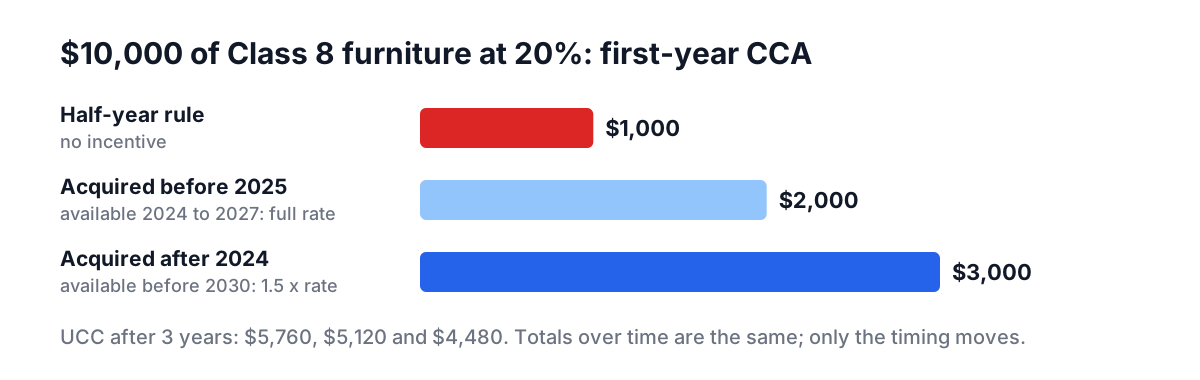
In the year you acquire property, the CRA says you can usually claim CCA on only one-half of your net additions to a class. On a $10,000 Class 8 purchase that is 20% of $5,000: $1,000.
The Accelerated Investment Incentive (AII)
For property acquired after November 20, 2018 and available for use before 2028, the CRA's AII page applies the class rate to up to one-and-a-half times the net addition and suspends the half-year rule, which is three times the normal first-year claim. For property that became available for use from 2024 to 2027, it describes a phase-out to twice the normal first-year claim.
Bill C-15 and the restored incentive
Budget 2025 announced a "Productivity Super-Deduction", including reinstating the AII and immediate expensing of productivity-enhancing assets such as computers. The Budget 2025 Implementation Act, No. 1 (Bill C-15) received Royal Assent on March 26, 2026. It defines "reaccelerated investment incentive property" as property acquired after 2024 and available for use before 2034, and adds a first-year factor to the CCA regulation:
- Most classes: an extra 1/2 for property available for use before 2030, nil after 2029. Added to the full net addition, that is the familiar 1.5 times the class rate. This does not cover Classes 12, 13, 14, 15, 43.1, 44, 46, 50, 53 to 56 or 59, which have their own factors. Property available for use from 2030 to 2033 still escapes the half-year rule, so it gets the full class rate in year one.
- Class 50 (computers): an extra 9/11 for property available for use before 2027, nil after 2026. With the 55% rate, 55% x (1 + 9/11) is 100%: a full write-off in year one. Available for use from 2027 to 2033, it gets the plain 55% in year one, still outside the half-year rule.
At the time of writing, the CRA's AII page still describes the 2024 to 2027 phase-out, so check its current wording, or ask your accountant, before relying on the restored factor.
Worked example 1: office furniture, Class 8
$10,000 of desks and shelving, Class 8 at 20%:
| Year | Half-year rule | Acquired before 2025, available 2024 to 2027 (full rate) | Acquired after 2024, available before 2030 (1.5 x rate) |
|---|---|---|---|
| 1 | $1,000 | $2,000 | $3,000 |
| 2 | $1,800 | $1,600 | $1,400 |
| 3 | $1,440 | $1,280 | $1,120 |
| UCC after 3 years | $5,760 | $5,120 | $4,480 |
Furniture bought in 2026 and available for use before 2030 takes the last column; the middle one applies only to AII property acquired before 2025 and available for use from 2024 to 2027. The incentive moves deductions forward; it does not change the total. A business with little income this year might claim less than the maximum and keep the UCC for later.
Worked example 2: a work vehicle, Class 10 and 10.1
A $35,000 pickup used for the business, Class 10 at 30%:
| Year | Half-year rule | AII, 1.5 x rate |
|---|---|---|
| 1 | $5,250 | $15,750 |
| 2 | $8,925 | $5,775 |
| 3 | $6,247.50 | $4,042.50 |
| UCC after 3 years | $14,577.50 | $9,432.50 |
A passenger vehicle is different. If it costs more than the prescribed limit, it goes into Class 10.1 with its capital cost capped. Finance Canada set the limit at $39,000 before tax for vehicles acquired on or after January 1, 2026 (up from $38,000), and the CRA's class page adds the GST/HST or PST on the capped amount. For a $52,000 car bought in 2026, CCA runs on $39,000 plus tax, not on $52,000. On the $39,000 alone, the 1.5 x first year is $17,550. Zero-emission vehicles are Class 54, with a $61,000 limit before tax.
Worked example 3: a laptop, Class 50
A $3,000 laptop, Class 50 at 55%:
| Year | Available for use before 2027 (Bill C-15 9/11 factor) | Available for use 2027 to 2033 (full 55%, no half-year rule) |
|---|---|---|
| 1 | $3,000.00 | $1,650.00 |
| 2 | $0 | $742.50 |
| 3 | $0 | $334.13 |
| UCC after 3 years | $0 | $273.38 |
Both columns assume the laptop was acquired after 2024. In the calculator, choose the tax-pool method at 55%, then a 100% first-year allowance if the laptop was available for use before 2027, or "Full rate in year 1" if it was available for use from 2027 to 2033.
Book depreciation sits beside it
Your financial statements use your own estimates. The same $35,000 pickup, expected to fetch $7,000 after five years, depreciates by $5,600 a year straight-line. In year one the tax deduction under the AII ($15,750) is almost three times that, so accounting income is higher than taxable income, and the difference reverses in later years. That timing difference is what deferred tax records in the accounts.
Tools for this job
- CCA calculator (Canada): class rate on the UCC with the half-year rule, the AII or a first-year allowance, or a book depreciation schedule.
- Auto loan calculator (Canada) for financing the vehicle in example 2.
- Break-even calculator (Canada) and NPV and IRR calculator (Canada) for deciding whether the purchase pays.
Frequently asked questions
Is depreciation deductible in Canada?
Not as such. For tax you claim capital cost allowance by CRA class, at the class rate on the undepreciated capital cost. The depreciation in your financial statements follows your accounting policy and usually differs.
What is the half-year rule for CCA?
In the year you acquire property, you can usually claim CCA on only half of your net additions to the class. The CRA's Accelerated Investment Incentive suspends that rule for eligible property and applies the rate to up to 1.5 times the addition.
Can I write off a computer in one year in Canada?
Bill C-15, which received Royal Assent on March 26, 2026, adds a 9/11 first-year factor for Class 50 property acquired after 2024 and available for use before 2027; with the 55% rate that is a 100% write-off. Class 50 property available for use from 2027 to 2033 gets the full 55% in year one, with no half-year rule. Confirm the CRA's current guidance before filing.
What is the current Class 10.1 limit?
$39,000 before tax for passenger vehicles acquired in 2026 (on or after January 1, 2026), up from $38,000 in 2025, according to Finance Canada. A car that costs more goes into Class 10.1 with its capital cost capped at the limit plus the sales tax on it.
Sources and further reading
- Classes of depreciable property, Canada Revenue Agency. Class rates and the Class 10.1 and 54 limits.
- Basic information about capital cost allowance, Canada Revenue Agency. Optional claims, the half-year rule, recapture and terminal loss.
- Accelerated investment incentive, Canada Revenue Agency. The 1.5 x net addition rule and the 2024 to 2027 phase-out.
- Bill C-15, Budget 2025 Implementation Act, No. 1, as assented to, Parliament of Canada. Reaccelerated investment incentive property and the new first-year factors.
- Budget 2025, Chapter 1, Government of Canada. The Productivity Super-Deduction.
- 2026 automobile deduction limits, Department of Finance Canada. The $39,000 Class 10.1 limit.
Open the Depreciation Calculator
More Business Calculators
Every tool in the Business Calculators section, free and in your browser.