
Dividend Yield, Franking Credits and DRPs in Australia
How grossed-up dividend yield, franking credits and dividend reinvestment plans work for Australian investors, with a 20-year A$ example at three tax rates.
By Redbison Dev · · 10 min read
Australia edition. Written for Australian investors: A$ amounts, interim and final dividends, franking credits under Division 207, refunds of excess credits, 2026-27 resident tax rates plus the Medicare levy, super funds at 15%, and DRPs. US edition
An ASX share at A$32 that pays A$1.60 a year, fully franked, has a cash yield of 5% and a grossed-up yield of about 7.1%. The second figure exists because Australia's imputation system passes the company's tax to you as a franking credit: A$25,000 in that share brings A$1,250 of cash dividends plus A$535.71 of credits. What you keep then depends on your own tax rate. On the 30% bracket plus the Medicare levy you keep A$1,214.29; with no tax to pay, the credits come back as a refund and you end up with A$1,785.71.
This edition works through cash and grossed-up yield, how franking credits are taxed and refunded, dividend reinvestment plans (DRPs), and a 20-year example run in the Australian dividend calculator. It explains the arithmetic, not which share to buy; a registered tax agent or licensed adviser can look at your own position.
Cash yield and grossed-up yield
cash yield        = annual dividend per share / share price x 100
                  = 1.60 / 32 x 100 = 5.0%
franking credit   = dividend x franked share x company rate / (1 - company rate)
                  = 1.60 x 100% x 0.30 / 0.70 = A$0.6857 a share
grossed-up yield  = (1.60 + 0.6857) / 32 x 100 = 7.14%
For a company that pays an interim and a final dividend, a trailing yield adds the last two. Broker screens may show either the cash or the grossed-up figure; compare like with like, and check the franking percentage on each dividend statement. A partly franked dividend carries a smaller credit, an unfranked one none, and dividends from overseas shares carry no Australian franking.
The company rate in the formula is the rate the company pays. The Income Tax Rates Act 1986 sets it at 30%, or 25% for a base rate entity, so a smaller company's fully franked dividend carries less credit per dollar.
Yield moves against price. If the A$32 share falls to A$27 and the dividend holds, the cash yield rises to 5.9%. Nothing about the income changed; a yield far above the sector usually means the market expects a cut.
To work back from an income goal: A$40,000 a year at a 5% cash yield needs A$800,000 invested, before tax and credits.
How franking credits are taxed
Section 207-20 of the Income Tax Assessment Act 1997 does two things when you receive a franked dividend: it adds the franking credit to your assessable income, and it gives you a tax offset equal to the credit. Section 67-25 makes that offset refundable for individuals, so if the credits exceed the tax on your income, the excess comes back to you.
Tax on the A$1,250 dividend with A$535.71 of credits, at the 2026-27 resident rates:
| Your rate (2026-27) | Tax on A$1,785.71 grossed up | After the A$535.71 offset | You keep |
|---|---|---|---|
| 0% (income under the A$18,200 threshold) | A$0.00 | A$535.71 refund | A$1,785.71 |
| 15%, complying super fund | A$267.86 | A$267.86 refund | A$1,517.86 |
| 32% (30% bracket plus 2% Medicare levy) | A$571.43 | A$35.71 to pay | A$1,214.29 |
| 47% (45% bracket plus 2% Medicare levy) | A$839.29 | A$303.57 to pay | A$946.43 |
The resident rates for 2026-27 in Schedule 7 of the Income Tax Rates Act are 15% above A$18,200 up to A$45,000, 30% to A$135,000, 37% to A$190,000 and 45% above, and the Medicare levy is 2%. A complying super fund pays 15% on its low tax component, which is why franked dividends are so valuable inside super: the credit more than covers the fund's tax.
Franking changes the result as much as your bracket does. At 32%, the same A$1,250 leaves A$1,105.00 if it is 70% franked (A$375.00 of credits) and A$850.00 if unfranked.
One condition to know: section 207-145 removes both the gross-up and the offset if you are not a "qualified person" for the dividend under the holding rules in Division 1A of former Part IIIAA of the 1936 Act. The calculator assumes you qualify; check the holding rules before buying shortly before an ex-dividend date. Under ASX Listing Rules Appendix 6A the ex date is the business day before the record date that identifies the holders entitled to the dividend.
Dividend reinvestment plans
Where a company offers a DRP, each dividend buys new shares on the terms set in the plan instead of being paid in cash. Nothing changes for tax. The dividend and its franking credit are still assessable income in the year the dividend is paid, even though no cash reached your bank account, so you need cash from elsewhere to pay any tax due. Keep each DRP allotment statement; every allotment is a separate parcel with its own date and price when you later work out a capital gain.
Inside super the fund handles all of this. Outside super, a DRP on a fully franked share at a 32% rate reinvests almost all of the cash dividend, because the credit covers most of the tax.
Twenty years at three tax rates
Run the A$25,000 holding for 20 years with half-yearly DRP purchases, the dividend rising 4% a year and the price 3%, fully franked at 30%:
| Taxed at | Value after 20 years | Cash dividends in year 21 |
|---|---|---|
| 15% (complying super fund) | A$162,890.86 | A$9,880.73 |
| 32% (30% bracket plus levy) | A$126,438.47 | A$7,669.58 |
| 47% (45% bracket plus levy) | A$100,976.71 | A$6,125.10 |
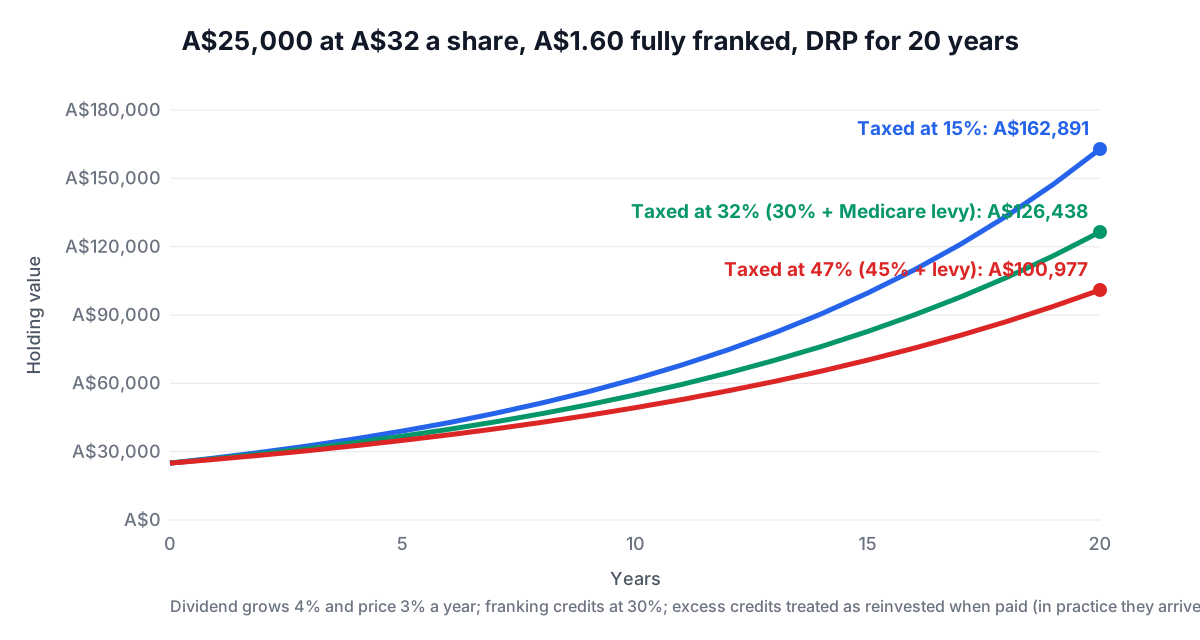
The 15% line assumes the refunded credits are reinvested along with the cash, which is roughly how a super fund's tax works across its whole portfolio. For an individual on a low rate the refund arrives only after the tax return for the year is assessed, so the real figure for a low-income investor using a DRP is a little lower unless they reinvest the refund themselves.
The gap between the 32% and 47% lines, about A$25,500 after 20 years, comes from tax on dividends that would otherwise have bought shares. At 32%, the year-20 dividend of A$7,071.22 carries A$3,030.52 of credits and leaves only A$202.03 of tax to pay, which is why a fully franked share in the 30% bracket compounds almost as if it were untaxed.
Yield on cost and the limits of a projection
At 32%, year-21 cash dividends of A$7,669.58 on A$25,000 are a 30.68% yield on cost. The holding is then worth A$126,438.47, and the cash yield on that is about 6.1%. Judge whether to hold on the current yield, not the historic one.
- Boards decide each dividend and can cut or stop franking; a steady 4% growth rate is an assumption.
- Prices move in jumps, so a DRP buys more shares in bad years and fewer in good ones.
- Tax rates change. The 2026-27 rates above are held flat, and the 15% bracket is legislated to fall to 14% from 2027-28.
- One company is one risk. The Australian edition of the ETF fees and dividends guide covers what a fund's fees do to distribution income.
Tools for this job
- The Australian dividend calculator applies franking credits and your marginal rate to each payment.
- The Australian ETF investment calculator projects fortnightly investing with the management fee.
- The Australian compound interest calculator shows the same compounding on a term deposit, explained in the Australian compound interest guide.
- The Australian retirement calculator puts a dividend income goal into a full retirement plan.
Frequently asked questions
Do I pay tax on DRP shares if I never received cash?
Yes. A reinvested dividend is still a dividend paid to you, so the cash amount and its franking credit go into your assessable income for the year it was paid, and the credit is offset against your tax. Each DRP allotment is also a new parcel of shares for capital gains purposes.
Can I get franking credits refunded?
Generally yes, if you are an individual or a complying super fund and the credits are more than the tax on your income. Section 67-25 of the Income Tax Assessment Act 1997 makes the offset from franked distributions refundable. At a 0% rate, A$535.71 of credits on A$1,250 of dividends comes back in full.
What is a grossed-up dividend yield?
The cash dividend plus its franking credit, divided by the share price. A fully franked A$1.60 dividend at the 30% company rate carries a A$0.69 credit, so a A$32 share has a 5% cash yield and about a 7.1% grossed-up yield.
Why does a 25% company give smaller franking credits?
Franking credits are worked out at the company's own rate. A base rate entity pays 25% under the Income Tax Rates Act, so a fully franked dollar of its dividend carries 33.3 cents of credit instead of 42.9 cents at 30%.
Sources and further reading
- Income Tax Assessment Act 1997, Volume 5: sections 207-20 and 207-145, Federal Register of Legislation. Gross-up and tax offset for franked distributions; the qualified person condition.
- Income Tax Assessment Act 1997, Volume 2: section 67-25, Federal Register of Legislation. Refundable tax offsets for franked distributions.
- Income Tax Rates Act 1986 (1 July 2026 compilation), Federal Register of Legislation. Schedule 7 resident rates for 2026-27, section 23 company rates and section 26 super fund rates.
- ASX Listing Rules Appendix 6A: Timetables, ASX. Dividend timetable: the ex date is the business day before the record date.
- Medicare Levy Act 1986 (1 July 2026 compilation), Federal Register of Legislation. Section 6: the 2% levy.
More Calculators
Every tool in the Calculators section, free and in your browser.
- Investment Calculator
- Compound Interest Calculator
- Simple Interest Calculator
- Interest Calculator
- EMI Calculator
- Retirement Calculator
- Time-Weighted Return Calculator
- Savings Goal Calculator
- Inflation Calculator
- CAGR Calculator
- ROI Calculator
- Present and Future Value Calculator
- NPV and IRR Calculator
- 401(k) Calculator
- Roth IRA Calculator
- APY and CD Calculator
- SIP Calculator
- Annuity Calculator
- Bond Price and Yield Calculator
- Currency Converter
- Dividend Calculator
- Stock Average Calculator
- RMD Calculator