
Dividend Yield, Dividend Tax and Reinvesting in the UK
How UK dividend yield, the £500 dividend allowance and reinvesting work, with a 20-year example in pounds inside and outside a stocks and shares ISA.
By Redbison Dev · · 10 min read
United Kingdom edition. Written for UK investors: pounds and pence, interim and final dividends, the £500 dividend allowance and the 2026 to 2027 dividend tax rates, ISAs, accumulation units and how HMRC wants dividends reported. US edition
A UK share priced at 1,200p that pays 54p a year yields 4.5%. Put £15,000 into it and you own 1,250 shares and collect £675 a year, usually in two instalments, an interim and a final dividend. Whether you keep all of that depends less on the share than on the account it sits in: inside a stocks and shares ISA no tax is due, while in a general investment account everything above the £500 dividend allowance is taxed at your dividend rate. Over 20 years of reinvesting, that difference grows into thousands of pounds.
This edition works through the yield arithmetic in pounds and pence, the 2026 to 2027 dividend tax rules, the ways UK investors reinvest, and a 20-year example run in the UK dividend calculator. It explains the sums; it is not a recommendation to buy any share or fund.
Yield in pence and pounds
London share prices are quoted in pence, and dividends are declared in pence per share, so the yield is a pence-to-pence division:
dividend yield = dividends per share over a year / share price x 100
54p / 1,200p x 100 = 4.5%
Two habits trip people up:
- Adding up the right payments. Many UK companies pay twice a year, and the two are often unequal: a small interim and a larger final. A "yield" built from the latest interim doubled will understate the year; one built from the final doubled will overstate it. Add the last interim and the last final together, which is what a trailing yield does.
- Special dividends. A one-off special dividend inflates the trailing yield for twelve months and then drops out. Strip it out before you plan an income on it.
Price moves the yield too. If the 1,200p share falls to 1,000p with the dividend unchanged, the yield becomes 5.4%. The income did not change; the market's view of the company did, and a yield well above similar companies often means the market expects a cut.
To size a holding for a target income, reverse the formula. £1,000 a month is £12,000 a year, and at a 4.5% yield that needs £12,000 / 0.045 = £266,667, before any tax.
Dividend tax for the 2026 to 2027 tax year
GOV.UK sets out the rules for dividends received from 6 April 2026 to 5 April 2027:
| Band your dividends fall in | Rate on dividends above the allowance |
|---|---|
| Covered by your unused Personal Allowance | 0% |
| First £500 of dividends (dividend allowance) | 0% |
| Basic rate | 10.75% |
| Higher rate | 35.75% |
| Additional rate | 39.35% |
The allowance is a nil rate, not a deduction from your income: the £500 still counts when HMRC works out which band the rest falls into. GOV.UK's own example has £29,570 of wages and £3,000 of dividends. The £12,570 Personal Allowance covers the first £12,570 of wages, the remaining £17,000 of wages is taxed at 20%, the first £500 of dividends at 0% and the other £2,500 at 10.75%.
For a £40,000 holding at the same 4.5% yield, £1,800 of dividends a year is taxed like this when all of it sits in one band:
| Your band | Taxed amount | Tax | You keep |
|---|---|---|---|
| Basic rate | £1,300 | £139.75 | £1,660.25 |
| Higher rate | £1,300 | £464.75 | £1,335.25 |
| Additional rate | £1,300 | £511.55 | £1,288.45 |
| Inside an ISA | £0 | £0.00 | £1,800.00 |
Reporting it. GOV.UK splits this by size. With dividend income above your allowances but no more than £10,000, you can ask HMRC to change your tax code so the tax comes out of your wages or pension, or put it on a Self Assessment return if you already send one; if you do not send a return, tell HMRC after the tax year ends on 5 April and before 5 October. Above £10,000 you need to complete a Self Assessment return; if you do not usually send one, tell HMRC by 5 October after that tax year.
Three ways UK investors reinvest
A company or broker dividend reinvestment plan. Each cash dividend buys more of the same share. For tax, it is still a cash dividend: you owe dividend tax on it in a general account, and the shares it buys go into your holding at their cost, which matters when you sell.
Accumulation units in a fund. With "Acc" units of a unit trust or OEIC, nothing is paid out; the income stays in the fund and the unit price rises instead. HMRC's helpsheet HS284 calls this a notional distribution. Outside an ISA it is still taxable income in the year it arises, and the helpsheet lets you add the amount to the cost of your accumulation units, so you are not taxed on it a second time as a gain. Keep the annual tax vouchers; they show the figure to add.
Doing it yourself. Take the cash and buy more shares or units when it suits you. This costs dealing charges on each purchase but lets you redirect income to a different holding.
When you eventually sell shares bought at many prices, HS284 matches disposals first with shares bought the same day, then with shares bought in the following 30 days, and the rest from the Section 104 holding, where every share of that class in that company carries the same average cost. Every reinvested dividend is a new addition to that pool.
Twenty years, four ways
Take £15,000 in the 1,200p share paying 54p a year in two equal halves, held for 20 years in an ISA so no tax applies, and vary two things: whether dividends are reinvested, and whether the business grows (dividend up 4% a year, share price up 3%).
| Scenario | Shares after 20 years | Value with any cash taken | Income in the following year |
|---|---|---|---|
| No growth, dividends taken as cash | 1,250.00 | £28,500.00 | £675.00 |
| No growth, reinvested | 3,043.99 | £36,527.83 | £1,643.75 |
| Growth, dividends taken as cash | 1,250.00 | £47,191.87 | £1,479.01 |
| Growth, reinvested | 3,247.98 | £70,394.54 | £3,843.03 |
The value column adds the cash dividends collected along the way when they are not reinvested (£13,500.00 with no growth, £20,100.20 with growth). Reinvesting with no growth at all still lifts the yearly income from £675 to £1,643.75, because the extra shares earn their own dividends. Growth and reinvestment together take the income to £3,843.03 a year by year 21, a 25.62% yield on the original £15,000.
Note what happens to the share count: with growth it reaches 3,247.98, only a little more than the 3,043.99 without, because each reinvested dividend buys fewer shares as the price rises from £12 towards £21.67.
The same holding outside an ISA
Now leave the growth-and-reinvest case in a general investment account, with the £500 allowance and the 2026 to 2027 rates held flat for 20 years:
| Account | Tax in year 1 | Tax in year 20 | Value after 20 years |
|---|---|---|---|
| Stocks and shares ISA | £0.00 | £0.00 | £70,394.54 |
| General account, basic rate | £19.62 | £305.96 | £66,031.33 |
| General account, higher rate | £65.24 | £865.57 | £57,158.64 |
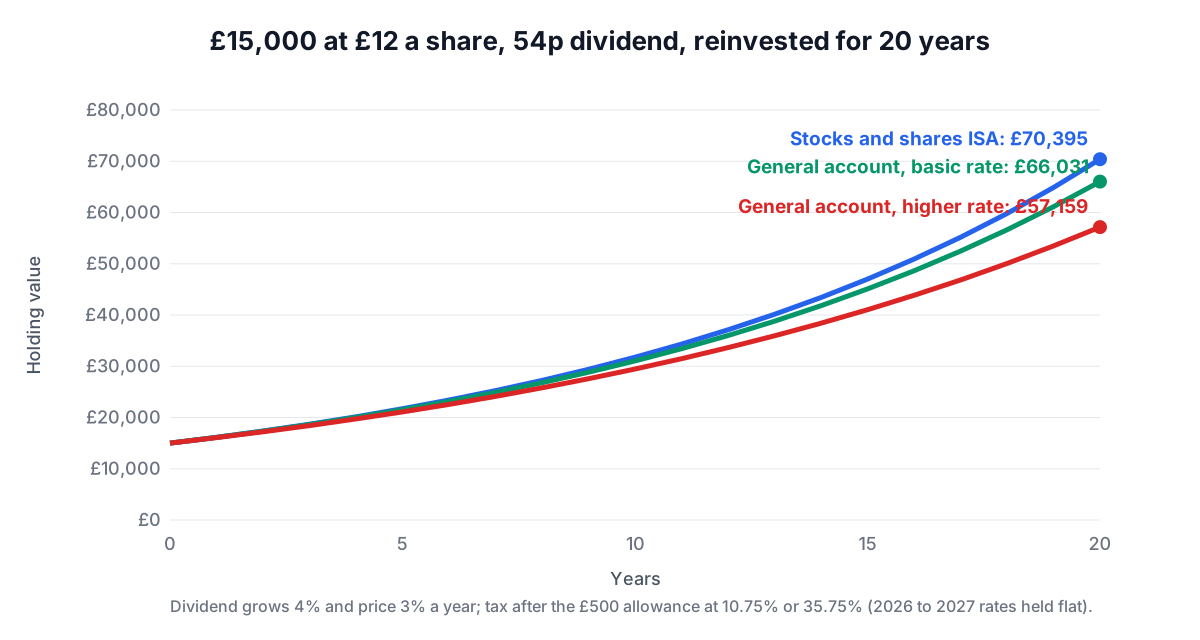
In year 1 the dividends (£682.48) are only just above the allowance, so the tax is small. The allowance is a fixed £500, so every pound of dividend growth lands in the taxable slice, and by year 20 a higher-rate taxpayer is paying £865.57 a year. The ISA ends £13,235.90 ahead of the higher-rate general account. That is why many people move holdings into an ISA a tranche at a time, within the £20,000 ISA allowance for the 2026 to 2027 tax year. Selling in the general account to rebuy in the ISA is a disposal for Capital Gains Tax, so check the gain first.
Yield on cost, and where projections stop
Yield on cost divides today's income by what you paid. In the ISA case, £3,843.03 on £15,000 is 25.62%. It measures how far the income has grown; it is not the return you would get by buying today. The holding is then worth £70,394.54, and £3,843.03 on that is about 5.5%. Decide whether to hold or sell on that current figure.
The calculator's limits matter more over 20 years:
- Dividends can be cut or suspended. Boards decide them each time. A steady 4% growth rate is an assumption.
- Prices do not rise smoothly. Reinvesting buys more shares in falling markets and fewer in rising ones, so real results differ in both directions.
- One company is one risk. A single share's dividend ties your income to one business; a fund spreads it. The UK edition of the ETF fees and dividends guide shows what fund charges do to that income.
- Tax rates change. The rates above are for 2026 to 2027; rerun the numbers each April.
Tools for this job
- The UK dividend calculator runs the projections above with the dividend allowance and your band's rate.
- The UK ETF investment calculator projects a monthly fund investment inside an ISA with its ongoing charge.
- The UK compound interest calculator shows the same compounding on cash savings, explained in the UK compound interest guide.
- The UK stock average calculator works out your average cost after several purchases.
Frequently asked questions
Do reinvested dividends count towards the £500 dividend allowance?
Yes. A dividend that a reinvestment plan uses to buy more shares is still a dividend paid to you, so in a general investment account it uses the allowance and is taxed above it like cash. Inside a stocks and shares ISA, dividends are not taxed and do not use the allowance.
Are accumulation units taxed if I never receive the income?
Outside an ISA or pension, yes. HMRC's helpsheet HS284 treats the income kept in the fund as a notional distribution that is taxable in the year it arises, and lets you add that amount to the cost of your units when you work out a gain on sale. Inside an ISA there is nothing to report.
When do I have to tell HMRC about dividends?
When your dividends are more than your unused Personal Allowance plus the £500 dividend allowance. Up to £10,000 you can ask HMRC to change your tax code, or tell HMRC between 6 April and 5 October after the tax year. Above £10,000 you need a Self Assessment return.
Why do UK dividend yields look different on different websites?
Usually because they add up different payments. One may use the last interim and final together (trailing), another a forecast for the next year, and some include a special dividend. Check which payments the figure covers before you compare two shares.
Sources and further reading
- Tax on dividends, GOV.UK. The £500 dividend allowance, the 2026 to 2027 rates and the worked example.
- Tax on dividends: how to report tax on dividends, GOV.UK. Tax code, Self Assessment and the £10,000 threshold.
- Individual Savings Accounts (ISAs), GOV.UK. The £20,000 allowance for the 2026 to 2027 tax year.
- HS284 Shares and Capital Gains Tax (2025), HM Revenue and Customs. Section 104 holdings, matching rules and accumulation units.
- SAIM5050: stock dividends, HMRC Savings and Investment Manual. Shares taken instead of a cash dividend follow separate rules.
More Calculators
Every tool in the Calculators section, free and in your browser.
- Investment Calculator
- Compound Interest Calculator
- Simple Interest Calculator
- Interest Calculator
- EMI Calculator
- Retirement Calculator
- Time-Weighted Return Calculator
- Savings Goal Calculator
- Inflation Calculator
- CAGR Calculator
- ROI Calculator
- Present and Future Value Calculator
- NPV and IRR Calculator
- 401(k) Calculator
- Roth IRA Calculator
- APY and CD Calculator
- SIP Calculator
- Annuity Calculator
- Bond Price and Yield Calculator
- Currency Converter
- Dividend Calculator
- Stock Average Calculator
- RMD Calculator