
Dividend Yield and Reinvesting in Singapore: SGX and REITs
How dividend yield, income and reinvestment work for SGX shares and S-REITs held by Singapore investors, with no tax on one-tier dividends and 30% on US ones.
By Redbison Dev · · 10 min read
Singapore edition. Written for Singapore investors: S$ examples, IRAS treatment of one-tier dividends and REIT distributions, the 30% US withholding tax, and the CPF OA rate and CPFIS limits as a benchmark for yield. US edition
Singapore investors start from an unusual position: most of the dividends they receive are not taxed at all. IRAS treats dividends from Singapore resident companies under the one-tier system, distributions from REITs and foreign dividends received by resident individuals as not taxable, with a few exceptions. That makes the arithmetic of yield, income and reinvestment cleaner than in most countries, and it makes the 30% the US withholds from American dividends stand out. This guide works through the numbers with the Singapore dividend calculator, using an SGX share, an S-REIT and a US share. It explains the arithmetic; it is not a recommendation to buy any security.
Dividend yield and income
Yield is the annual dividend per share divided by the share price. A S$30 share that paid S$1.50 over the last 12 months yields 5%. Invest S$50,000 and you hold 1,666.67 shares (or the nearest board lot your broker allows) and receive S$2,500 a year, S$1,250 at each of two half-yearly payments.
Three things change that figure in practice:
- Trailing or forward. A yield based on the last 12 months can overstate next year if the payer has signalled a cut, and many SGX companies pay an interim and a final dividend of different sizes, so add both.
- Special dividends. One-off payouts lift the trailing yield without saying anything about next year. Strip them out.
- REIT distribution per unit. S-REIT yields are quoted on distribution per unit, which can include capital distributions and can fall when interest costs rise or occupancy drops.
What IRAS taxes and what it does not
From the IRAS page on dividends, for individuals:
| Payment | Taxed? |
|---|---|
| One-tier dividends from Singapore resident companies, listed or private | No |
| Distributions from REITs | No, unless received through a Singapore partnership or as part of a trade, business or profession in REITs |
| Foreign dividends received in Singapore by resident individuals | No, unless received through a Singapore partnership |
| Dividends from approved CPF Investment Scheme agent banks and unit trusts in Singapore | No |
| Dividends from co-operatives, such as NTUC FairPrice Co-operative, received through the co-operative | Yes |
Taxable dividends are reported in the year they are declared payable, under Other Income, unless the payer's voucher says it will send the information to IRAS. For a CDP account of SGX shares and S-REITs, the tax box in the calculator stays at 0.
US shares are different. The IRS withholds 30% from US-source dividends paid to non-residents unless a tax treaty lowers it, and Singapore is not on the IRS list of US treaty partners. That 30% is gone before the money reaches you, so enter 30 in the tax box for US shares and US-listed funds.
Reinvesting: what it adds over 15 years
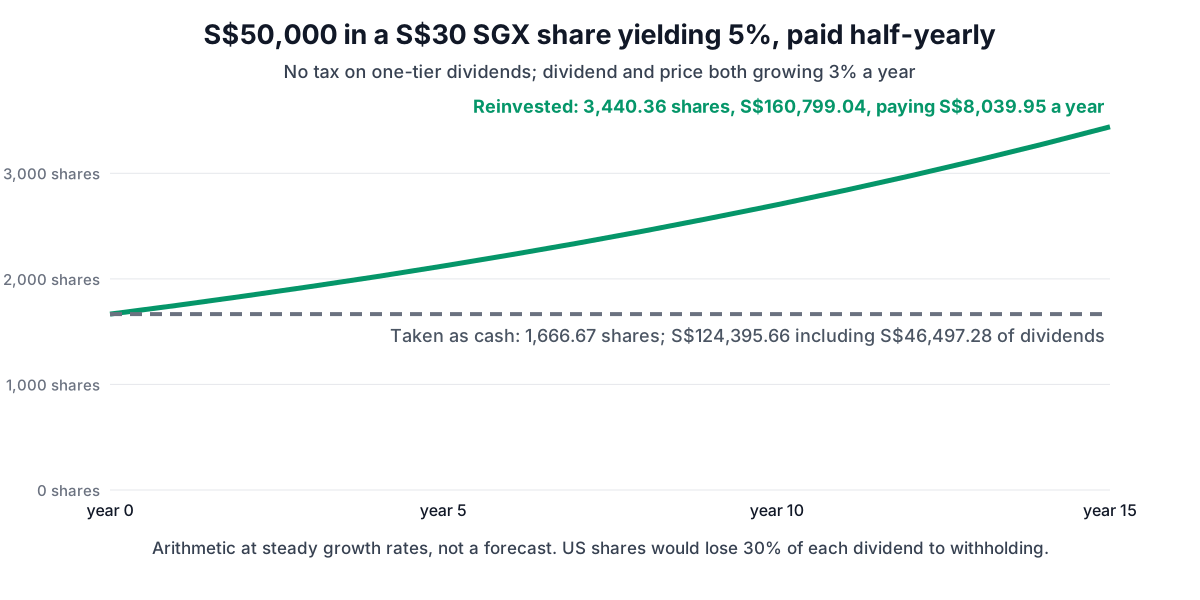
Some SGX companies run scrip dividend schemes, issuing new shares in place of cash, and IRAS notes dividends can be paid in kind; otherwise reinvesting means buying more shares or units yourself with each payment. Using the same S$30 share, assume the dividend and the price both grow 3% a year for 15 years:
| After 15 years | Reinvested | Taken as cash |
|---|---|---|
| Shares held | 3,440.36 | 1,666.67 |
| Value, including any cash received | S$160,799.04 | S$124,395.66 |
| Dividends received in cash | none | S$46,497.28 |
| Income in the following year | S$8,039.95 | S$3,894.92 |
Reinvesting adds about S$36,400 at these assumptions, and the share count roughly doubles. Because no tax is taken from one-tier dividends, every cent of each payment goes back into shares. Brokerage and the size of board lots mean real reinvestment is a little lumpier than the calculator's fractional shares.
An S-REIT for income, and what a cut does
S-REITs are often held for income rather than growth. Take a unit priced at S$2.50 with a distribution of S$0.15 a year, a 6% yield, paid quarterly. S$30,000 buys 12,000 units and pays S$1,800 a year, S$450 a quarter, untaxed.
| 10 years, distributions taken as cash | Distribution and price grow 1% a year | Both shrink 2% a year |
|---|---|---|
| Distributions received | S$18,831.98 | S$16,463.45 |
| Value including that cash | S$51,970.65 | S$40,975.63 |
| Income in year 11 | S$1,988.32 | S$1,470.73 |
The starting yield was identical. The outcome depends on whether the distribution per unit holds up, which is why a REIT with a high yield after a price fall deserves a closer look at its gearing, interest costs and leases before it is treated as safe income.
Building a REIT position over time works the same way. Starting with S$30,000 and adding S$500 a month, reinvested for 20 years at 1% growth, the calculator ends with S$380,937.65 paying S$22,856.26 a year. If the same holding were a US-listed fund losing 30% of each payout, the value after 20 years would be S$295,102.62, about S$85,800 less.
Comparing yield with your CPF Ordinary Account
For many Singaporeans the realistic alternative to an SGX share is not cash in a bank but money left in the CPF Ordinary Account. CPF pays 2.5% a year on OA savings for October to December 2026, which is also the legislated floor. Under the CPF Investment Scheme you can invest OA savings only after setting aside S$20,000 in the OA, and only up to 35% of your investible savings can go into stocks.
So a 5% dividend yield is not "double the OA rate" in any safe sense: the OA rate has a legislated floor, while a dividend can be cut and the share price can fall below what you paid. The comparison is useful as a hurdle. If a holding's yield plus realistic growth does not clearly beat 2.5% after costs, the risk is hard to justify for CPF money.
Sizing a portfolio for an income target
The calculator turns a target into the capital it needs: income divided by yield. S$2,000 a month is S$24,000 a year, which needs S$480,000 at a 5% yield or S$400,000 at 6%. S$3,000 a month at 6% needs S$600,000. Those are figures at a single yield on a single day; spreading across several payers and leaving room for cuts is the cautious way to use them.
Dates to know
A company or REIT announces the dividend, an ex-date, a record date and a payment date. Buy before the ex-date and the payment is yours; buy on or after it and the seller keeps it. The price usually drops by about the dividend on the ex-date, so buying just before it does not create free money. Shares held in your own CDP account receive payments directly; shares in a custodian account at a broker are paid through the broker, on that broker's terms and fees.
Tools for this job
The Singapore dividend calculator runs every example here. The Stock Average Cost Calculator tracks your average price as you reinvest, the Compound Interest Calculator gives the OA-style comparison, and the guide to average cost per share explains cost basis when buying in stages. For a MAS-licensed view of your whole position, speak to a financial adviser.
Frequently asked questions
Are dividends taxable in Singapore?
Generally not for individuals. IRAS lists one-tier dividends from Singapore resident companies, REIT distributions and foreign dividends received by resident individuals as not taxable, except when received through a Singapore partnership or, for REITs, as part of a trade in REITs. Dividends from co-operatives are taxable.
How much tax is taken from US dividends for a Singapore investor?
30% at source. The IRS applies 30% to US-source dividends paid to non-residents unless a tax treaty lowers it, and Singapore is not on the IRS list of US income tax treaty partners.
How much do I need for S$2,000 a month in dividends?
S$24,000 a year divided by the yield: S$480,000 at 5% or S$400,000 at 6%. Yields change with prices and payouts, so treat the figure as a starting point.
Can I buy SGX shares with my CPF savings?
Under the CPF Investment Scheme you can invest Ordinary Account savings after setting aside S$20,000 in the OA, with up to 35% of investible savings in stocks. The OA itself earns 2.5% a year for October to December 2026.
Sources and further reading
- Dividends, Inland Revenue Authority of Singapore. One-tier dividends, REIT distributions, foreign dividends, the co-operative exception and reporting.
- Investing your CPF savings, CPF Board. The S$20,000 OA set-aside and the 35% stock limit.
- Earning attractive interest, CPF Board. OA interest of 2.5% for 1 October to 31 December 2026 and the legislated floor.
- Fixed, determinable, annual, periodical (FDAP) income, Internal Revenue Service. 30% withholding on US-source dividends to non-residents.
- United States income tax treaties, A to Z, Internal Revenue Service. Singapore is not on the list.
More Calculators
Every tool in the Calculators section, free and in your browser.
- Investment Calculator
- Compound Interest Calculator
- Simple Interest Calculator
- Interest Calculator
- EMI Calculator
- Retirement Calculator
- Time-Weighted Return Calculator
- Savings Goal Calculator
- Inflation Calculator
- CAGR Calculator
- ROI Calculator
- Present and Future Value Calculator
- NPV and IRR Calculator
- 401(k) Calculator
- Roth IRA Calculator
- APY and CD Calculator
- SIP Calculator
- Annuity Calculator
- Bond Price and Yield Calculator
- Currency Converter
- Dividend Calculator
- Stock Average Calculator
- RMD Calculator