
ETF Fees, Distributions and Fortnightly Buys in Australia
What management fees, reinvested distributions, inflation and the CGT changes from 1 July 2027 do to a fortnightly ETF plan over 20 years, in A$.
By Redbison Dev · · 6 min read
Australia edition. Written for Australian investors: A$ amounts, fortnightly buys to match pay cycles, management fees, DRPs and taxable distributions with franking, and the CGT discount for gains before 1 July 2027 with indexation and a 30% minimum rate after. US edition
Invest A$400 every fortnight in an ETF for 20 years and assume 7% a year before fees, half of it paid as distributions and reinvested. With no fee at all it would reach A$441,275. At a 0.07% management fee it reaches A$437,769; at 0.2%, A$431,340; at 0.5%, A$416,906; at 1.2%, A$385,305. The same A$208,000 goes in each time, and the 1.2% plan ends A$55,970 behind the no-fee case after paying A$36,684 in fees.
Fees are only part of what an Australian investor needs to model. Distributions are taxable every year even when a DRP reinvests them, many carry franking credits, and the capital gains rules change for gains from 1 July 2027. This edition works through each with the Australian ETF investment calculator, using steady returns to show the mechanics. It is not advice about any fund; a licensed adviser or registered tax agent can look at your own position.
Management fees over 20 years
An ETF's management fees and costs, set out in its product disclosure statement, come out of the fund's assets, so its published returns are already after them. The calculator treats your return as before fees and deducts the fee from the average balance each year:
| Management fee | Value after 20 years | Fees deducted | Lost against no fee |
|---|---|---|---|
| 0% | A$441,275 | A$0 | A$0 |
| 0.07% | A$437,769 | A$2,321 | A$3,506 |
| 0.2% | A$431,340 | A$6,569 | A$9,935 |
| 0.5% | A$416,906 | A$16,070 | A$24,369 |
| 1.2% | A$385,305 | A$36,684 | A$55,970 |
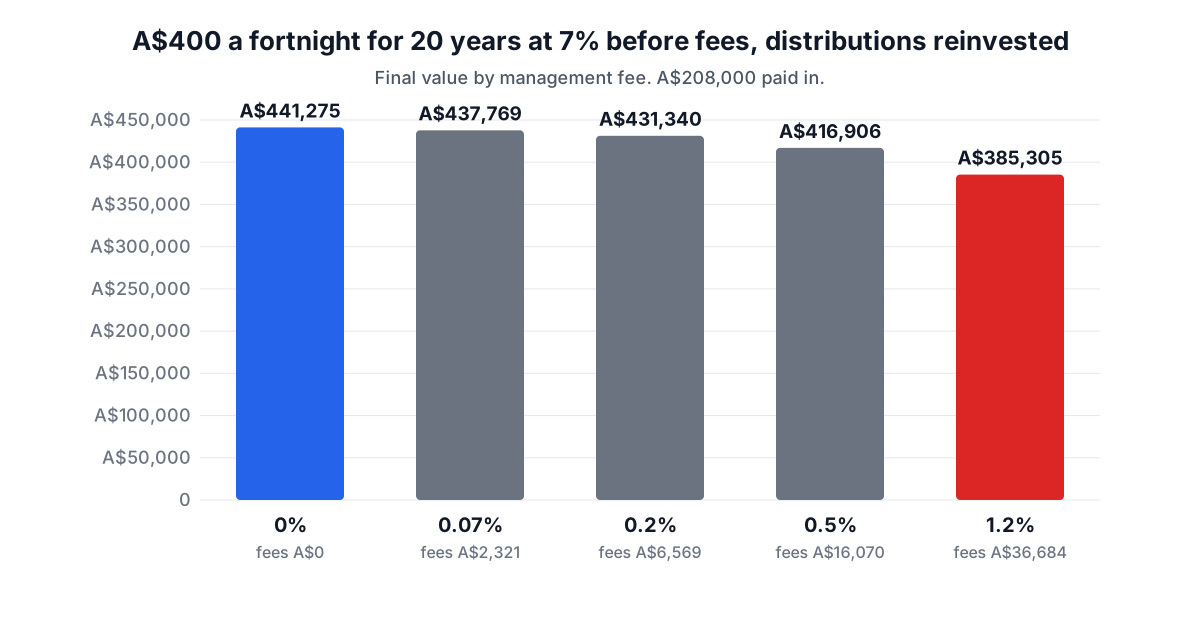
The lost value is about 1.5 times the fees paid, because each fee dollar also stops compounding. Between two cheap broad-market ETFs the gap is small; between a cheap ETF and a 1%-plus managed option it is tens of thousands of dollars. Do not subtract a fund's fee from its published return, which already includes it.
Fortnightly buys and brokerage
If you are paid fortnightly, buying each payday is natural. The calculator spreads each year's contributions evenly, so A$400 a fortnight (A$10,400 a year) gives the same result whether you choose fortnightly or monthly. What changes the answer in real life is brokerage: a fixed charge on every trade is a large percentage of a A$400 purchase. If your broker charges per trade, add that cost as a percentage of what you invest to the fee box, or buy less often in larger amounts.
Distributions, DRPs and franking
An ETF set up as a unit trust passes its income to unitholders each year. The calculator splits the 7% return into 3.5% distributions and 3.5% price growth.
Reinvest or take the cash. With the DRP on, the 0.2% plan reaches A$431,340. Taking distributions as cash instead leaves the holding at A$292,892, with A$90,037 of distributions paid to you along the way. Reinvesting ends A$138,448 ahead, which is compounding on the distributions themselves.
Tax. Either way the distributions are taxable income for the year, at your marginal rate plus the Medicare levy. The resident rates for 2026-27 are 15% above A$18,200 to A$45,000, 30% to A$135,000, 37% to A$190,000 and 45% above, and the levy is 2%. The fund's annual tax statement splits each distribution into its parts: Australian dividends with franking credits, foreign income, interest and capital gains. Franking credits on Australian dividends flow through the trust to you under Subdivision 207-B of the Income Tax Assessment Act 1997, which can cut the tax on an Australian-share ETF's distributions sharply. The calculator does not model tax or franking, so its result is closest to what happens inside super or for a low-income investor. The Australian dividend yield guide shows franking credits at work over 20 years.
Cost base. Each DRP allotment is a new purchase of units at that day's price. Keep the statements: you will need every parcel's date and cost when you sell.
Capital gains: before and after 1 July 2027
Selling units triggers capital gains tax, and the rules change partway through a 20-year plan. In the 1 July 2026 compilation of the Income Tax Assessment Act 1997:
- Discount before 1 July 2027. Section 115-100 gives individuals a 50% discount on discount capital gains from CGT events happening before 1 July 2027. Complying super funds get 33⅓%.
- Indexation and a minimum rate after. Division 114 provides indexation of the cost base, and Division 119 can impose extra tax on certain capital gains of Australian resident individuals so that they bear at least a 30% rate.
- A deemed sale at the changeover. Subdivision 112-E treats resident individuals as selling and reacquiring their assets just before 1 July 2027, with rules to defer that gain or loss until the later sale.
For a plan running to the 2040s, most of the growth will fall under the new rules. The calculator does not deduct CGT, so treat its final value as before tax on sale, and check the detail for your own holdings with a registered tax agent.
Inflation: reading the result at today's prices
The calculator's Australian default is 2.5% inflation. Over 20 years that raises prices by a factor of 1.025^20, or 1.639. The 0.2% plan's A$431,340 is about A$263,234 at today's prices, and the 1.2% plan's A$385,305 about A$235,140. Compare any goal, such as a house deposit or early retirement, in the same terms.
ETFs outside super, or more into super?
Super is taxed at 15% on a complying fund's low tax component under the Income Tax Rates Act 1986, but it is preserved until you meet a condition of release. ETFs held in your own name can be sold at any time but are taxed at your marginal rate. The calculator shows the same growth either way; the tax difference and the contribution caps are worth checking for your own income.
Common mistakes
- Ignoring brokerage on small fortnightly buys. A fixed fee per trade can cost more than the management fee.
- Treating reinvested distributions as untaxed. A DRP does not defer tax; the distribution is income in the year it is paid.
- Double counting the fee by subtracting it from a published return.
- Assuming the 50% discount for future gains. For gains from 1 July 2027 the indexation and minimum-rate rules apply.
Tools for this job
- The Australian ETF investment calculator runs the fee, DRP and inflation scenarios above.
- The Australian dividend calculator applies franking credits to an Australian share's dividends.
- The Australian compound interest calculator compares the same savings in a term deposit, explained in the Australian compound interest guide.
- The Australian retirement calculator and the Australian FIRE planner set the result against a spending goal, alongside the Australian retirement savings guide.
Frequently asked questions
Are ETF distributions taxed if I use the DRP?
Yes. A reinvested distribution is still income for the year it is paid, taxed at your marginal rate plus the Medicare levy, with any franking credits added to your income and offset against the tax. Each DRP allotment is also a new parcel of units for CGT.
How much does a 0.5% fee cost over 20 years?
On A$400 a fortnight at 7% before fees, a 0.5% fee ends at A$416,906 against A$437,769 at 0.07%, a gap of A$20,863 on A$208,000 invested.
What happens to the CGT discount from 1 July 2027?
Under the Income Tax Assessment Act 1997 as compiled on 1 July 2026, the 50% discount for individuals applies to CGT events before 1 July 2027. After that, cost base indexation and a 30% minimum rate on certain gains apply, and resident individuals are treated as selling and reacquiring their assets just before 1 July 2027, with rules to defer that gain until a later sale.
Should I buy fortnightly or monthly?
In the calculator it makes no difference, because contributions are spread evenly through the year. In practice compare your broker's per-trade cost with the amount you invest; if brokerage is a noticeable share of each buy, investing monthly or less often costs less.
Sources and further reading
- Income Tax Assessment Act 1997, Volume 3 (1 July 2026 compilation), Federal Register of Legislation. Section 115-100 discount percentages, Division 114 indexation, Division 119 minimum rate and Subdivision 112-E deemed sales on 1 July 2027.
- Income Tax Assessment Act 1997, Volume 5 (1 July 2026 compilation), Federal Register of Legislation. Subdivision 207-B: franked distributions received through trusts.
- Income Tax Rates Act 1986 (1 July 2026 compilation), Federal Register of Legislation. 2026-27 resident rates and the 15% rate for complying super funds.
- Medicare Levy Act 1986 (1 July 2026 compilation), Federal Register of Legislation. The 2% levy.
- Expense ratio, US Securities and Exchange Commission. How ongoing fund costs reduce returns.
Open the ETF Investment Simulator
More Analysis Tools
Every tool in the Analysis Tools section, free and in your browser.