
Dividend Yield, TDS and Reinvesting Dividends in India
How dividend yield, slab-rate tax, 10% TDS and reinvesting work for Indian shareholders, with a 15-year example in rupees across three tax slabs.
By Redbison Dev · · 10 min read
India edition. Written for Indian shareholders: rupees in lakh, dividends taxed at your slab rate plus 4% cess for tax year 2026-27, TDS above ₹10,000 a year per company, the 15% surcharge cap, and reinvesting by buying more shares yourself. US edition
A share trading at ₹420 that paid ₹21 a share over the last year yields 5%. ₹10 lakh buys about 2,381 shares and brings in ₹50,000 of dividend a year. In India that ₹50,000 is added to your income and taxed at your slab rate plus 4% cess, the company deducts 10% TDS before paying you because it is above ₹10,000, and if you want the money to compound you usually have to reinvest it yourself by buying more shares. Each of those steps changes what the holding is worth after 15 years.
This edition works through the yield arithmetic, the tax and TDS rules that apply from tax year 2026-27 under the Income-tax Act, 2025, and a 15-year example run in the India dividend calculator. It explains the arithmetic; it is not advice to buy any share, and a SEBI-registered investment adviser can look at your whole portfolio.
Dividend yield from the exchange page
dividend yield = dividends per share over 12 months / share price x 100
₹21 / ₹420 x 100 = 5%
Indian companies often declare an interim dividend during the year and a final dividend after the annual general meeting, and some add a special dividend in a good year. The yield on a market website usually adds up whatever was paid in the last 12 months, so a one-off special payment can make a share look like a high-yield stock for a year. Before you plan an income on it, check which payments the figure includes.
Yield moves against price. If the ₹420 share falls to ₹350 and the dividend stays at ₹21, the yield is 6%. A yield far above other companies in the same sector is often the market expecting a lower dividend.
To work back from an income goal: ₹50,000 a month is ₹6,00,000 a year, and at a 5% yield that needs ₹6,00,000 / 0.05 = ₹1.2 crore invested, before tax.
How dividends are taxed from tax year 2026-27
The Explanatory Memorandum to the Finance Bill, 2026 describes dividend income as taxable under the head "Income from other sources" under the Income-tax Act, 2025, so it is added to your total income and taxed at your slab rate. The same memorandum keeps the new-regime slabs for tax year 2026-27 unchanged:
| Total income (new regime, tax year 2026-27) | Rate | Rate with 4% cess |
|---|---|---|
| Up to ₹4,00,000 | Nil | Nil |
| ₹4,00,001 to ₹8,00,000 | 5% | 5.2% |
| ₹8,00,001 to ₹12,00,000 | 10% | 10.4% |
| ₹12,00,001 to ₹16,00,000 | 15% | 15.6% |
| ₹16,00,001 to ₹20,00,000 | 20% | 20.8% |
| ₹20,00,001 to ₹24,00,000 | 25% | 26% |
| Above ₹24,00,000 | 30% | 31.2% |
Three details matter for dividend investors:
- Cess and surcharge. Health and Education Cess is 4% of the tax plus any surcharge. Surcharge applies above ₹50 lakh of income, but on the part of income that is dividend it cannot exceed 15%; the memorandum applies the same cap to certain capital gains.
- No interest deduction any more. Section 93 of the Income-tax Act, 2025 used to allow interest paid on money borrowed to buy the shares, up to 20% of the gross dividend. The Finance Bill, 2026 as introduced amended section 93(2) so that no interest is deductible against dividend or mutual fund income, from 1 April 2026; check the Finance Act, 2026 as passed. On that basis borrowing to buy dividend shares no longer reduces the tax on the dividend.
- Rebate. For income up to ₹12 lakh the new regime's rebate can wipe out the tax entirely; the income tax portal shows a rebate of up to ₹60,000 for income up to ₹12 lakh for 2025-26 (AY 2026-27); check the figure for tax year 2026-27 before relying on it. If your total income, dividends included, is near the limit, a large dividend can push you over it.
TDS: the 10% the company keeps
A company deducts tax at source before paying you. The Budget 2025 memorandum sets this at 10% and raised the threshold from 1 April 2025: no TDS is deducted when a company's dividends to an individual during the financial year do not exceed ₹10,000. The threshold is per company, so ₹9,000 from each of five companies attracts no TDS even though the total is ₹45,000.
TDS is an advance payment, not the final tax. On the ₹50,000 example:
| Your slab | Tax due with cess | TDS deducted | What happens at filing |
|---|---|---|---|
| 5% | ₹2,600 | ₹5,000 | ₹2,400 comes back as a refund |
| 20% | ₹10,400 | ₹5,000 | ₹5,400 more to pay |
| 30% | ₹15,600 | ₹5,000 | ₹10,600 more to pay |
If your total income is below the taxable limit you can give the company a written declaration for no deduction, now under section 393(6) of the Income-tax Act, 2025, instead of waiting for a refund. Under the Finance Bill, 2026 as introduced, from 1 April 2027 you can file that declaration once with your depository, which passes it to each company, for listed securities held in demat, instead of filing it separately with every registrar; check the Finance Act, 2026 as passed. Higher-slab investors should plan advance tax for the gap between TDS and the slab rate, since dividends arrive in lumps.
Reinvesting: you do it yourself
Unless your company or broker offers an automatic plan, "reinvesting" means using each dividend to buy more of the same share through your broker. The calculator assumes you do that on the payment date at that day's price, after paying tax at your slab rate. Each purchase is a new lot with its own cost and holding period, which matters when you later sell. Mutual funds handle this differently: a growth option keeps income inside the fund's NAV, while a payout option sends it to you as a taxable dividend.
Run the ₹10 lakh example for 15 years with one dividend a year, the dividend rising 6% a year and the price 8%, every dividend reinvested after tax:
| Your slab | Value after 15 years | Dividend income in year 16 |
|---|---|---|
| Nil tax (income under the limit) | ₹57,74,644.16 | ₹2,18,135.77 |
| 5% slab (5.2%) | ₹56,00,812.90 | ₹2,11,569.33 |
| 20% slab (20.8%) | ₹51,08,160.32 | ₹1,92,959.50 |
| 30% slab (31.2%) | ₹48,02,517.65 | ₹1,81,413.93 |
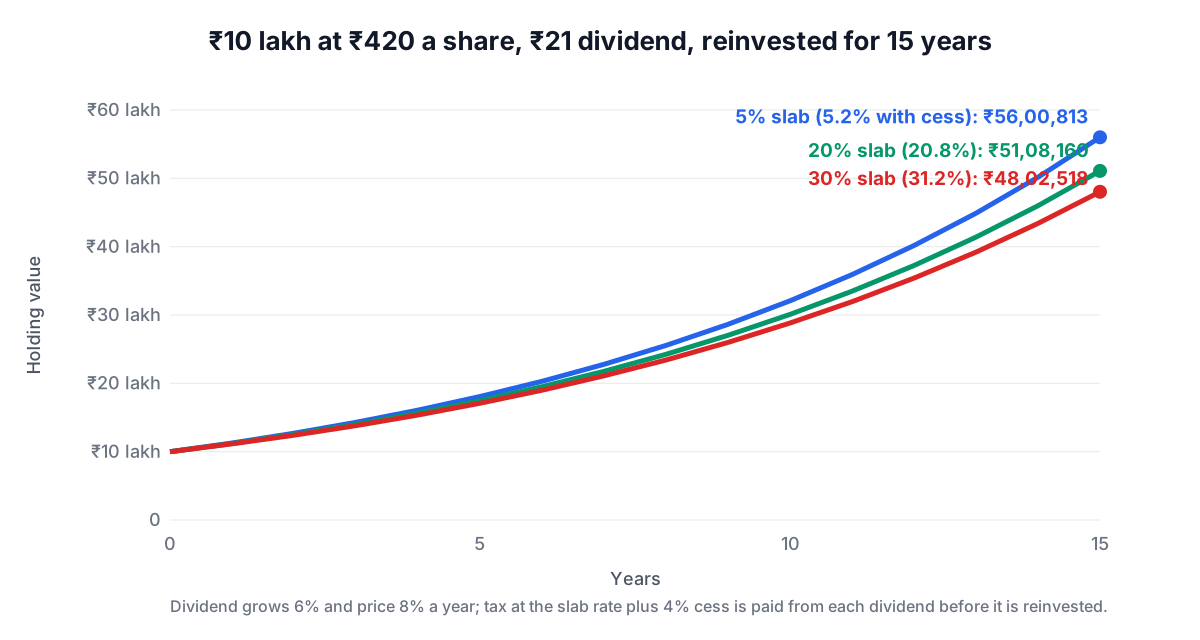
The gap between the 5% and the 30% slab is almost ₹8 lakh after 15 years, all of it from tax paid every year on dividends that could otherwise have bought shares. In the 30% slab, taking the dividends as cash instead leaves the 2,380.95 shares worth ₹31,72,169.11 plus ₹8,00,693.36 of after-tax dividends received, ₹39,72,862.48 in total: reinvesting adds about ₹8.3 lakh.
Building a holding with ₹15,000 a month
Start from nothing and buy ₹15,000 of the same share every month for 15 years (₹27,00,000 in all), 30% slab, dividends reinvested after tax. The calculator ends at ₹68,31,365.45, with dividend income of ₹2,58,053.15 in year 16, still taxed at your slab rate when it arrives. This is a SIP into one company; the India SIP calculator does the same arithmetic for a mutual fund.
When dividends are not the cheapest income
For an investor in the 30% slab, every rupee of dividend costs 31.2% in tax. Gains on listed shares held more than 12 months are taxed differently: the Budget 2024 memorandum set long-term gains under section 112A of the 1961 Act at 12.5%, with the first ₹1.25 lakh a year exempt, for transfers from 23 July 2024. The Income-tax Act, 2025 carries these capital gains rules into its own sections: for tax year 2026-27 the 2026 memorandum's surcharge rules refer to sections 196, 197 and 198 of the 2025 Act where earlier years named sections 111A, 112 and 112A. So a high-slab investor who needs ₹2 lakh a year may pay less tax by selling a few shares than by owning a high-yield share. A low-slab or nil-tax investor sees little difference, and may prefer the simplicity of dividends.
Buy-backs are moving the other way. Under the Income-tax Act, 2025 as first enacted, money received in a buy-back was treated as dividend; under the Finance Bill, 2026 as introduced, from tax year 2026-27 money received in a buy-back is taxed as capital gains, not dividend, with an effective 30% rate for promoters (22% for promoter companies); check the Finance Act, 2026 as passed.
Yield on cost and the limits of any projection
In the 30% slab case the year-16 income of ₹1,81,413.93 is 18.14% of the ₹10 lakh you put in. That yield on cost shows how far the income has grown, but the holding is then worth ₹48 lakh, and on that the yield is about 3.8%. Judge the holding on the current figure.
- Dividends are decided by the board each year and can be cut; a steady 6% growth rate is only an assumption.
- Prices move in jumps, so reinvesting buys more shares in bad years and fewer in good ones.
- One company is one risk. The India edition of the ETF fees and dividends guide covers what index fund costs do to a diversified holding.
- Rules change in the Budget each February, so recheck the slab, TDS and rebate figures for each tax year.
Tools for this job
- The India dividend calculator runs the projections above at your slab rate.
- The India index fund and ETF calculator shows what the expense ratio costs a monthly investment.
- The India CAGR calculator turns a start and end value into a yearly growth rate for comparing holdings.
- The stock average calculator works out your average buying price after reinvesting.
- The India compound interest guide and the SIP vs lump sum guide cover the same compounding for FDs and mutual funds.
Frequently asked questions
Is TDS on dividends the final tax?
No. The 10% TDS is credited against your total tax for the year. You report the full dividend in your return and pay the difference at your slab rate plus cess, or claim a refund if the TDS was more than the tax due, as it is for someone in the 5% slab.
Is there TDS if my dividend is below ₹10,000?
Not from that company. From 1 April 2025 a company deducts no tax when its dividends to an individual during the financial year do not exceed ₹10,000. The dividend is still taxable income and must be shown in your return.
Can I claim the interest on a loan taken to buy dividend shares?
Not from 1 April 2026 under the Finance Bill, 2026 as introduced; check the Finance Act, 2026 as passed. Section 93 of the Income-tax Act, 2025 had allowed such interest up to 20% of the gross dividend, and the Bill amended section 93(2) so that no interest is deductible against dividend income.
What rate should I enter in the calculator?
Your slab rate multiplied by 1.04 for cess: 31.2% for the 30% slab, 20.8% for 20%, 10.4% for 10%. If your income is high enough to attract surcharge, add the surcharge on dividend income, which is capped at 15% of the tax.
Sources and further reading
- Explanatory Memorandum to the Finance Bill, 2026, Ministry of Finance. Tax year 2026-27 slabs, 4% cess, the 15% surcharge cap on dividends, sections 196 to 198 of the 2025 Act, the section 93 interest change, the depository declaration (from 1 April 2027) and buy-back taxation, as introduced in the Bill.
- The Finance Bill, 2026 (as introduced in Lok Sabha), Ministry of Finance. Clause 36 substitutes section 93(2) of the Income-tax Act, 2025; check the Finance Act, 2026 as passed.
- Explanatory Memorandum to the Finance Bill, 2025, Ministry of Finance. Section 194: 10% TDS on dividends and the ₹10,000 threshold from 1 April 2025.
- Which ITR should I file?, Income Tax Department. Dividends under other sources, the ₹60,000 section 87A rebate for AY 2026-27 and surcharge rules.
- SEBI investor education, Securities and Exchange Board of India. Investor education on securities market investing and scams to avoid.
More Calculators
Every tool in the Calculators section, free and in your browser.
- Investment Calculator
- Compound Interest Calculator
- Simple Interest Calculator
- Interest Calculator
- EMI Calculator
- Retirement Calculator
- Time-Weighted Return Calculator
- Savings Goal Calculator
- Inflation Calculator
- CAGR Calculator
- ROI Calculator
- Present and Future Value Calculator
- NPV and IRR Calculator
- 401(k) Calculator
- Roth IRA Calculator
- APY and CD Calculator
- SIP Calculator
- Annuity Calculator
- Bond Price and Yield Calculator
- Currency Converter
- Dividend Calculator
- Stock Average Calculator
- RMD Calculator